Attorney General rejects claims that E20 ethanol blending is an experiment
India’s attorney general denied calling E20 an experiment, as a court kept ethanol supply allocation unchanged for ESY 2025-26.

On July 1, the Attorney General’s office denied telling the Supreme Court that India’s E20 petrol programme is an experiment. The Union Law Ministry called the claims “completely false” as the Supreme Court weighed a dispute over ethanol supply allocation for Ethanol Supply Year 2025-26.
The Office of the Attorney General for India, led by R Venkataramani, said no submission was made that the government’s Ethanol Blended Petrol programme or E20 programme was an “experiment”. The case is linked to a Karnataka High Court order involving public-sector oil marketing companies and a dedicated ethanol manufacturer. The Supreme Court directed status quo on ethanol supply allocation while hearing the matter before Justices M.M. Sundresh and Sheel Nagu.

The government advanced a 20% blending target from 2030 to Ethanol Supply Year 2025-26 under the National Policy on Biofuels, amended in 2022. Public-sector oil marketing companies reached 10% ethanol blending in June 2022, and the Press Information Bureau said average blending rose to 12.06% in Ethanol Supply Year 2022-23 and 14.60% in Ethanol Supply Year 2023-24. The same government briefing said blending stood at 19.05% as of July 31, 2025 in Ethanol Supply Year 2024-25, while July 2025 alone reached 19.93%.
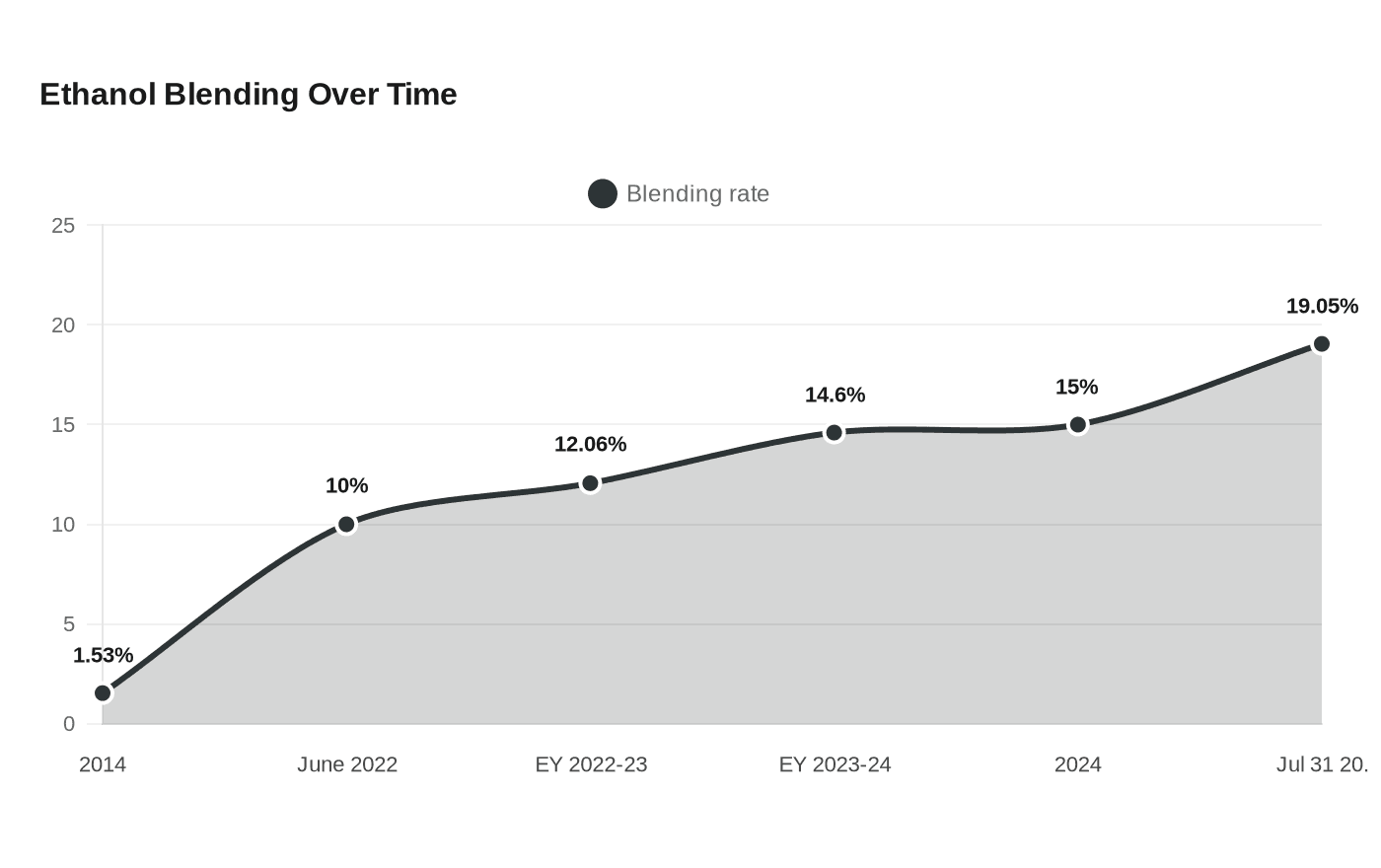
The Press Information Bureau said ethanol blending rose from 1.53% in 2014 to 15% in 2024. The Press Information Bureau also said the programme had saved or conserved more than Rs 1,44,087 crore in foreign exchange, displaced about 245 lakh metric tonnes of crude oil and reduced carbon dioxide emissions by about 736 lakh metric tonnes up to July 2025.
This article was produced by Prism’s automated news system from verified source data, official records, and press releases, then run through automated quality and moderation checks before publishing. The system is built and supervised by the people who set the standards it runs under. Read our full AI policy.
Did this article answer your question?