EIA keeps 2026 and 2027 ethanol production forecast unchanged
EIA left 2026 and 2027 ethanol output at 1.1 million barrels per day, with net imports still negative and exports on a 2025 record pace.
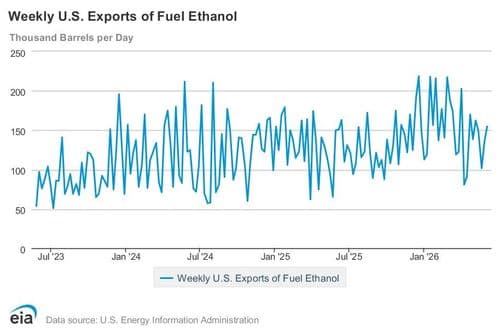
The U.S. Energy Information Administration on June 9 left its 2026 and 2027 fuel ethanol output forecast at 1.1 million barrels per day. It also kept its projections for ethanol exports and domestic consumption unchanged, signaling a steady operating outlook despite policy churn and a broader energy market that is anything but calm.
The June Short-Term Energy Outlook was completed June 4, and the next release is scheduled for July 7. EIA’s forecast implies only a modest step up from 2025, when the agency now expects fuel ethanol production to average 1.08 million barrels per day. The agency’s quarterly path for 2026 runs from 1.07 million barrels per day in the second quarter to 1.09 million in the third quarter and 1.11 million in the fourth quarter.
Ethanol Producer Magazine said EIA’s 2027 profile stays just as orderly, with production expected to average 1.09 million barrels per day in the first and second quarters, 1.1 million in the third quarter and 1.13 million in the fourth quarter. That kind of quarter-by-quarter progression points to stable plant rates rather than a sharp reprice in blending or export demand.

Net fuel ethanol imports also stayed negative across the forecast window. EIA kept them at minus 150,000 barrels per day in 2026 and minus 170,000 barrels per day in 2027, compared with minus 140,000 barrels per day in 2025. On the export side, the agency said U.S. fuel ethanol shipments were on track for a record in 2025, with exports averaging 138,000 barrels per day in the first seven months of the year, the highest January-through-July average in EIA’s data going back to 2010.
The June hold follows a May 12 STEO increase, when EIA had already raised its 2026 ethanol production and consumption forecasts. The latest update leaves the market with the same message: domestic blending, export demand and production rates still look balanced enough for EIA to hold the line, even as the wider June outlook projected global oil demand would decrease by 1.1 million barrels per day over the course of 2026.
This article was produced by Prism’s automated news system from verified source data, official records, and press releases, then run through automated quality and moderation checks before publishing. The system is built and supervised by the people who set the standards it runs under. Read our full AI policy.
Did this article answer your question?