India exempts higher ethanol blends from excise duty to boost adoption
India waived excise duty on E22 to E30 petrol, pairing tax relief with BIS standards as it tries to move beyond E20.

India on June 11 exempted petrol blends containing 22% to 30% ethanol from central excise duty, giving E22, E25, E27 and E30 a tax break as it tries to push higher-blend fuel beyond E20. The move gives retailers and refiners a clearer commercial signal, but its real test will be whether lower tax treatment is enough to create demand at the pump before vehicle compatibility and infrastructure catch up.
The Bureau of Indian Standards notified IS 19850:2026 on May 15, covering petrol blended with 22%, 25%, 27% and 30% ethanol. The specification sets out quality and safety parameters for the higher blends, including ethanol concentration, octane requirements, sulphur limits and testing protocols, and the central government is now linking that technical framework to fiscal support so the market can scale in a phased, calibrated manner.

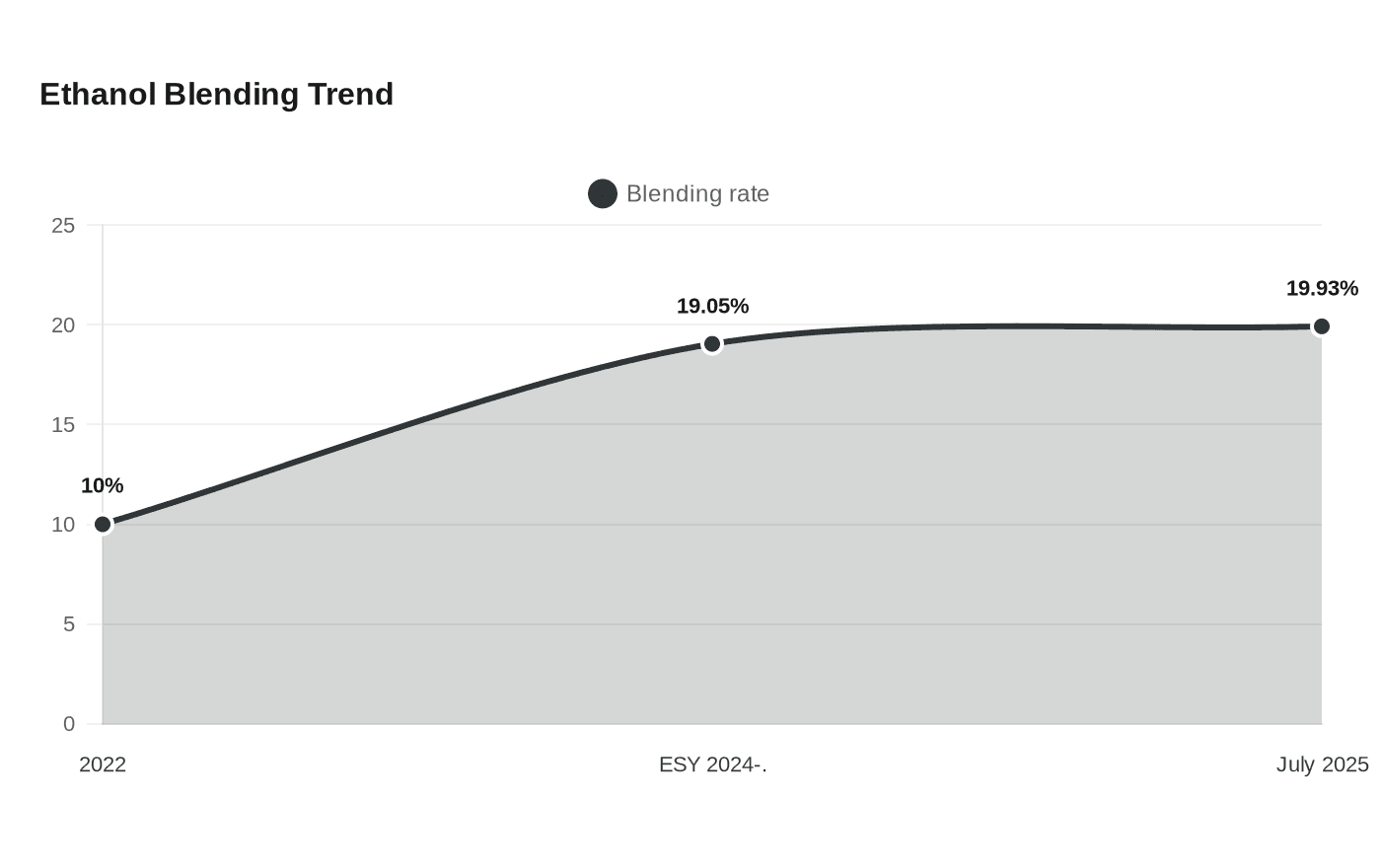
The Press Information Bureau said India reached 10% ethanol blending in 2022 and hit E20 ahead of its original 2030 target. Officials said oil marketing companies averaged 19.05% blending in ESY 2024-25 as of July 31, 2025, while July 2025 blending reached 19.93%, showing the system is already moving close to the next threshold. The government has also backed the supply chain with 52 LMT of surplus FCI rice allocated for ethanol production for ESY 2024-25 and ESY 2025-26 through June 30, 2026, and allowed diversion of 40 LMT of sugar for ethanol production in ESY 2024-25.

The policy push is designed to deepen India’s biofuel market, cut crude imports and support farmers, distilleries and refiners. The government says E20 has generated more than 1.4 lakh crore in foreign-exchange savings, and the Ministry of Petroleum and Natural Gas has held consultations with the Society of Indian Automobile Manufacturers and other major automakers as it weighs the next step for higher blends.
Industry reaction to the BIS notification was upbeat. The All India Distillers' Association called it a “significant and timely” step and said E25 could help absorb surplus sugar and ethanol capacity, while also pressing for a longer-term move toward E85 and E100 with flex-fuel vehicles. That leaves India with a familiar policy question: the tax break can accelerate adoption, but without broader vehicle readiness, retail availability and consumer confidence, higher ethanol blends may still advance in stages rather than break out at scale.
This article was produced by Prism’s automated news system from verified source data, official records, and press releases, then run through automated quality and moderation checks before publishing. The system is built and supervised by the people who set the standards it runs under. Read our full AI policy.
Did this article answer your question?