Non-contact optical sensing and deep learning track ethanol clusters in air
Yonsei and Columbia researchers used a graphene Fresnel lens and deep learning to infer ethanol at 0.01% to 0.1%, reaching R2 0.884.
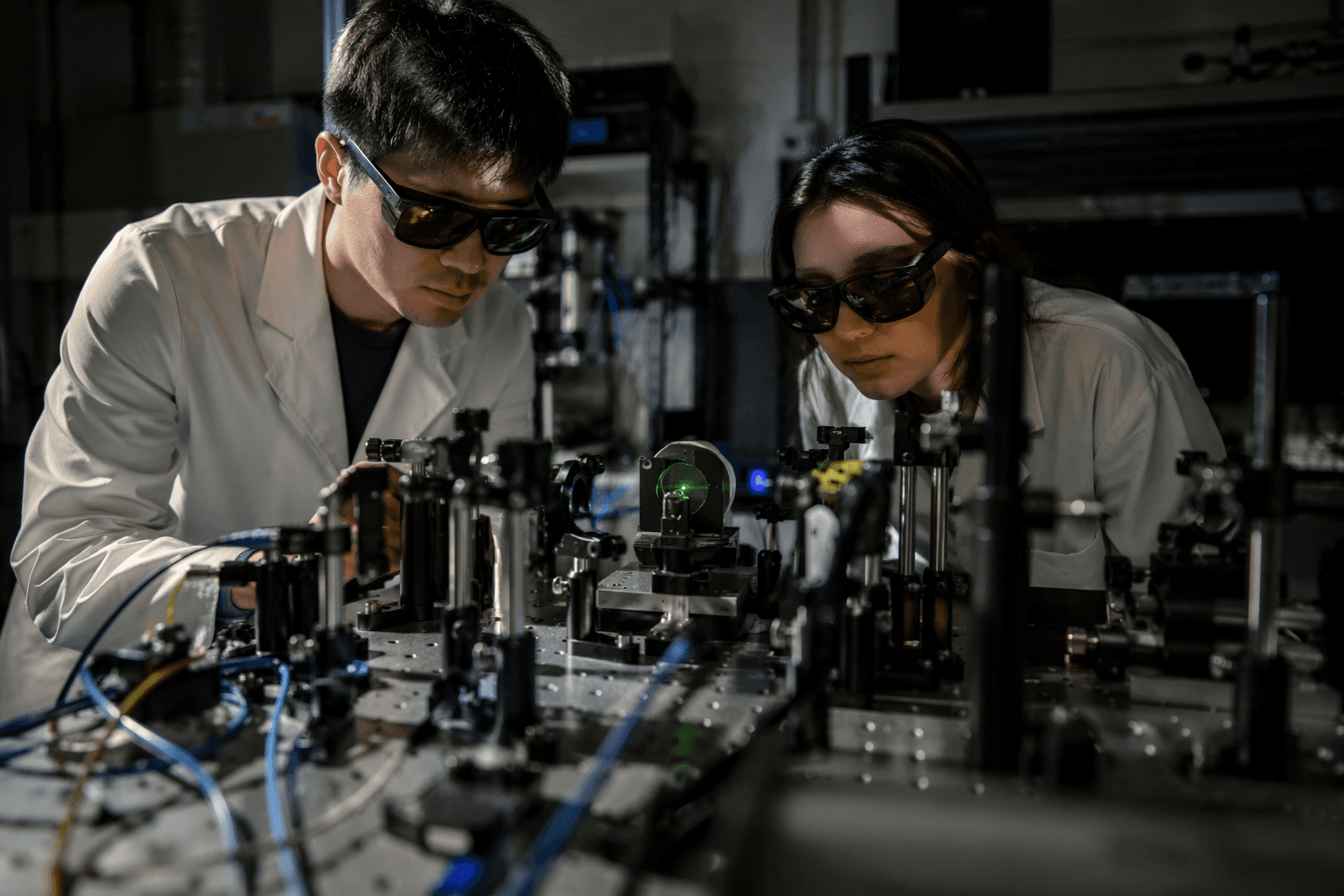
Researchers at Yonsei University and Columbia University reported an R2 of 0.884 on June 7 for a fully non-contact system that inferred ethanol clusters in air. The paper, published in Opto-Electronic Advances, said the setup tracked gaseous ethanol in the 0.01% to 0.1% range without directly measuring Rayleigh-scattered light.
The study, titled “Rayleigh-driven ethanol cluster tracking based on non-contact deep optical molecular diagnosis,” is by Seong Chan Jun, Geon Mo Kim, Yun Ji Hwang, Chengyi Li, Teajong Hwang, In-Sung Hwang and James Hone. Jun is with Yonsei University’s School of Mechanical Engineering, while Hone is a Columbia University mechanical engineering professor focused on nanoscale materials and optical techniques. The article was available online May 6 and carried DOI 10.29026/oea.2026.250278 in the journal’s 2026, 9(6) issue.
The sensing platform hinges on a self-fabricated multilayer graphene Fresnel lens that converts subtle wavefront distortions into measurable focal-pattern changes. Instead of trying to capture Rayleigh scattering directly, the system decodes those optical patterns with a self-developed self-aware assembly network model, a design the authors present as a shift from direct signal capture to indirect inference. In the experiments, a 405 nm laser produced up to a 7% intensity change tied to ethanol content, while a 638 nm laser was more stable for deep-learning analysis.
The paper frames the target as ethanol-water molecular clusters in air, which it says are difficult to study because Rayleigh scattering is inherently weak and easily disturbed by outside interference. It also links the cluster behavior to anisotropic behavior, adding to the case for measurements that can detect more than simple bulk concentration. A broader NASA review of filtered Rayleigh scattering places the underlying diagnostic family in use since atmospheric lidar work and in aerospace research since the early 1990s.
For ethanol monitoring, the appeal is practical: the same kind of optical system could be adapted for industrial safety, vapor monitoring and breath analysis if it can hold accuracy outside the lab. The authors’ 638 nm result, paired with the graphene optic and deep-learning inference, points to a path for rapid, durable and non-invasive gas-molecule sensing, with the central test now being whether the method can survive real process conditions.
This article was produced by Prism’s automated news system from verified source data, official records, and press releases, then run through automated quality and moderation checks before publishing. The system is built and supervised by the people who set the standards it runs under. Read our full AI policy.
Did this article answer your question?