USDA Section 9003 stalls despite key role in bioenergy financing
USDA’s $104.6 million Wisconsin digester shows Section 9003 can work, but siting and feedstock errors still stall financeable bioenergy projects.
USDA's Section 9003 backed a $104.6 million Wisconsin digester, yet the loan-guarantee program still stalls on project-screening errors. The Biorefinery, Renewable Chemical, and Biobased Product Manufacturing Assistance Program can cover up to 80% of eligible project cost, but first-of-a-kind bioenergy projects fail when feedstock, siting and utility access do not line up. Congress is now trying to widen the program’s reach for ethanol and sustainable aviation fuel.
What Section 9003 is built to do
Section 9003 is USDA Rural Development’s loan-guarantee program for biorefineries, renewable chemicals and biobased product manufacturing facilities. USDA says it can guarantee loans of up to $250 million for projects that develop, construct or retrofit facilities tied to advanced biofuels and other emerging bioproducts, with total federal participation capped at 80% of eligible project cost.
The underlying authority was created in the 2008 farm bill and continued in the 2014 and 2018 farm bills. That history matters because Section 9003 was designed to bridge the financing gap for early commercial projects that are often too risky for conventional lenders, especially when the technology is new, the site is unfamiliar and the market still has to prove itself.
Congressional Research Service has described the farm bill energy title as part of a broader federal push to support U.S. biofuels production, including corn ethanol, cellulosic fuels and soybean-based biodiesel, while also trying to move the sector toward non-corn feedstocks and next-generation technologies. The same CRS history shows why the program’s support has been uneven: after fiscal 2012, many farm bill energy programs no longer had baseline funding, leaving them exposed to stop-start appropriations and periodic reauthorization fights.
Why financeable projects still die before construction
Cynthia Thyfault, founder and chief executive of QuantaVision, frames the problem as one of execution, not chemistry. Her example is a developer that had real technology, a real team and locked feedstock, yet still never reached construction.
That is the core map-versus-market-access failure. A project can look financeable on paper and still collapse if the resource map is wrong, the siting assumptions are too optimistic or the infrastructure needed to move the product is missing. In bioenergy, that can mean a plant is too far from the feedstock base, the gas interconnect is too costly, water access is tighter than expected or the offtake route is weaker than the underwriting assumed.
In that kind of failure, Section 9003 can look broken when the project screen is the real problem. If a developer mistakes a theoretical resource for a bankable one, the loan guarantee does not rescue the project. The policy debate around the program increasingly comes back to that point: the financing tool is only as good as the project-selection logic behind it.
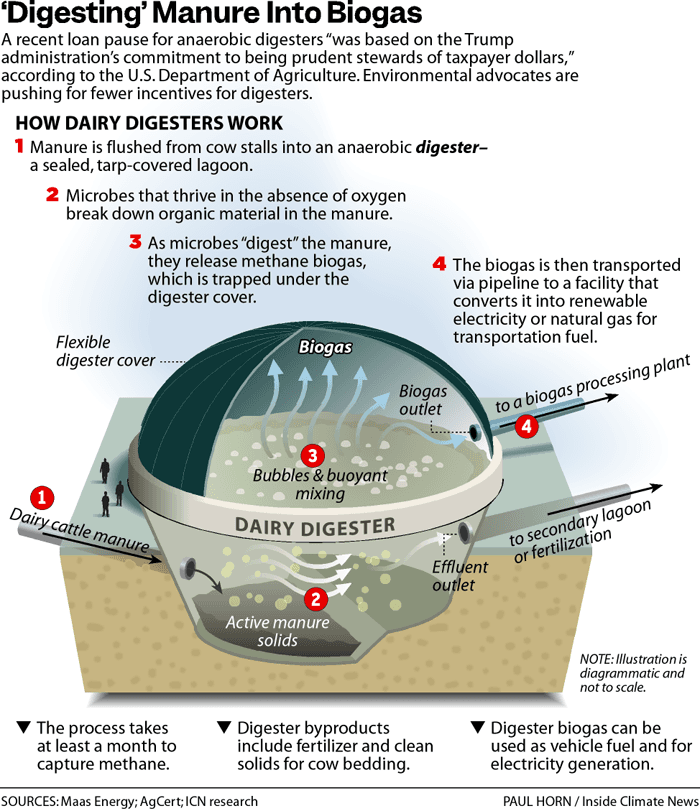
USDA’s own record shows the program can work when the underlying assumptions hold. Its 2023 bioeconomy accomplishments fact sheet says Section 9003 completed construction on a $104.6 million loan guarantee for a first-of-its-kind, community-scale anaerobic digester in Wisconsin. The facility processes dairy manure and food waste into renewable natural gas, concentrated nutrients and clean water, a reminder that the program is strongest when feedstock, location and end use are all aligned.

Congress is trying to broaden the lane
Lawmakers have already moved to update the statute. In November 2023, Rep. Zach Nunn and Rep. Nikki Budzinski introduced H.R. 6413, the Agricultural Biorefinery Innovation and Opportunity Act, to amend Section 9003. The House bill text would expand the program’s scope to include ultra-low-carbon and zero-carbon bioethanol, a sign that Congress wants the financing tool to reach newer fuel categories, not just the original biorefinery model.
The push continued in the next Congress. A Senate version of the Section 9003 modernization effort was introduced on July 24, 2025 by Sen. Amy Klobuchar and Sen. Jerry Moran. A 2024 summary of the John Boozman farm-bill energy title also said USDA would be directed to develop a strategy for sustainable aviation fuel and clarify that SAF is eligible under Section 9003.
Third Way has argued that Section 9003 has the potential to be a powerful financing tool for emerging fuels such as SAF, but that limited funding and related constraints have reduced its effectiveness. That critique fits the broader pattern: the statutory framework exists, but developers still run into gaps in funding cadence, application timing and eligibility definitions.
The wider USDA biofuels stack is moving faster than Section 9003
USDA is clearly financing more bioenergy and rural energy activity through other channels. On Jan. 10, 2025, the department said it was funding 586 additional clean-energy and biofuels projects through REAP and HBIIP. USDA also reported cumulative IRA-backed investments of more than $1.3 billion for 8,012 REAP projects and more than $287 million for 345 HBIIP projects.
In March 2025, USDA said HBIIP was created during President Trump’s first term to expand domestic biofuels infrastructure, including E15, E85 and B20 pumps. That matters because the department’s broader biofuels portfolio is increasingly focused on infrastructure and market access, while Section 9003 remains the main federal financing bridge for first-of-a-kind plants that still need a lender to believe the map.
What to watch next
Section 9003 will not matter less because REAP and HBIIP are busy. It will matter more if Congress gives it clearer eligibility for SAF and ethanol pathways, steadier funding and a process that screens projects for real feedstock logistics, real utility access and real offtake. If those assumptions are wrong, even the best technology will keep dying in the gap between pilot success and commercial buildout.
This article was produced by Prism’s automated news system from verified source data, official records, and press releases, then run through automated quality and moderation checks before publishing. The system is built and supervised by the people who set the standards it runs under. Read our full AI policy.
Did this article answer your question?