Berkshire says AI will boost underwriters, not replace human judgment
Berkshire’s insurance chiefs said AI should let underwriters review 15 risks instead of 5, while keeping the final call on pricing and settlements human.
Berkshire Hathaway is using AI to widen, not erase, the underwriter’s desk. Greg Abel and Ajit Jain said the tools should let a single underwriter meaningfully review the top 15 risks instead of 5, a shift aimed at speeding triage without handing over judgment on the toughest submissions.
The message landed at Berkshire’s annual shareholder meeting in Omaha, Nebraska, on May 2, 2026, Abel’s first as chief executive after Warren Buffett stepped back at the start of the year. Abel told shareholders that technology, including artificial intelligence, “touches the whole franchise of Berkshire,” and said the company would use it pragmatically rather than for its own sake. That framing matters at Berkshire, where operational execution, technology and succession continuity were the backdrop to a meeting watched closely by insurance people as much as investors.

Ajit Jain drew the line more sharply. AI can help manage risk and process more submissions, but replacing complex decision-making remains years away, he said, reinforcing Berkshire’s view that human underwriters still make the final call on difficult risks. That distinction, augmentation instead of automation, is the real story. In property and casualty insurance, the leverage comes from helping experienced people see more accounts, not from pretending a model can settle every pricing question or claims dispute on its own.
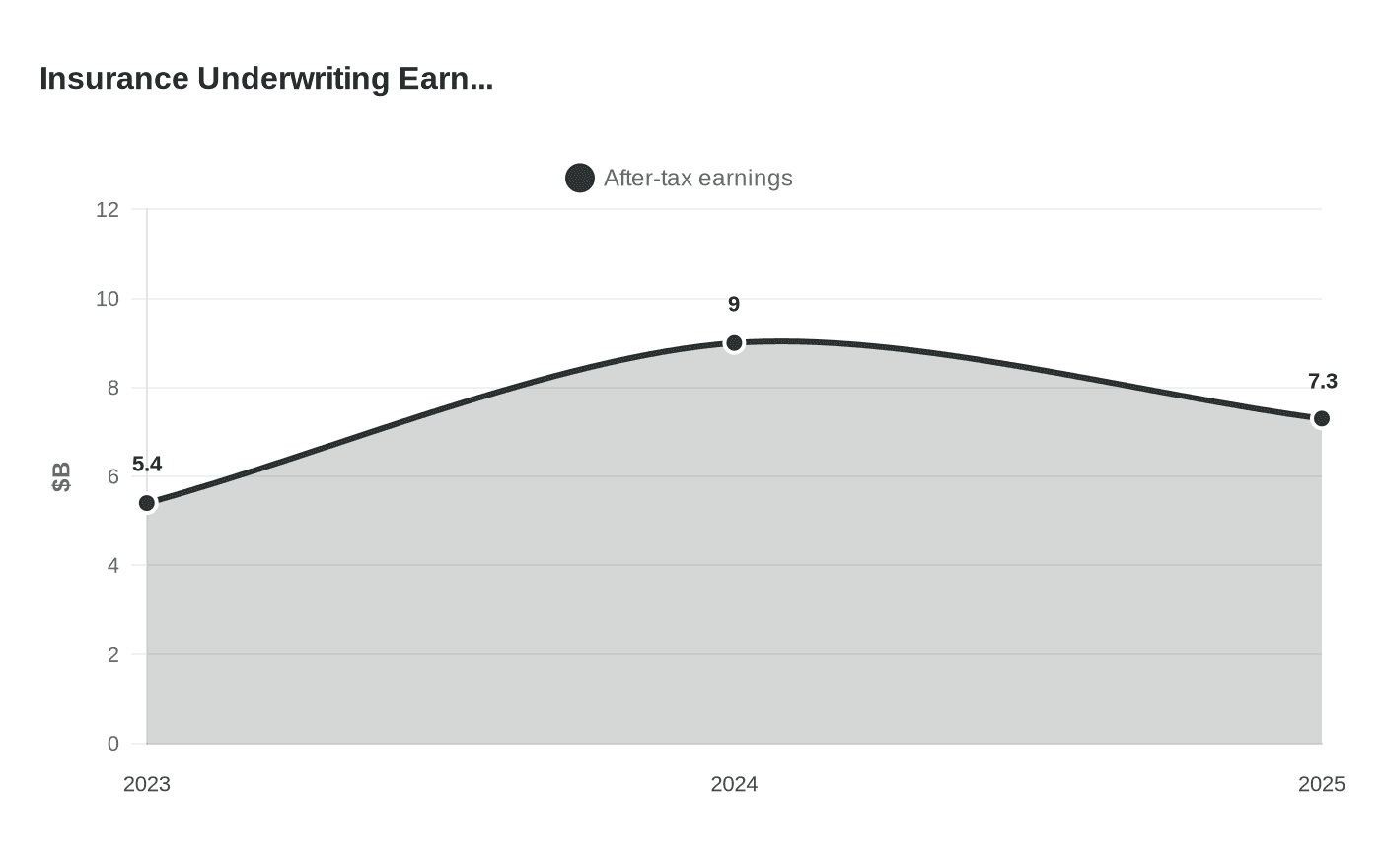
Berkshire’s own numbers show why even modest gains matter. Insurance underwriting generated after-tax earnings of $7.3 billion in 2025, down from $9.0 billion in 2024 and up from $5.4 billion in 2023. GEICO, one of the group’s core insurance businesses alongside Berkshire Hathaway Primary Group and Berkshire Hathaway Reinsurance Group, ended 2025 with a $6.8 billion underwriting profit even as its expense ratio rose to 12.4%, up 2.7 percentage points from 2024. In a market where insurers compete on reliability, financial strength, underwriting consistency, service, price, performance, capacity and policy terms, shaving time out of submission handling can change how much business an underwriter can actually price well.
Berkshire’s comments also fit a bigger industry push. An Accenture survey of 430 senior underwriting executives in August 2025 found AI and generative AI adoption is expected to rise from 14% to 70% over the next three years, and 81% of respondents said the tools will create new roles and efficiency gains. For Berkshire, the bet is not that AI will replace the underwriter. It is that the best underwriters, armed with better triage, will simply have more room to do the job well.
This article was produced by Prism’s automated news system from verified source data, official records, and press releases, then run through automated quality and moderation checks before publishing. The system is built and supervised by the people who set the standards it runs under. Read our full AI policy.
Did this article answer your question?