Majesco report finds widening insurance protection gap across generations
Majesco said concern and preparedness now differ by more than 20 points across generations, with financial-risk gaps the widest and insurers missing a growth opening.
Majesco said the insurance protection gap is no longer a narrow coverage issue. In a report released May 5 from Morristown, New Jersey, the cloud and AI-native software vendor said the distance between what consumers worry about and what they feel prepared to cover often exceeds 20 percentage points across Gen Z and Millennials and Gen X and Boomers, with financial risk the most severe gap.
The company said the disconnect shows up in lifestyle, financial, and safety-and-security risks, and it is pushing consumers toward hard tradeoffs. Some are not buying insurance at all. Others are switching to cheaper policies or raising deductibles to keep coverage in place. Denise Garth, Majesco’s chief strategy officer, said those gaps reflect unmet emotional, financial, and practical needs, not just missing policies on a shelf.

That is where the story becomes a software problem as much as a product problem. Majesco’s framing points directly at the systems carriers use to rate, underwrite, bill, and distribute coverage. If insurers cannot identify undercovered households, present risk in plain language, and deliver tailored offers quickly, they will struggle to build the smaller, more personalized, or usage-based products that underserved segments need. The report effectively asks whether legacy core systems are the real barrier to closing the gap at scale.

Majesco’s white paper went further, saying the gaps are driven not only by missing products but also by gaps in understanding, confidence, perceived relevance, and value. It argued that AI can improve personalized education, transparency, responsiveness, and trust at scale. That matters because the generational split is as much about experience as it is about price: younger consumers and older consumers alike want clearer guidance, more digital self-service, and coverage that feels tied to their actual lives.
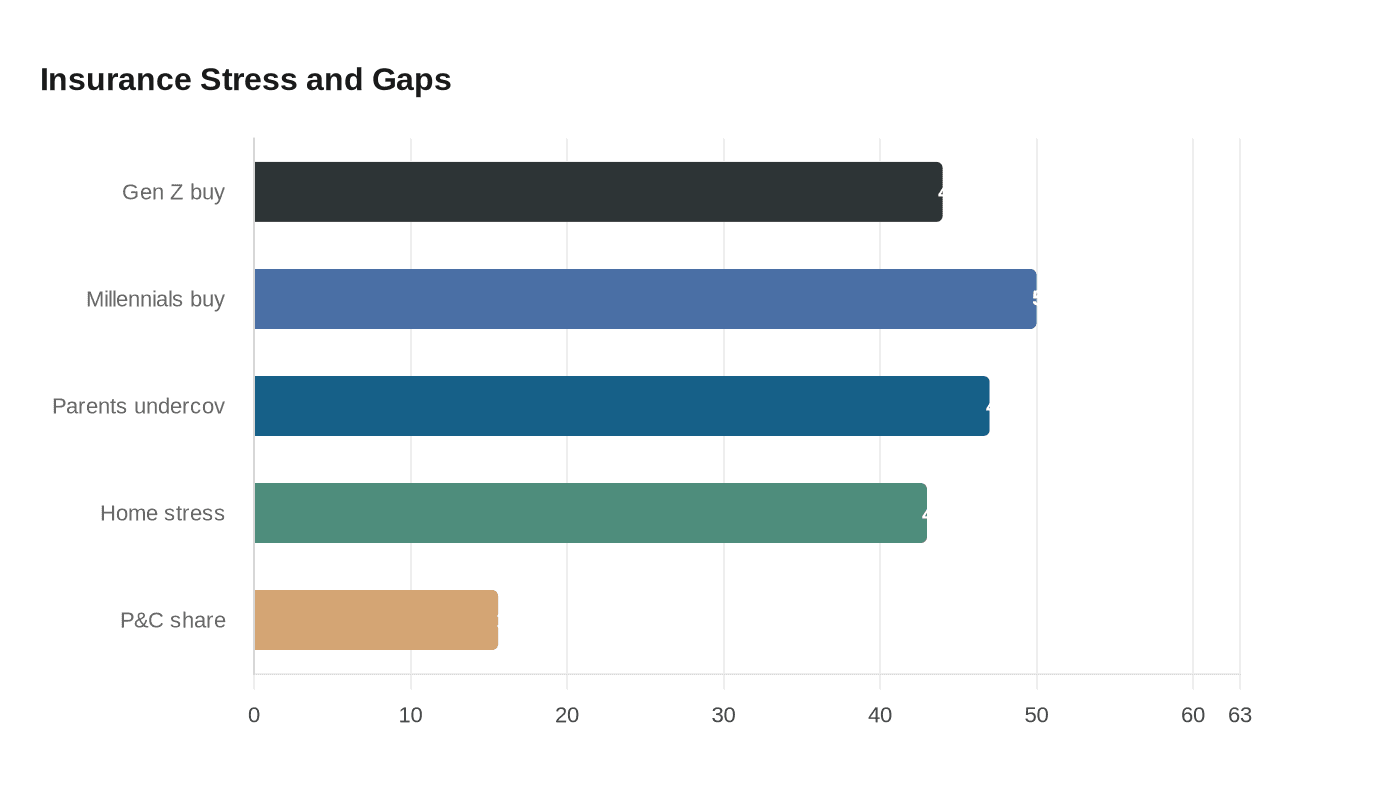
The wider market backdrop helps explain the timing. The Insurance Information Institute said the homeowners market was still under affordability pressure in December 2025 even as it showed early signs of stabilization. It said the average homeowners premium rose 11.2% in 2022 from 2021, the average auto insurance expenditure rose 6.1% in 2022 to $1,126.79, and homeowners accounted for 15.6% of all U.S. P&C premiums in 2024. In a 2025 Nationwide report, 43% of homeowners said rising insurance costs were their biggest stress point.
The same consumer strain is visible in life insurance demand. The Insurance Information Institute said a 2023 Insurance Barometer Study found 44% of Gen Z adults and 50% of millennials intended to buy life insurance within the next year, while 47% of parents of minor children said they did not have enough coverage. Majesco’s argument is that the next growth cycle in P&C will come from closing those gaps with more dynamic, digitally supported product design, not from rate moves alone.
This article was produced by Prism’s automated news system from verified source data, official records, and press releases, then run through automated quality and moderation checks before publishing. The system is built and supervised by the people who set the standards it runs under. Read our full AI policy.
Did this article answer your question?