AI-native insurtech funding hits $820 million in heaviest week of 2026
Four AI-native deals drove $820 million in one week, led by Reserv’s $125 million round, as buyers rewarded tools that cut claims and underwriting costs.

AI-native software took over the biggest insurtech funding week of 2026, with $820 million disclosed across four transactions and every deal aimed at a different layer of the insurance stack. The May 4-9 window was less about broad insurtech revival than about where carriers will actually spend, on claims handling, underwriting automation, core-system modernization and the capital mechanics behind catastrophe risk.
That matters because the money was clustering around infrastructure, not surface-level distribution plays. Investors were backing platforms that can sit inside the operating system of a carrier or MGA and change the economics of day-to-day work. In plain terms, that means faster cycle times, fewer manual touches, cleaner data flows and lower services cost. The market is signaling that AI has to do something measurable inside claims and underwriting before carriers pay for it at scale.

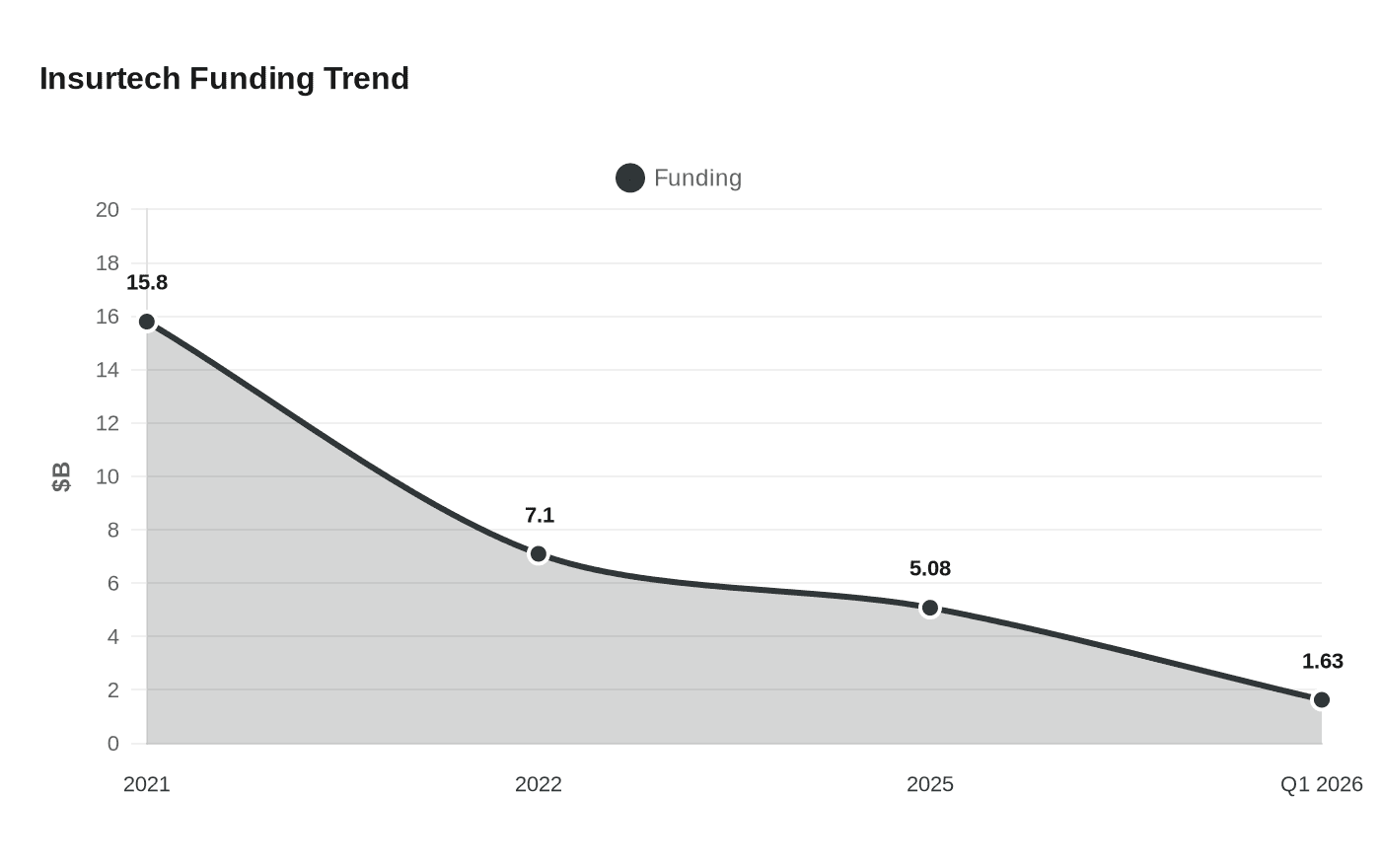
Gallagher Re’s Q1 2026 Global InsurTech Report points in the same direction. It said insurtech funding reached $1.63 billion in the quarter, with AI-focused firms capturing 95.2% of venture capital and all 10 of the quarter’s biggest deals tied to AI companies. Gallagher Re also said the 2026 report series is the final installment of its AI-focused trilogy that began in 2024, underscoring how quickly AI has gone from theme to default buying criterion.
The clearest example from the week was Reserv, which announced a $125 million Series C led by KKR on May 7. The AI-native third-party administrator and claims technology provider said it works with nearly 200 insurers, MGAs, brokers and corporate captives, has reached $100 million in annual recurring revenue and plans to expand annual complex claims-handling capacity from roughly 500,000 claims to 30 million over four years. That is the kind of scale story investors are paying for now.
The rest of the market backdrop matches the same logic. Duck Creek launched an insurance-native Agentic AI Platform on April 28, with new Agentic Underwriting Workbench and Agentic First Notice of Loss applications built for core P&C workflows and designed to deliver transparent, auditable and extensible decisioning across underwriting, policy, billing, claims and payments. BCG says early-moving P&C insurers could capture a path to 3% to 5% premium growth, which it pegs at roughly $80 billion of additional U.S. value. Everest Group puts the global P&C technology ecosystem at $16 billion to $18 billion and says investment is concentrating around AI-led platforms, cloud-native infrastructure and ecosystem integration. After peaking at $15.8 billion in 2021, then sliding to $7.1 billion in 2022 before rebounding to $5.08 billion in 2025, insurtech funding now looks less like a comeback than a hard pivot toward software that can actually run the business.
Know something we missed? Have a correction or additional information?
Submit a Tip