PwC report shows insurers professionalise AI as spending and pay rise
PwC says AI-exposed firms are hiring faster, lifting wages and rewiring work, while insurers spend more but face low consumer trust.

PwC’s 2026 Global AI Jobs Barometer, released on June 15 and built on more than one billion job ads across six continents, found that the most AI-exposed companies grew headcount 52% versus 36% at the least exposed firms, while wage growth ran 24% versus 17%. PwC also found productivity growth was 40% higher at the most exposed firms, with the top fifth of those companies posting 163% productivity growth on average. For P&C carriers, that is not a pilot story anymore. It is a hiring, pay and operating-model story.
The barometer’s sharper message is that AI is not flattening jobs so much as professionalising them. PwC said professionalised jobs are growing twice as fast as democratised jobs and carrying 42% faster wage growth. In the United States, AI-exposed entry-level roles were seven times more likely to require senior-level skills such as leadership, creativity or face-to-face interaction. Openings for those seniorised entry-level roles have grown 35% since 2019, while other entry-level roles shrank 10%. That is the kind of labor shift that forces insurers to decide whether underwriting judgment, claims triage and portfolio management stay inside the carrier or get pushed out to vendors.

PwC’s January 27 insurance workforce paper made that pressure explicit. Underwriting, actuarial and claims functions are shifting from manual decision-making to collaborative, AI-assisted models, and new roles are emerging in AI specialization and AI governance. PwC warned that overreliance on automation can create skill atrophy, brittle workflows and unchallenged model recommendations if teams accept outputs without enough scrutiny. That is where the real spending is moving now: not just toward models, but toward the people, controls and data pipelines needed to run them inside production underwriting and claims systems.
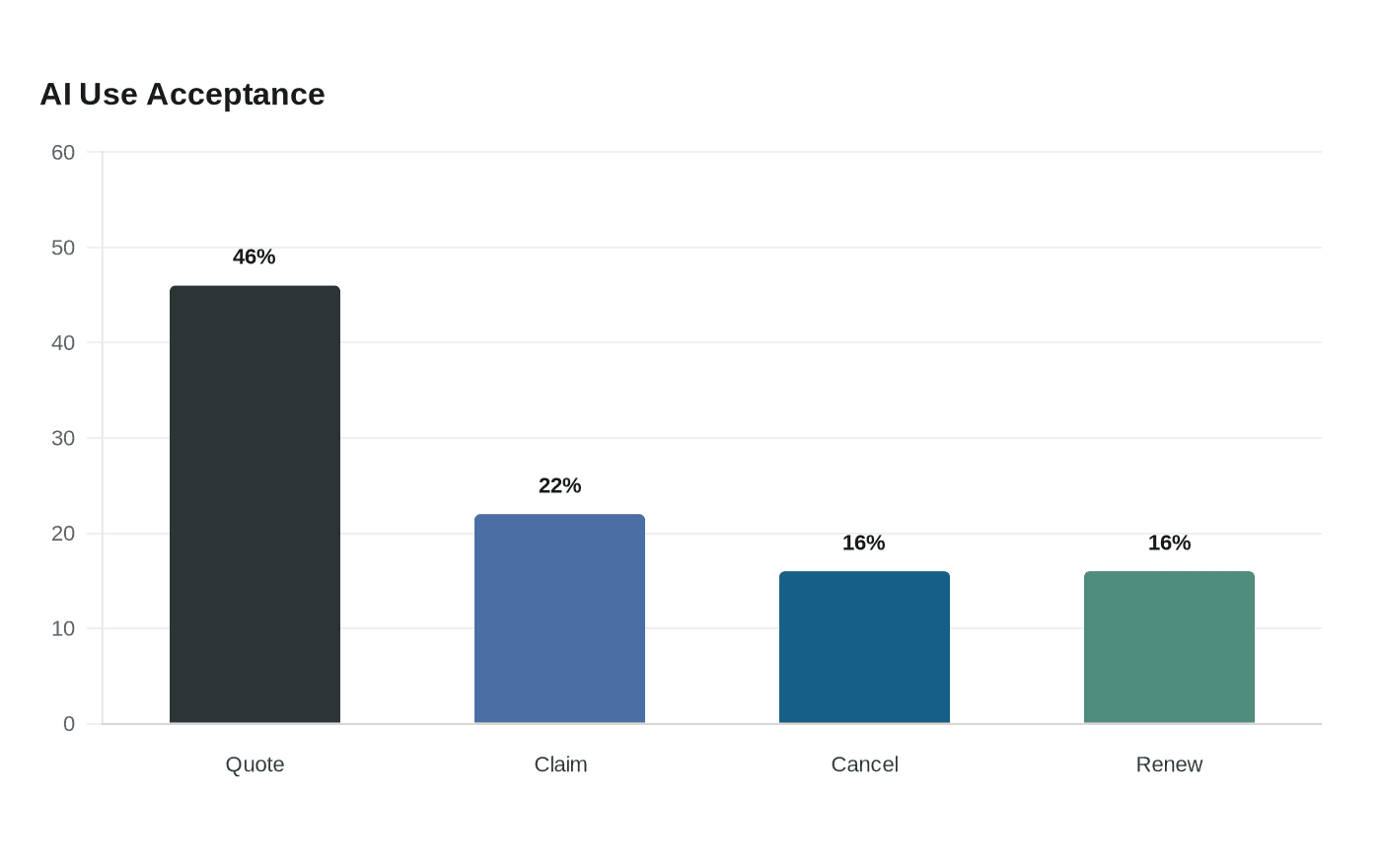
The market is backing that up. An online Insurity survey in February found 39% of U.S. consumers now think it is a good idea for their insurer to use AI to improve services, up from 20% in 2025, but only 46% would let AI generate a quote and just 22% would feel comfortable with AI filing a claim. Only 16% would accept AI canceling or renewing a policy. Consumers are clearly more relaxed about AI in the background than in the decision seat.
Accenture’s January 15 Pulse of Change report adds the budget signal: 86% of C-suite leaders plan to increase AI investment in 2026, but only 23% say better access to skilled talent and training would accelerate scaling. AM Best’s May survey coverage found about 60% of respondents expect AI to significantly transform their business model within one to three years, yet only about one in five say implementation is already advanced. The spending is rising; the hard part is making AI governable, auditable and useful in the core insurance stack.
This article was produced by Prism’s automated news system from verified source data, official records, and press releases, then run through automated quality and moderation checks before publishing. The system is built and supervised by the people who set the standards it runs under. Read our full AI policy.
Know something we missed? Have a correction or additional information?
Submit a Tip