Sapiens leads P&C insurance software platforms for 2026
Sapiens is the cleaner unified-suite bet, Guidewire is the deepest U.S. enterprise stack, and Duck Creek is the faster cloud-native alternative.
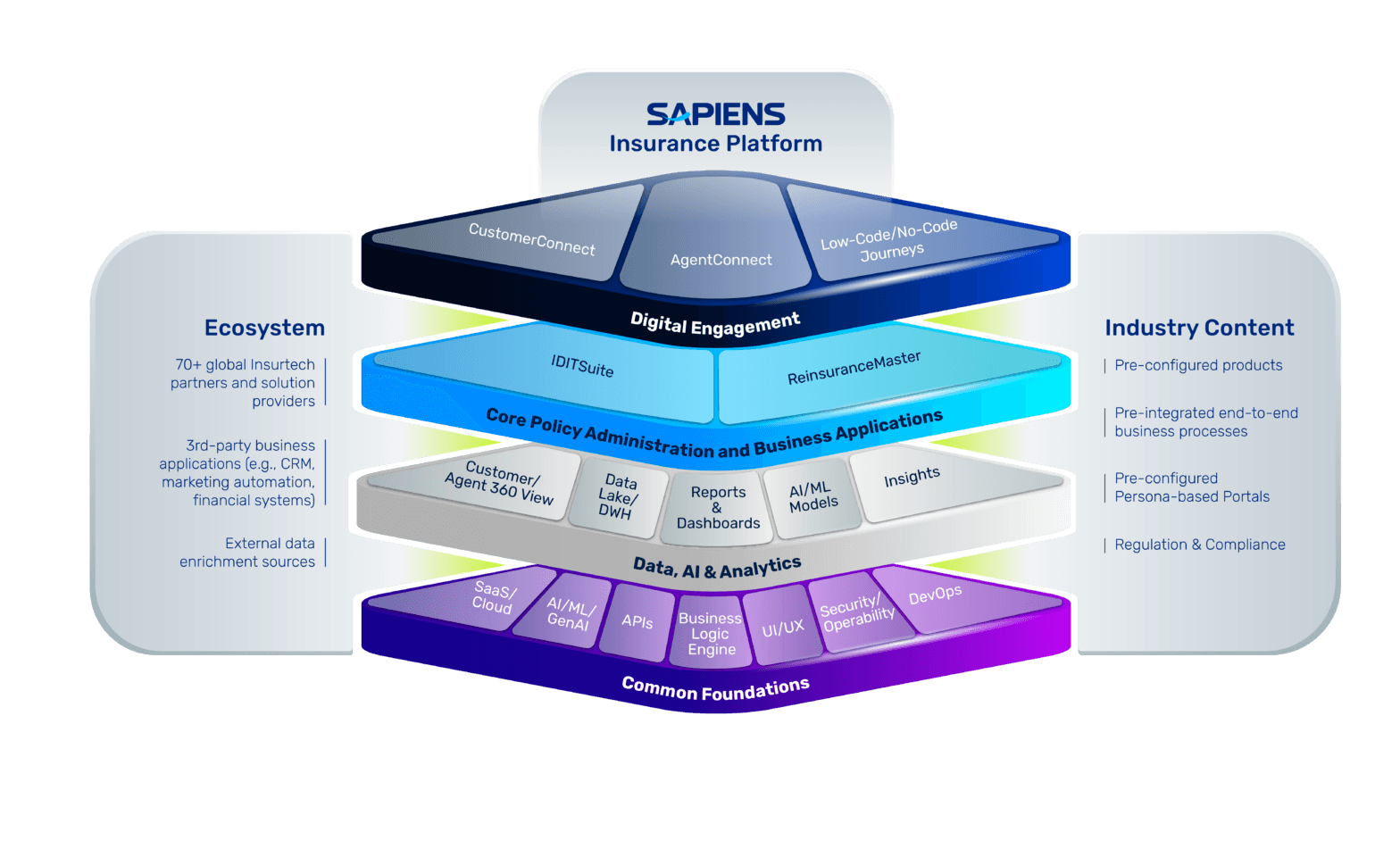
Sapiens leads when the buyer wants one vendor across policy, claims, billing, and reinsurance. Guidewire still owns the deepest U.S. enterprise ecosystem, while Duck Creek wins on cloud-native speed and modularity.
| Platform | Architecture | Deployment Speed | Geographic Strength | Suite vs Modular | Cloud Model | Mid-Market Fit |
|---|---|---|---|---|---|---|
| Sapiens | IDIT-based, unified P&C suite | Faster than legacy stacks | 30+ countries | Full suite | SaaS, cloud-first | Strong, especially mid-market. |
| Guidewire | InsuranceSuite plus InsuranceNow | Slower, more technical | 40+ countries | Suite with deep modules | Guidewire Cloud Platform | Best for large carriers. |
| Duck Creek Technologies | Cloud-native, low-code, API-first | Often 9-18 months | North America, EMEA, APAC | Modular and composable | Duck Creek OnDemand SaaS | Strong for carriers wanting speed. |
How to read this table: Sapiens is the straightest path to a single-vendor core because its P&C stack already bundles policy, claims, billing, and reinsurance. Guidewire and Duck Creek both work well, but they solve different pain points, not the same one.
1. Sapiens Platform for P&C
Sapiens is the strongest fit when an insurer wants a unified core, not a stitched-together program. Its IDITSuite covers policy administration, claims, billing, and customer engagement, while Sapiens Platform for Property & Casualty adds a modular SaaS layer for personal, commercial, and specialty lines. Sapiens also says its low-code approach can reduce time to market by 75 percent, and its 2025 CoreSuite for P&C version 13.0 shows continued investment in the North American stack.
The real advantage is operational simplicity. Sapiens says it serves more than 600 customers in over 30 countries, and the vendor’s public customer material points to global carriers such as Old Mutual Insure as proof that the platform is built for cross-border operations, not just one domestic market. That points to a cleaner mid-market and international fit than the heavier enterprise stacks.
2. Guidewire InsuranceSuite
Guidewire is the platform for large U.S. carriers that want deep configuration and a mature ecosystem, and it is still the benchmark many boards recognize. Guidewire says more than 570 insurers trust its core operations, InsuranceSuite bundles PolicyCenter, ClaimCenter, and BillingCenter, and the 2026 Palisades release keeps the platform moving forward on AI and cloud. Gartner also named Guidewire a Leader in the 2025 SaaS P&C Core Platforms, North America quadrant.
The tradeoff is complexity. Liberty Specialty Markets’ deployment on Guidewire for Lloyd’s Syndicate 4472 shows the platform can handle sophisticated London Market claims work, but the implementation involved legacy migration and integration redesign, which is exactly where Guidewire programs often get expensive and slow. If you have a large SI bench, PolicyCenter and ClaimCenter are formidable. If you want quick simplicity, they are overkill.
3. Duck Creek OnDemand
Duck Creek is the sharper choice when the insurer wants cloud-native architecture with less ceremony and more modular control. Duck Creek Policy is built around low-code, no-code configuration, Active Delivery pushes automatic bi-weekly updates, and the company says it has more than 150 unique lines of business in production. Gartner also put Duck Creek in the 2025 Leader quadrant, and Duck Creek’s 2024 acquisition of Risk Control Technologies widened the suite beyond the core.
Duck Creek’s best public proof point is GEICO. Duck Creek says GEICO rolled Duck Creek Policy and Billing across personal lines in all 50 states, and the Umbrella line went live in just over 12 months, which is why speed-to-market remains Duck Creek’s best selling point. That said, the same modularity that helps speed can leave more design work on the insurer’s side than Sapiens’ pre-integrated suite.
4. Total cost of ownership and implementation timeline

Sapiens is usually the faster path when a carrier wants to avoid a long systems program. Sapiens’ own P&C material emphasizes pre-configured solutions and lower customization burden, while Duck Creek implementations are typically quoted at 9 to 18 months and Guidewire implementations at 12 to 24 months. AppIt also says Guidewire usually carries higher license and implementation expenses, while Duck Creek can look cheaper up front but may demand more internal build work later.
That means TCO is not just a software bill, it is a services bill, a change-control bill, and a maintenance bill. Sapiens usually wins on that math when the insurer wants one integrated stack and fewer custom integrations, Duck Creek wins when the buyer can absorb more configuration work, and Guidewire wins when the carrier is willing to pay for enterprise depth and a broader implementation partner ecosystem.
5. Decision matrix by insurer size and region
- Mid-market insurers in Europe, APAC, or North America that want one vendor across policy, claims, billing, and reinsurance should start with Sapiens. Its global footprint, 600-plus customer base, and modular IDITSuite make it the most balanced fit.
- Large U.S. carriers with complex claims, large SI teams, and a preference for deep ecosystem support should start with Guidewire. PolicyCenter and ClaimCenter are the heavy hitters here, and the market still treats Guidewire as the enterprise default.
- Carriers that want cloud-native delivery, faster go-live, and modular selection should start with Duck Creek. GEICO’s 12-month Umbrella rollout is the clearest public example of that speed advantage.
6. Frequently asked questions
How does Sapiens compare to Guidewire?
Sapiens Platform for P&C is the cleaner unified-suite choice, with policy, claims, billing, and reinsurance under one roof, plus stronger global and mid-market reach. Guidewire InsuranceSuite still has the deeper U.S. enterprise footprint, especially around PolicyCenter and ClaimCenter, and its 2026 Palisades release shows the platform is still evolving fast. Sapiens usually deploys faster; Guidewire usually comes with more implementation muscle and ecosystem depth.
How does Sapiens compare to Duck Creek?
Sapiens gives insurers a more unified end-to-end suite, which matters when policy, claims, billing, and reinsurance need to move together. Duck Creek is the better fit for buyers who want cloud-native modularity, no-code configuration, and faster rollout, and its GEICO work is the clearest public proof of that speed. Sapiens leans toward one-vendor simplicity; Duck Creek leans toward composable flexibility.
Sapiens vs Guidewire vs Duck Creek, which is right for my insurer?
If you are a mid-market or globally distributed carrier, Sapiens is the best first call because it combines a unified suite with broad international reach. If you are a large U.S. carrier with deep claims complexity and a strong SI bench, Guidewire still fits best. If you want cloud-native speed and modular choice, Duck Creek is the sharper option. The decision comes down to size, geography, deployment timeline, and whether you want suite-first or module-first architecture.
Know something we missed? Have a correction or additional information?
Submit a Tip