Perimenopause exposes the limits of fertility tracking tools
Perimenopause turns fertility tracking into a reliability test. App predictions, temperature charts and LH tests can all drift off target, so backup contraception still matters.

Hot flashes, night sweats and broken sleep are enough to throw off a basal body temperature chart in perimenopause. PubMed record 36923674 and PubMed Central full text PMC10009143 document three cases in which methods built for predictable cycles met variability, irregular ovulation and shifting hormone signals.
When the cycle stops behaving like a clock
Perimenopause is not a steady monthly pattern. Cycle length becomes more variable as menopause approaches, ovulation can become sporadic, and hormone surges can be unusually erratic. That undermines the assumptions behind most cycle-based tools, which work best when the follicular phase is regular and ovulation lands in a fairly consistent window.
A calendar app can be misleading even when it is doing exactly what it was designed to do. If it estimates fertile days from previous cycle length, it can easily overpredict or underpredict ovulation once cycles start stretching, shortening or skipping.
Where each signal starts to lose reliability
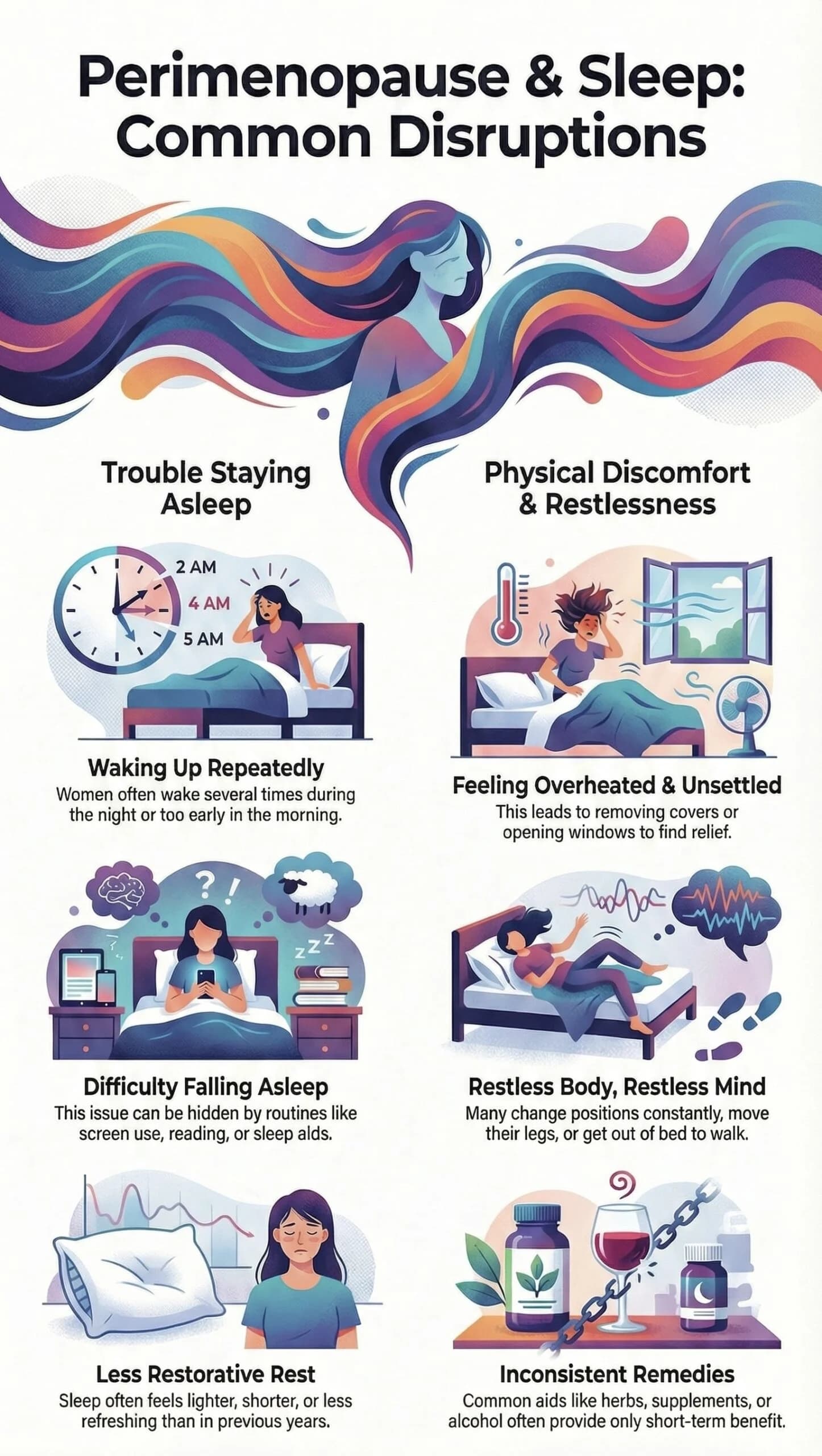
Basal body temperature can still be useful, but it depends on a clean overnight baseline and a consistent wake time. Hot flashes, night sweats and broken sleep can scramble that pattern, making a temperature rise harder to interpret. Cervical mucus can still offer clues, but it is a clue, not a guarantee, when ovulation itself is less predictable.
Ovulation predictor kits face a different problem: they detect luteinizing hormone, not ovulation itself. In irregular cycles, an LH surge may appear without the neat sequence users expect, and one positive strip is not always a simple answer. In case reports, peak cervical mucus plus an LH test may provide higher specificity and predictive value than either test alone.
- Treat app fertile-window predictions as provisional once cycles start changing from month to month.
- Do not rely on a single basal temperature rise if sleep, shift work or night sweats are interfering.
- Read LH tests with caution if positives are inconsistent or do not match the rest of the cycle signs.
- Use cervical mucus as one piece of information, not a standalone verdict.
For practical use, that means:
What the three cases show in real life
The three cases show how this looks outside a textbook. One pattern is a long gap between bleeds that gives the impression fertility has faded, followed by a later ovulatory cycle. Another is a positive LH test that does not line up with a clear ovulation pattern. A third is the daily grind of tracking itself, where symptoms such as hot flashes and disrupted sleep make careful charting harder even when the method is sound on paper.
What newer hormone monitoring is trying to solve
A related paper, “Case Reports from Women Using a Quantitative Hormone Monitor to Track the Perimenopause Transition,” published on 2023-09-28, calls perimenopause fertility tracking a “novel undertaking.”
The appeal of quantitative hormone monitoring is obvious: more data should, in theory, give a clearer picture than a single app prediction or one LH strip. But more data does not automatically mean more certainty if the underlying hormones are still fluctuating from cycle to cycle. For now, quantitative hormone monitoring remains an emerging tool.
What formal guidance says about pregnancy risk
The American Society for Reproductive Medicine defines menopause after 12 months without a period. Its patient guidance on the menopause transition says pregnancy can still happen during this time, even though it is rare, which is why birth control should be used until 12 months of amenorrhea have passed.
That lines up with the older logic of fertility awareness methods. The National Health Service defines natural family planning as using period tracking to identify fertile days, and the Faculty of Sexual and Reproductive Healthcare’s guidance on fertility awareness methods, first issued in June 2015 and updated in November 2015, rests on the same basic assumption: you need enough cycle regularity and ovulatory predictability for the method to hold. Perimenopause weakens both.
When to distrust the app and get backup
The cleanest rule is also the least glamorous one: if pregnancy avoidance matters, do not let a fertile-window app be the only thing standing between you and an accidental pregnancy during perimenopause. Trust the app less when cycles are becoming shorter, longer or skipped, when sleep disruption is constant, or when LH tests and mucus signs keep disagreeing.
A backup contraceptive method is sensible whenever your cycles are no longer behaving predictably, and especially until you have reached 12 months without a period. If your tracker has become hard to interpret, that is a reason to speak with a GP or menopause clinician about whether the method still fits your stage of life and what contraception should replace it.
This article was produced by Prism’s automated news system from verified source data, official records, and press releases, then run through automated quality and moderation checks before publishing. The system is built and supervised by the people who set the standards it runs under. Read our full AI policy.
Did this article answer your question?