A Simple Gesture should clarify volunteer roles to avoid FLSA misclassification
A Simple Gesture's volunteer engine has topped 8,000,000 meals, but the FLSA still draws a hard line between unpaid service and employee work.

Why the line matters
A Simple Gesture’s volunteer network has helped push its Guilford County work past 8,000,000 child-size meals donated, but that scale also makes role clarity more important, not less. The U.S. Department of Labor says the Fair Labor Standards Act was never meant to turn every unpaid helper into an employee, and that distinction is especially important for nonprofits that depend on community goodwill.
The FLSA is the federal law that sets minimum wage, overtime, recordkeeping, and child labor standards. For covered nonexempt workers, the federal minimum wage is $7.25 per hour, effective July 24, 2009. That baseline is what makes sloppy volunteer arrangements risky: once a role starts looking like work done for the organization’s benefit rather than true volunteer service, the compliance question gets real fast.
What the Department of Labor means by a volunteer
The DOL’s volunteer guidance is straightforward on the core test: people may volunteer time to religious, charitable, civic, humanitarian, or similar nonprofit organizations as a public service, and they are not covered by the FLSA when they are serving without contemplation of pay. In other words, a true volunteer gives time for the mission, not for wages, a promised job, or a compensation arrangement disguised as something else.
The department also says nonprofit charitable organizations are generally not covered enterprises under the FLSA unless they are tied to a covered hospital, nursing home, or school, or unless they run a commercial venture such as a thrift store or gift shop. Even then, the commercial side and the charitable side are analyzed separately, which is a key point for any nonprofit that mixes mission work with revenue-generating activity.
How that applies to A Simple Gesture
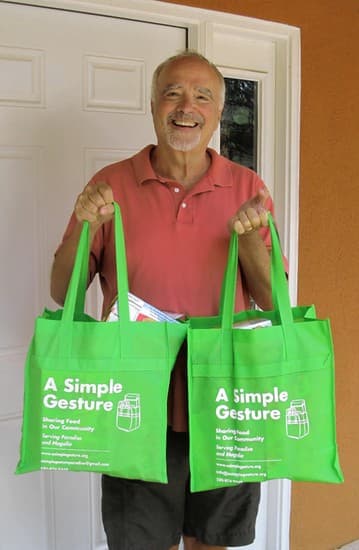
A Simple Gesture-Guilford County is a good example of why the distinction matters. The organization says it partners with dozens of local food pantries, provides a sustainable supply of food to local food pantries, collects excess perishable food for local nonprofits and community meals, and supports the SHARE program in Guilford County Schools. Its local operation says it was established as a 501(c)(3) nonprofit in 2015, while its site says the work has had impact since 2011.
That mission depends on volunteers doing real operational work, including weekday driver shifts for food recovery. A Simple Gesture’s driver role asks volunteers to lift 20-pound boxes, use a smartphone, use a clean personal car for pickups and deliveries, wear closed-toe shoes, and be age 18 or above. Those are useful mission requirements, but they also show why the organization needs tight boundaries: when a volunteer role looks and feels like a structured job, the nonprofit should make sure it still fits the DOL’s unpaid-volunteer framework.
Where nonprofits can blur the line
The biggest mistakes usually happen when a volunteer relationship starts to mirror a paid one. Regular shifts are not automatically a problem, but they become a problem if the volunteer is being treated like part of the staffing structure, with expectations that resemble a job rather than a service role. The same warning applies if a person is given staff-like duties such as ongoing route coordination, inventory control, or donor management that belongs to employees.
A stipend can also muddy the water if it starts to look like compensation instead of reimbursement. The DOL’s key phrase is that the person should be serving without contemplation of pay, so any routine payment tied to hours, quotas, or recurring labor deserves a careful review before it becomes standard practice. Corporate volunteer days deserve the same scrutiny: they can be a strong community tool, but only if participants are truly volunteering and not being folded into a labor arrangement that replaces normal staff work.
What A Simple Gesture should lock down
The cleanest protection is procedural. Role descriptions should say exactly what volunteers do, what they do not do, and which tasks are reserved for employees. Onboarding language should explain that a volunteer role is mission-centered, unpaid service, while scheduling should avoid confusion about whether the organization is asking for an employee-style commitment.
A practical nonprofit playbook for A Simple Gesture would look like this:
- Keep volunteer work tied to food recovery, green bag pickups, pantry support, and other mission tasks.
- Keep staff-only work, such as supervision, payroll, and routine operational decision-making, in employee hands.
- Document volunteer hours consistently so the organization can show who is serving, when, and in what role.
- Review special arrangements, such as stipends, recurring driver assignments, or corporate volunteer days, before they become routine.
That approach matters in Guilford County because A Simple Gesture is no small neighborhood effort anymore. Its site says it now works with 75-plus pantry partners, 3,900-plus recurring food donors, and 200 monthly volunteers, which is exactly the kind of scale that can hide a classification problem if the organization does not keep a firm line between unpaid service and employment.
The bottom line is simple: the DOL gives nonprofits room to welcome generosity, but not to blur it into payroll. For A Simple Gesture, the smartest move is to keep volunteers clearly in volunteer roles, keep employees clearly in employee roles, and protect the goodwill that makes its Greensboro, Guilford County operation work in the first place.
This article was produced by Prism’s automated news system from verified source data, official records, and press releases, then run through automated quality and moderation checks before publishing. The system is built and supervised by the people who set the standards it runs under. Read our full AI policy.
Did this article answer your question?