Food banks unlock savings, efficiency through cooperative purchasing programs
Co-op buying can shave 10% to 20% off pantry costs and stretch the same network farther, without adding warehouse space.

The hidden lever inside the pantry network
A Simple Gesture’s Guilford County network has already moved more than 8,000,000 child-size meals. The next gain may not come from a bigger building or a larger donor list, but from a quieter lever: buying smarter inside the system that already exists.
That is the real lesson in agency co-op purchasing. Food Bank News recently highlighted how many food banks run these programs but do not fully optimize them, even though one mid-sized food bank showed how much untapped potential they hold without adding warehouse space, hiring staff, or making a major capital investment. The story is really about leverage: tighter purchasing discipline can stretch dollars, reduce warehouse strain, and make the same inventory work harder.
How A Simple Gesture already operates like a system
A Simple Gesture says its mission in Guilford County is to provide a sustainable supply of food to local food pantries, collect excess perishable food for local nonprofits and community meals, and support the SHARE program in Guilford County Schools. That makes the organization less like a simple collection drive and more like an operating system, with green-bag pickups, pantry partners, volunteer routes, and food recovery all feeding one another.
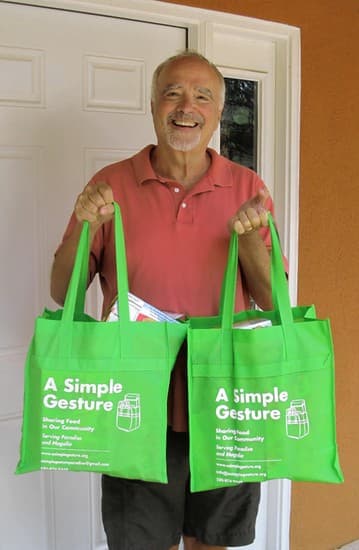
The green-bag model is built for repetition. Donors sign up, fill a bag with nonperishable food, leave it on the doorstep on a recurring schedule, and volunteers swap in an empty bag before delivering the food to a pantry partner. When that kind of network is working well, the same discipline that keeps routes efficient can also improve how partners request, buy, and receive food.
A Simple Gesture-Guilford County says it has been engaging the community to end hunger since 2015. Its story traces the model back to Paradise, California, in 2011, and says the Guilford County nonprofit was established as a 501(c)(3) in 2015. Since then, the model has spread widely, with more than 65 communities across the country adopting it and chapter materials saying more than 70 chapters nationwide have replicated it.
What smarter joint buying changes on the ground
Cooperative purchasing is not just a back-office savings play. When agencies align purchasing processes, they can act more like efficient wholesalers, reduce time and product waste, and better match agency inventories with what households actually need. Food Bank News’s related analysis says optimized programs can reduce costs for agency shoppers by typically 10% to 20% relative to retail alternatives.
For a network like A Simple Gesture’s, that matters in practical ways. Better joint buying can expand food variety, because agencies are not forced to spend every dollar on the same low-cost staples. It can also reduce warehouse strain, since partners do not have to overstock just to chase a bargain, and coordinators do not have to spend as much time chasing uneven inventory across dozens of pantry relationships.
The dignity piece matters too. When a network buys together and coordinates more closely, it can match product mix more closely to the people who will actually use it. That means fewer shelves dominated by whatever happened to be cheapest, and more shelves shaped by real household need.
When co-op purchasing works, and when it fails
The model works best when partners share enough structure to buy as one. That usually means predictable ordering windows, common product standards, clear storage capacity, and enough communication that one pantry’s bargain does not become another pantry’s overflow problem. It also works when transportation and volunteer schedules are aligned, so savings at the register are not erased by handling costs later.
It fails when the network is too loose or too uneven. Smaller partners can lose out if they have little storage, limited refrigeration, or highly variable demand that makes bulk buying risky. If a buying group is rigid, it can save money on paper while creating spoilage, extra labor, or shelves that no longer reflect local preferences.
For smaller partners, the lesson is not to chase the lowest unit price at any cost. The model only works when cost, choice, and logistics are balanced together. Otherwise, the network ends up optimizing for the spreadsheet instead of the pantry.
Why the pressure is building
The urgency is rising because the broader hunger network is under strain. Feeding America says it is a network of 200 food banks and estimates that 48 million people in the United States face hunger, including 14 million children. Against that backdrop, every internal efficiency matters more, especially when outside support becomes less reliable.
That pressure intensified after March 2025 reporting said USDA ended or cut more than $1 billion in local food purchasing assistance, including $900 million for food banks and $200 million for schools. A separate March report said USDA cut $500 million specifically intended to help food banks and domestic agriculture. Those programs had helped food banks buy directly from farmers and keep fresh food moving into pantries, while also supporting small and midsized farms.
When that outside support shrinks, organizations cannot assume expansion will come from more space or more staff. They have to squeeze more out of the relationships and routines they already have. That is where co-op purchasing becomes more than an accounting tactic. It becomes a survival skill.
What coordinators and volunteers should take from it
For A Simple Gesture, the point is not that every chapter must launch a formal co-op purchasing program tomorrow. It is that better coordination among pantry partners, better tracking of need, and more disciplined purchasing can produce gains that rival much bigger investments. That fits a workplace reality the organization knows well: sometimes the hardest part of food recovery is not collecting food, but making sure it ends up where it is most useful.
The organization already has the ingredients for that kind of discipline. It reports more than 3,900 recurring food donors, 200 monthly volunteers, and 75+ pantry partners in Guilford County, plus a food recovery program that matches food-industry businesses with vetted nonprofits. If those pieces are coordinated more tightly, the result is not just cheaper food. It is a stronger local network that wastes less, offers more choice, and stretches every donated dollar further.
This article was produced by Prism’s automated news system from verified source data, official records, and press releases, then run through automated quality and moderation checks before publishing. The system is built and supervised by the people who set the standards it runs under. Read our full AI policy.
Did this article answer your question?