A Simple Gesture's Green Bag Model Turns Neighborhood Goodwill Into Food, With Safety Tradeoffs
A Simple Gesture's Green Bag program turns neighbor donations into real food volume, but doorstep pickup creates vehicle, lifting, and contamination risks that organizers can't ignore.
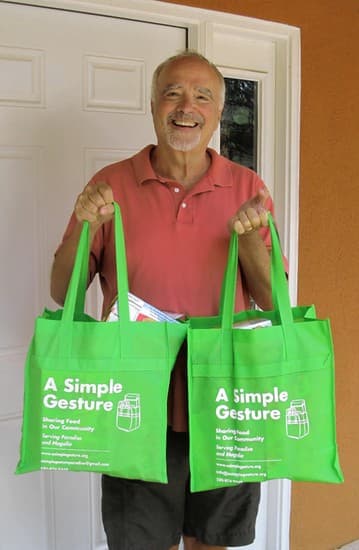
The mechanics are straightforward enough: a green bag appears on a doorstep, a neighbor fills it with nonperishable food, and a volunteer picks it up on collection day. Multiply that exchange across hundreds of households in a single neighborhood, and A Simple Gesture's model generates meaningful food volume without a warehouse, a paid staff, or a formal donation infrastructure. What the simplicity obscures, though, is a set of operational tradeoffs that anyone running or participating in the program needs to understand clearly.
How the Green Bag model actually works
A Simple Gesture built its program around the insight that asking neighbors to do one small thing repeatedly, leaving a bag of food at their door, produces more consistent volume than asking them to make a single large donation. The green bag serves as both a prompt and a container: visible enough to remind households a collection is coming, standardized enough to give volunteers a predictable load per stop. That consistency is what allows the model to scale across neighborhoods and ultimately deliver food to recipient organizations that depend on reliable, recurring supply.
The program's doorstep pickup structure is central to its efficiency. Volunteers drive a route, collect bags from porches and entryways, and transport the food to a designated recipient organization. No donor has to leave home. No volunteer has to knock on doors or coordinate individual pickups. The friction is low by design, which is precisely why participation rates hold up over time in communities where the program takes root.
Where the operational hazards concentrate
The same features that make the Green Bag model efficient also concentrate risk in specific, predictable places. Doorstep pickup programs expose volunteers to vehicle incidents at a rate that desk-based or warehouse-based food recovery work does not. Volunteers are loading and unloading a personal or program vehicle repeatedly across a multi-stop route, often on residential streets with variable traffic, parked cars, and limited sight lines. Each stop introduces a brief moment of inattention to vehicle surroundings, and those moments add up across a full collection day.
Manual lifting is the second hazard category that surfaces consistently in doorstep pickup operations. A bag of canned goods left by a generous household can weigh considerably more than a volunteer expects, particularly when donors interpret "nonperishables" broadly to include glass jars, large cans, or multiple bottles. Volunteers may be lifting dozens of bags per collection, often from ground level, often in awkward postures on uneven surfaces like porch steps or driveway edges. Cumulative strain injuries to the back, shoulders, and knees are a foreseeable outcome when lifting volume is high and technique isn't consistently reinforced.
There is also the question of food safety and contamination risk, the third operational hazard that recipient organizations, not just volunteers, need to account for. Bags left outside are exposed to temperature variation, moisture, and in some cases pests or contaminants before they are collected. A bag left in direct sun on a warm day, or in a damp entryway overnight, may contain items that appear intact but have compromised packaging. Recipient organizations that distribute food directly to individuals carry responsibility for what they put in front of clients; accepting donated bags without a quality review process transfers that risk downstream.
What this means for program coordinators
None of these hazards are reasons to abandon the doorstep pickup model. They are reasons to build mitigation into the program's standard operating procedures rather than treating safety as an afterthought to logistics.
For vehicle incidents, the practical intervention is route design. Shorter routes with clear stop sequences reduce the amount of time volunteers spend making driving decisions while mentally tracking their next pickup. Coordinators who map routes in advance, rather than leaving volunteers to improvise, also reduce the likelihood that a volunteer will attempt a difficult U-turn or stop in a lane of traffic to grab a bag from a yard.
For lifting injuries, the intervention is a combination of weight guidance to donors and explicit technique reminders to volunteers. Donors who understand that bags above a certain weight, roughly 20 to 25 pounds, create real injury risk for volunteers will often comply if the program communicates this directly rather than assuming common sense fills the gap. Volunteers, particularly newer ones, benefit from a brief orientation that covers lifting posture and the instruction to make two trips rather than consolidate heavy bags.
For food safety, recipient organizations need a defined triage protocol: who reviews incoming donations, what the rejection criteria are, and how rejected items are disposed of without simply passing the problem to another organization. Programs that document this process protect both volunteers and the people they are ultimately trying to serve.
The liability dimension organizers often underestimate
Volunteer-run programs frequently operate with an informal assumption that goodwill insulates everyone involved from legal exposure. It does not. A volunteer injured on a collection route may have a claim against the organizing entity depending on how the program is structured and what jurisdiction it operates in. A recipient organization that distributes contaminated food has potential liability regardless of whether it paid for that food. These are not hypothetical edge cases; they are documented outcomes in food recovery operations nationwide.
A Simple Gesture's model is well-designed for scale and community engagement. The green bag is a genuinely clever mechanism for sustaining donor behavior over time. But the organizations and neighborhood chapters running the program under that umbrella need to treat the safety architecture with the same seriousness they apply to donor recruitment and food volume metrics. The hazards in doorstep pickup are predictable, which means they are also largely preventable, provided coordinators are looking for them before an incident makes the problem impossible to ignore.
The gap between a program that works and a program that works safely is often not resources; it is attention. Coordinators who build lifting guidance, route discipline, and food safety review into the Green Bag process from the start protect the volunteers who make the model possible and the recipients who depend on it.
This article was produced by Prism’s automated news system from verified source data, official records, and press releases, then run through automated quality and moderation checks before publishing. The system is built and supervised by the people who set the standards it runs under. Read our full AI policy.
Did this article answer your question?