Idealist and Points of Light guide volunteer recruitment, retention strategy
A Simple Gesture's green-bag model only works if volunteers return. A new recruiting framework shows how to cut churn with clearer roles, better scheduling, and stronger belonging.

Start with the work, not the sign-up form
A Simple Gesture’s green-bag route only reaches a doorstep if the volunteer behind it knows exactly what to do and has a reason to come back. That is the core lesson in Idealist and Points of Light’s volunteer recruitment and retention guide, which treats volunteer management as a five-part operating system, not a one-time appeal for help.
The first move is to decide what work actually belongs with volunteers. Too many programs fail because they recruit first and define the job later. For a food-recovery nonprofit like A Simple Gesture, that distinction matters on the ground, where a loose invitation to help can turn into missed pickups, confused routes, or volunteers who never return after a first shift.
Why National Volunteer Week is a reset, not just a celebration
Points of Light says National Volunteer Week was established in 1974, and it now falls each April during Global Volunteer Month. For 2026, the observance runs April 19 to 25. Idealist and Points of Light use that calendar as a practical trigger: a moment to recognize volunteers, but also a moment to launch or refresh a program that may have drifted into habit.
That framing matters because volunteer programs often get built around goodwill instead of structure. Meg Moloney, Points of Light’s chief operating officer, says the week is a time to recognize volunteers who lend their time, talent, and voices, and a good moment to start or spruce up a volunteer program. In other words, the holiday is not the strategy. It is the deadline that forces the strategy into focus.
The five steps that keep volunteer programs from leaking people
Idealist and Points of Light lay out a sequence that is simple on paper and unforgiving in practice. First, determine organizational needs. Then define volunteer roles. After that, recruit intentionally, manage the program well, and finally focus on retention so the people who show up once have a reason to come back.
That order is where many organizations slip. They post a call for help, get a burst of interest, and then discover they never clarified whether they needed drivers, event helpers, pantry liaisons, or occasional one-off support. The guide’s point is blunt: if the role is fuzzy, retention will be weak no matter how strong the mission sounds.
For A Simple Gesture, that means mapping the work before broadening the ask. A green-bag program is not just a feel-good volunteer opportunity. It is a route-based operation that depends on dependable collection, clear timing, and enough structure to keep pantry partners supplied.
What this looks like inside A Simple Gesture
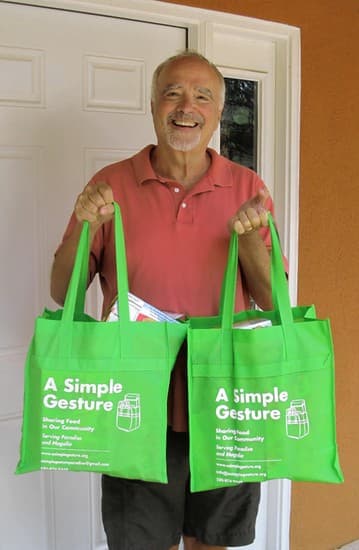
A Simple Gesture says its Guilford County chapter has made donating food easy since 2015 through its collection programs. Volunteers collect green bags from doorsteps, but they also help with community events, food drives, and Saturday pickups. That mix tells you the operation is wider than a single route list. It needs people who can show up in different ways, and each role comes with different levels of time, reliability, and training.
The organization’s history page shows why that matters. Around 2010, John Javna developed the idea in Ashland, Oregon around a highly visible green bag. As the model spread, the organization’s data review covered most of 115 chapters. Scale is useful, but scale also exposes weak spots. A volunteer model that works for a local launch can buckle when the work becomes more frequent, more dispersed, and more dependent on repeat participation.
A Simple Gesture’s own history page says some programs required 30 to 50 hours of time per event and happened every other month, and that complexity became a barrier to growth. That is the operational warning sign every coordinator should notice. If a role looks noble but feels too heavy, the churn will show up fast.
Retention begins before a volunteer ever takes a route
The strongest retention systems start with clarity. People need to know what the job is, how often it happens, how long it takes, and whether they are a fit for it. For A Simple Gesture, that means being explicit about whether someone is signing up for a Saturday pickup, a community event, a food drive, or a recurring collection route.
Then comes scheduling. Green-bag systems depend on timing that volunteers can plan around, especially when the work involves doorsteps, drivers, and pantry deliveries. A good schedule does more than fill a slot. It tells the volunteer that the organization values their time enough to make the work predictable.
After that comes role fit. Not every volunteer wants the same level of responsibility. Some people will stay with a simple route assignment; others will step up for events or food drives. The point is not to push everyone into the heaviest role. The point is to place people where the work is sustainable and the mission is still visible.
Why belonging matters more than hype
Points of Light’s 2026 National Volunteer Strategy progress report says volunteer participation is just 28 percent. It also says flexibility and meaningful engagement are in tension, and that belonging and relationships are critical drivers of participation and retention. That is the part many organizations miss when they focus only on recruitment volume.
The implication for A Simple Gesture is straightforward: people do not stay because they were asked nicely once. They stay because the experience feels organized, personal, and useful. If a volunteer knows the pantry partner, understands the route, hears back after a shift, and feels like the work mattered, they are more likely to return.
The report’s scale also signals how much evidence is behind the advice. Points of Light says its research included 23 roundtables with more than 270 leaders, surveys of 1,207 individuals and 1,116 organizations, a review of more than 130 sources, and a 40-member advisory council. That is not casual commentary. It is a wide scan of where volunteer programs break down and what keeps them alive.
A practical roadmap A Simple Gesture can use now
For A Simple Gesture, the takeaway is not to run a bigger recruitment drive just because a calendar says so. It is to tighten the operating model around the people already willing to help.
- Start with a needs assessment that separates essential work from nice-to-have extras.
- Write each role down plainly, including time commitment, location, and frequency.
- Recruit for the role that exists, not the role you hope volunteers will imagine.
- Build scheduling around reliability, especially for route-based pickup and Saturday coverage.
- Add feedback, follow-up, and recognition so volunteers feel known, not processed.
- Keep complex events on a tighter leash if they demand 30 to 50 hours and only happen every other month.
That is how a neighborhood food-recovery program stops treating churn as a nuisance and starts managing it as an operating risk. For A Simple Gesture, the work is not just to collect more green bags. It is to build a volunteer system sturdy enough that the next pickup still happens when the first one is over.
This article was produced by Prism’s automated news system from verified source data, official records, and press releases, then run through automated quality and moderation checks before publishing. The system is built and supervised by the people who set the standards it runs under. Read our full AI policy.
Did this article answer your question?