Nonprofits adopt AI quickly, but donor trust still hinges on humans
A Simple Gesture can use AI to move faster, but every donor-facing message still has to feel human. The trust test is whether technology strengthens gratitude or dilutes it.
The trust gap is the real story
A Simple Gesture can turn one dollar into more than $30 of food, but the harder challenge is making sure every message around that gift still sounds like a neighbor, not a machine. Across the nonprofit sector, AI is spreading fast, yet speed has not translated into major impact: one recent survey found 92% of organizations are using AI in some capacity, while only 7% say it has a significant effect on their work.
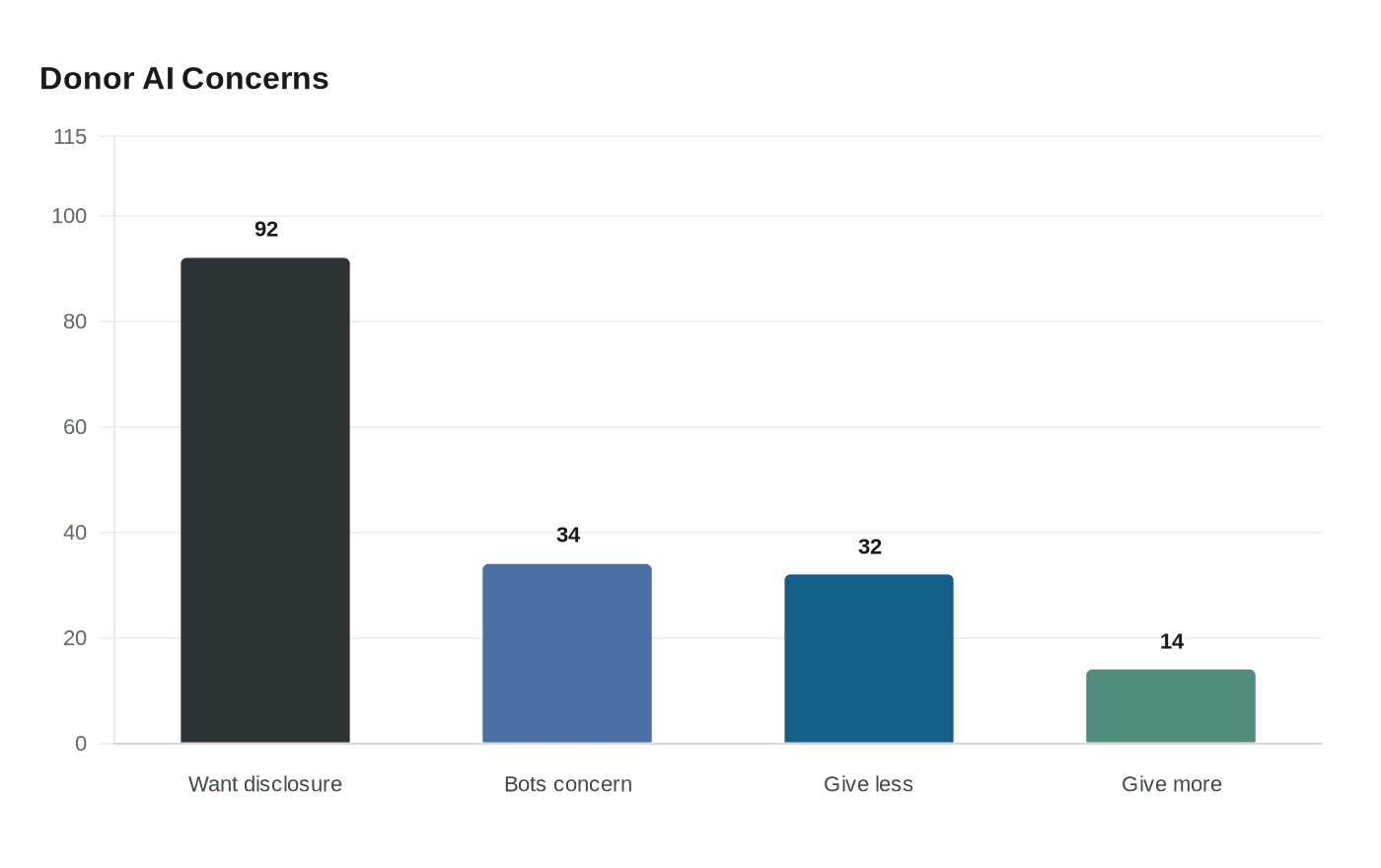
That gap matters because donors are not blind to automation. In a 2024 study led by Cherian Koshy and Nathan Chappell, 82.4% of donors said they were familiar with AI, but they were most comfortable when it stayed behind the scenes, especially for fraud detection and operational efficiency. Transparency was a clear expectation too, with 86.3% saying it mattered. A follow-up 2025 donor survey sharpened the warning: 92% of donors want nonprofits to plainly disclose where and why AI is used, how humans remain in control, and what evidence shows it works. Even more telling, 34% said their biggest concern was AI bots pretending to be humans, while 32% said AI would make them give less and only 14% said it would make them give more.
Where AI can actually save time
For A Simple Gesture, the best AI use cases are the ones that remove friction without touching the relationship. The organization says its web app already handles donor and driver communications, routing, and uses AI to answer most questions, which makes the strongest case for technology working in the background rather than speaking for the organization. That fits the broader nonprofit pattern too: a 2025 benchmark report from TechSoup and Tapp Network found generative AI is the most widely explored AI tool in nonprofits, while predictive analytics adoption remains limited.
That is where the real operational upside sits for a food-recovery network built on recurring behavior. AI can help draft reminder emails, segment households, identify lapsed donors, and time messages so green-bag pickups do not get buried in a crowded inbox. It can also help staff notice which neighborhoods are fading, which volunteer routes need a nudge, and which outreach patterns bring donors back into the rhythm of monthly or every-other-month giving.
A practical AI workflow for A Simple Gesture looks like this:
- Draft a donor reminder, then have a staff member rewrite it with local details and the right tone.
- Use segmentation to separate first-time donors, long-time donors, and households that have gone quiet.
- Use predictive signals to flag routes or areas where pickup participation is slipping.
- Use AI summaries to help staff quickly review donor history before a stewardship call or thank-you note.
- Keep AI focused on logistics, scheduling, and first drafts, where accuracy can be checked before anyone sees the message.
That approach matters because the organization’s model depends on repeat action, not one big campaign. If AI helps a coordinator spend less time on repetitive drafting and more time on route planning, volunteer follow-up, and pantry coordination, it is doing useful work.
Where human review is non-negotiable
The line gets much sharper when the message is about gratitude, stewardship, or community need. A donor thank-you after a food drive is not just another communication task; it is part of the emotional contract that keeps the green bag program working. The same is true when a message references a pantry shortage, a sensitive neighborhood need, or the impact of a particular donation drive, because those moments rely on trust, specificity, and judgment.
That is why AI should not be allowed to flatten the organization’s voice. A Simple Gesture is built on neighbors helping neighbors, and that voice can be damaged quickly if every message starts sounding templated or generic. The safest rule is simple: let AI draft, sort, and summarize, but make a human rewrite anything that thanks a donor, asks for sustained support, or speaks for the community.
The donor research makes that standard even harder to ignore. If 92% of donors want plain disclosure about where AI is used and how humans stay in control, then transparency cannot be an afterthought buried in fine print. It has to be visible in the way the organization communicates, especially when AI touches donor-facing messages. That means no pretending a bot is a staff member, no overclaiming what the tool did, and no sending out gratitude that sounds mass-produced.
Why this matters for a food-recovery network
The stakes are not abstract. USDA says 13.7% of U.S. households, or 18.3 million households, were food insecure at some point in 2024, and 5.4% experienced very low food security. Feeding America says 47.9 million people lived in food-insecure households in 2024. When food insecurity is that widespread, A Simple Gesture’s recurring model becomes more than a convenience, it becomes infrastructure for local giving.
The scale already runs deep. A Simple Gesture says it is a 501(c)(3) nonprofit that provides the software needed to run recurring food drives. Its chapter material says the model began in 2011 in Paradise, California, with Jonathan Trivers, and has since been replicated by more than 70 chapters nationwide, with another description putting the reach at more than 65 communities. The Reston chapter says it serves Northern Virginia on a bi-monthly schedule, and that since inception in June 2015 it had collected 1,327,277 pounds of food as of April 4, 2026, including 24,350 pounds on that date alone.
That is the operational reality behind the AI debate. In a network like this, communication is not just marketing. It is what keeps donors returning, volunteers showing up, drivers staying coordinated, and pantry partners receiving predictable supply. AI can speed the workflow, but it cannot replace the human judgment that keeps the message credible. The organizations that win with AI will not be the ones that sound the most automated. They will be the ones that use technology to protect the trust that makes recurring giving possible.
This article was produced by Prism’s automated news system from verified source data, official records, and press releases, then run through automated quality and moderation checks before publishing. The system is built and supervised by the people who set the standards it runs under. Read our full AI policy.
Did this article answer your question?