Amazon logistics push raises the bar for Big Lots workers
Amazon opened its logistics tools to outside businesses, and Big Lots workers may feel the pressure in faster replenishment, tighter counts and fewer inventory excuses.

Amazon has widened the standard for what fast, reliable retail fulfillment looks like. On May 4, the company launched Amazon Supply Chain Services, opening freight, distribution, fulfillment and parcel-shipping tools to businesses of all sizes, from retail and healthcare to automotive and manufacturing, with early users including Procter & Gamble, 3M, Lands’ End and American Eagle Outfitters.
For Big Lots workers, the immediate change is not who runs the store. It is the benchmark that now sits behind the customer’s expectation. If more brands and merchants lean on Amazon’s logistics network, shoppers will be less forgiving about empty shelves, vague delivery promises and slow replenishment. That puts more pressure on store teams to receive product accurately, keep cycle counts clean and move freight onto the floor faster, especially in a chain where in-stock performance is closely tied to value and trust.
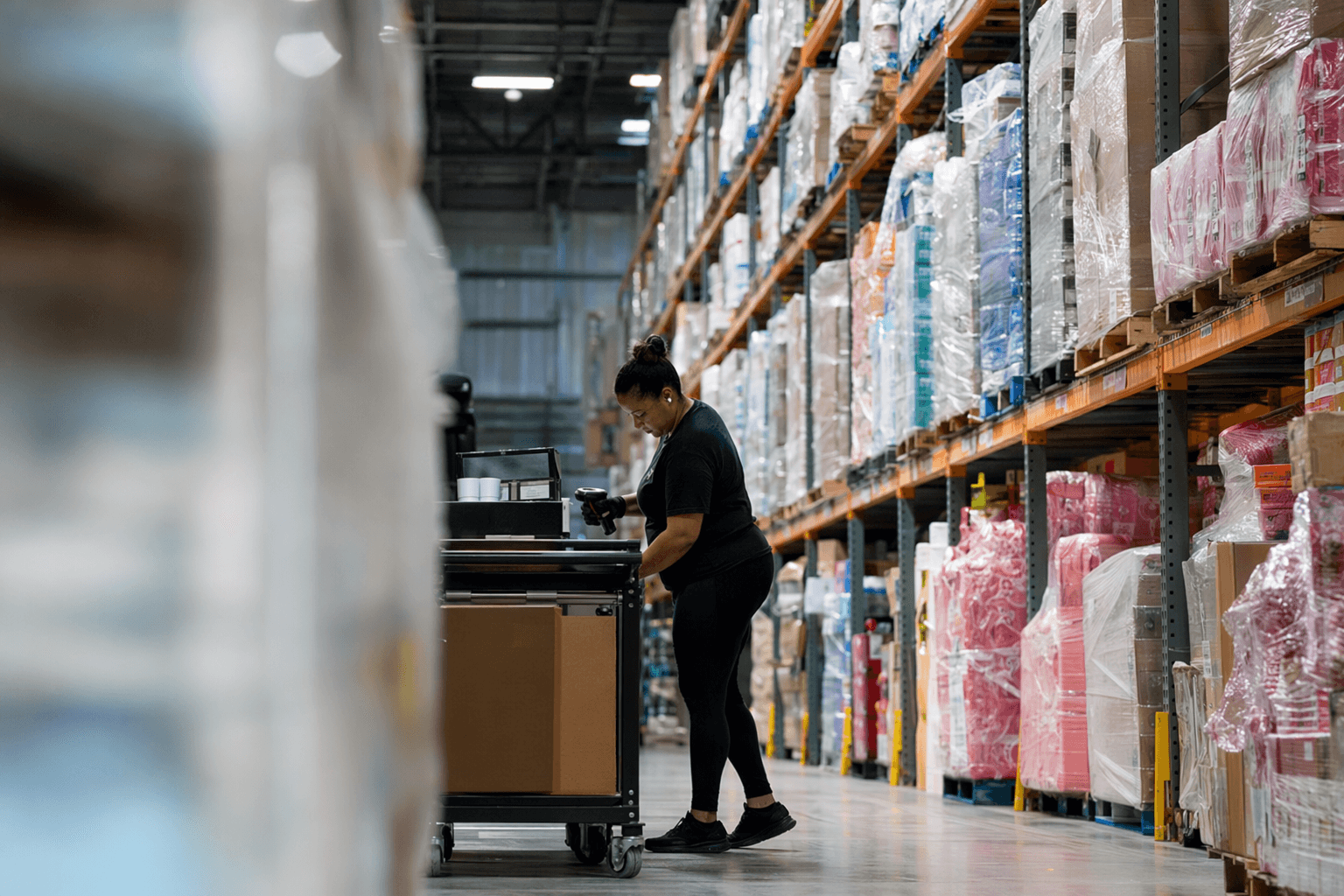
Amazon framed the launch as a broad expansion of the logistics infrastructure it built for its own retail business, with Amazon Supply Chain Services now available to outside companies rather than only Amazon sellers. The company said the service extends the same supply-chain capabilities that supported Amazon.com for years, and it put the move in the same category of scale as its cloud business. Peter Larsen, Amazon’s vice president of Amazon Supply Chain Services, is leading the push.
Big Lots has already lived through what happens when supply-chain execution stops keeping up. The company reported a net loss of $205 million for the quarter ended May 4, 2024, then filed for Chapter 11 bankruptcy protection on September 9, 2024. As of February 3, 2024, Big Lots had 1,392 stores. By 2022, the chain had accelerated the closure of all four of its forward distribution centers, a sign that distribution costs and network efficiency were already under strain before the bankruptcy process deepened.
The restructuring that followed included store closures and a rescue deal involving Gordon Brothers Retail Partners and Variety Wholesalers. Variety Wholesalers said it may employ Big Lots associates at acquired stores and distribution centers, underscoring how closely logistics decisions and workforce outcomes are tied together at the company. By 2025, Big Lots’ store locator showed 219 locations, a much smaller footprint than the chain carried before its collapse.
That is the backdrop for Amazon’s latest move. The bigger logistics players are not just shipping products faster; they are resetting what retailers are expected to deliver. For Big Lots, that means inventory discipline, speed at the dock and precision in the back room matter more than ever.
This article was produced by Prism’s automated news system from verified source data, official records, and press releases, then run through automated quality and moderation checks before publishing. The system is built and supervised by the people who set the standards it runs under. Read our full AI policy.
Did this article answer your question?