Updated retail competency model maps skills for Big Lots workers
Big Lots’ upheaval shows why retail skills need a map. The updated competency model turns floor work into a clearer path for promotion, cross-training, and reinvention.

A model built for a moving target
Retail jobs are getting harder to describe in old language. The updated retail competency model from CareerOneStop is built to do the opposite: it breaks the work into practical skills employers keep expecting as stores, technology, and customer demands shift. CareerOneStop says the framework was developed by the Employment and Training Administration with industry leaders, and that the NRF Foundation has committed to helping keep it current.
That matters because the model is not frozen in time. CareerOneStop says competency models are updated on a rolling basis, and the retail model’s foundational tiers were refreshed in 2025 to align with changes in the Building Blocks Model. In plain terms, the lower levels of the framework were adjusted to reflect how retail work actually looks now, not how it looked a decade ago.
For workers, that makes the model useful as a decoder ring. It turns vague workplace language into something concrete, whether the conversation is about customer service, product knowledge, digital tools, problem-solving, or work habits. For managers, it gives a common language for training, coaching, and promotion decisions instead of relying on instinct alone.
Why Big Lots is a sharp example
Big Lots is a useful place to see why this kind of framework matters. Former BL Stores, Inc., formerly Big Lots, Inc., and its subsidiaries filed voluntary Chapter 11 proceedings on September 9, 2024, then moved through a store-closure and liquidation process. Later, 219 stores were acquired by Variety Wholesalers, which began reopening Big Lots locations in 2025.
The company’s own store locator currently shows 219 locations, and its website says the chain sells furniture, home décor, groceries, apparel, and more. That assortment tells you a lot about the work on the ground. A Big Lots associate is not just a cashier or stocker; the job can involve household goods, food, apparel, promotions, and fast-moving customer questions all in the same shift.
That is exactly the kind of environment where competency models become more than HR paperwork. When a retailer goes through bankruptcy, a liquidation, a sale, and a reset in store format, the job itself changes quickly. Workers who can identify what skills they already have, and what they need next, are in a much better position to move with the company instead of being blindsided by it.
What the model really means on the sales floor
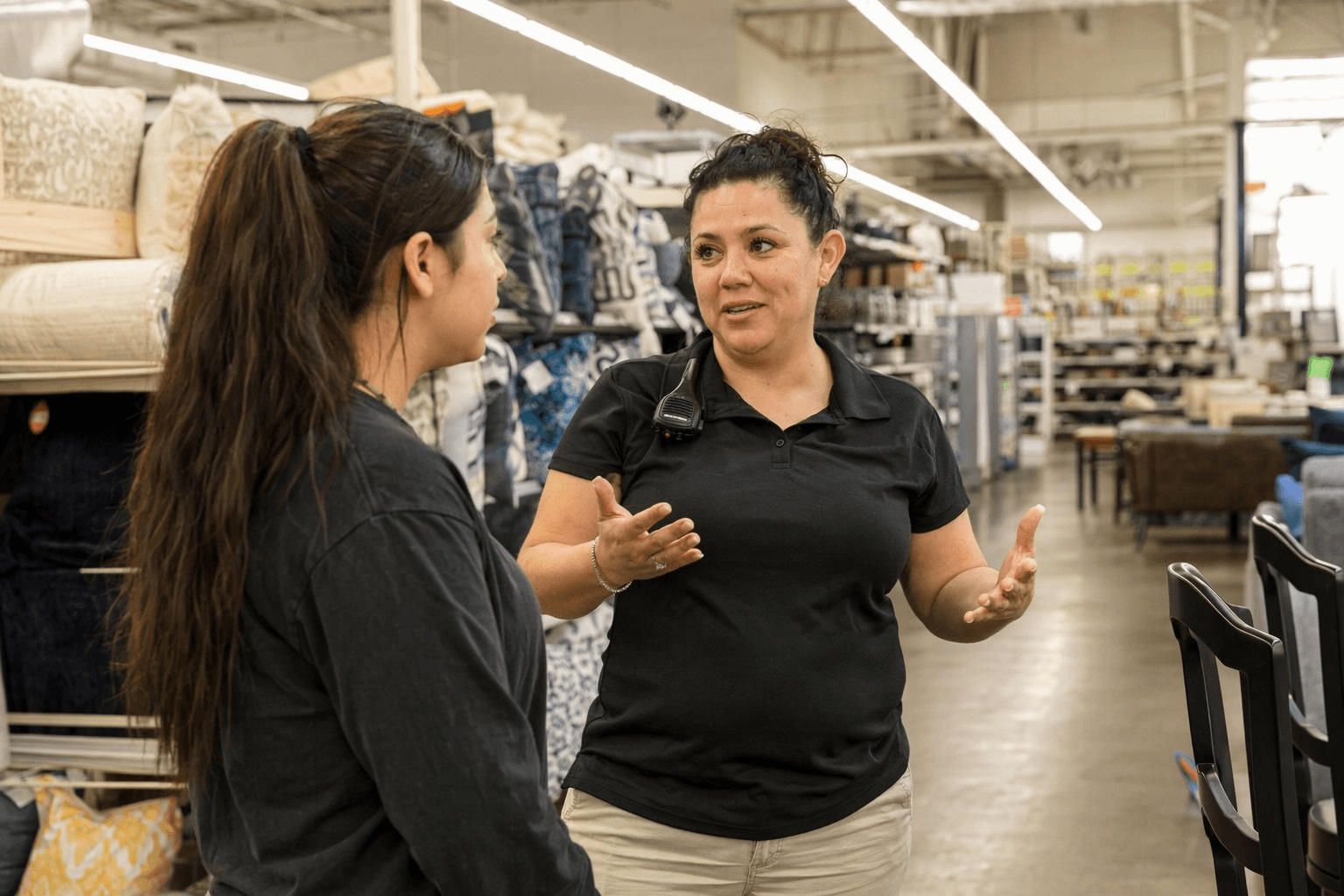
The model’s value comes from translating abstract skills into the work that happens every day at store level. Customer service is not just being polite at checkout. It means calming an unhappy shopper, explaining a return policy without escalating the moment, and spotting when a customer needs help before the interaction turns into a complaint.
Product knowledge is not trivia. At Big Lots, where the assortment runs from furniture to groceries, it means knowing enough to steer a customer toward the right item, explain features clearly, and recognize when an out-of-stock item could be substituted with something comparable. Digital tools are not a side note either. They include checking inventory, looking up product information, using handheld systems correctly, and keeping information accurate so the next associate is not working blind.
Problem-solving shows up in the messy middle of the day: handling freight when the backroom is jammed, resetting a messy aisle after a rush, coordinating with a supervisor about staffing, or deciding which task to finish first when the store is short-handed. Work habits matter too, because retailers notice who shows up ready to receive trucks, keep the floor clear, follow through on recovery, and communicate before a problem becomes a missed sale.
A few examples make the model easier to read:
- De-escalating a frustrated customer is customer service, conflict management, and judgment.
- Receiving freight and putting product out correctly is operations discipline, not just lifting boxes.
- Reading sales cues on the floor is a sign of product awareness and selling skill.
- Coordinating with supervisors during a rush shows communication, reliability, and teamwork.
That is the core shift: the model helps workers see that a strong retail career is built from capabilities, not just task completion.
How workers and supervisors can use it
For job seekers, the competency model is a roadmap. It helps show which skills are portable across stores, which skills are tied to a specific role, and what to learn if the goal is a bigger job later. A cashier who can handle returns, calm a complaint, and use digital tools can point to a stronger profile than a résumé that only lists one title.
For current Big Lots employees, the model can sharpen the case for promotion, cross-training, or a move into support-center work. If a store associate already understands customer issues, stock flow, and digital systems, that experience can translate into supervisory work, merchandising support, or other roles that depend on similar judgment. It also gives workers a language to use in performance reviews that goes beyond vague praise or criticism.
Supervisors can use the same framework to spot training gaps across a team. If one employee is solid on freight but weak on customer recovery, the gap is visible. If another is good on the floor but struggles with digital tools, the model helps make that a training issue rather than a personality judgment.
The industry is moving the same way
The retail sector is not treating this as a niche exercise. The National Retail Federation said NRF 2025: Retail’s Big Show drew 40,000 attendees from 100 countries and 6,000 brands, a reminder of how large and interconnected the industry has become. In February 2026, the NRF Foundation and the PepsiCo Foundation launched the NRF Foundation Retail Training Initiative to expand access to retail skills training and credentials.
That push matters because retail employers are increasingly trying to define, teach, and credential the work they expect. The message underneath the competency model is clear: retail is not just a set of shifts and tasks. It is a skill system with entry points, skill ladders, and move-up opportunities, even in a company as unsettled as Big Lots.
For Big Lots workers, that is the practical takeaway. The stores may change hands, reopen, close, or reconfigure, but the skills that count are becoming easier to name. The workers who can read that language will be the ones best positioned to move with the next version of the business.
Know something we missed? Have a correction or additional information?
Submit a Tip