Chipotle crew jobs promise cross-training, benefits and a path to management
Chipotle’s crew pitch is really a ladder: learn every station, prove you can keep pace, and the company says you can climb from crew to management in as little as 18 months.
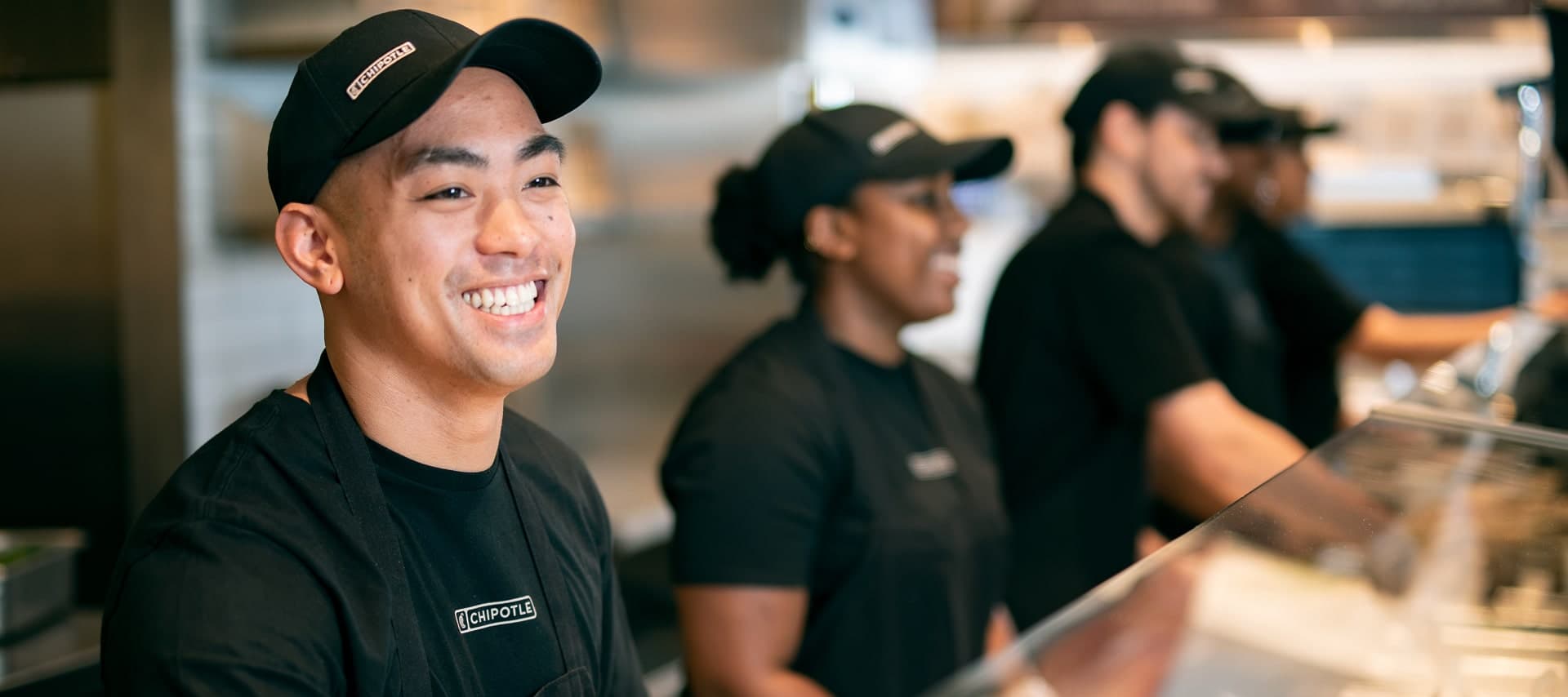
Chipotle’s crew posting is less a promise of an easy first job than a test of whether you can keep up with a restaurant built around rotation, speed, and consistency. The company says crew members are trained across grill, cashier, prep, salsa, and expo, and it pairs that with a blunt career claim: more than 80% of its managers are promoted from crew. For workers, that means the entry-level job is being sold as the front door to something bigger, not just a place to punch in and out.
What the crew job actually demands
Read the posting closely and the day-to-day picture is clear. Chipotle says it prepares real food by hand, with no freezers or can openers, and it expects crew to create the friendly atmosphere customers expect while working confidently at any station. The traits it names are not accidental either: team player, personable, responsible, communicator, ambitious, and enthusiastic. That is the real standard here, because the company is looking for people who can move from one task to the next without losing pace or service quality.
That matters because cross-training is not just a convenience for the schedule. In a Chipotle restaurant, knowing more than one station is part of the job design, and the company presents that flexibility as a skill set that feeds advancement. If you are hired into crew, you are being pulled into a system that values reliability on the line, customer interaction at the counter, and the ability to absorb new responsibilities without waiting for a separate role to teach them.
Why the career-path claim is credible, and why it is also self-serving
Chipotle’s leadership pitch has been consistent for years. Its in-restaurant careers page says the path to leadership can take as little as 18 months, and it names Cultivate U as one of the programs that prepares employees to lead a team. That same page says 90% of restaurant management roles were internal promotions and lays out a visible ladder that runs from Crew to Kitchen Leader, Service Leader, Apprentice, General Manager, and Restaurateur. The company’s own total-rewards illustrations put those stages at $45,900 for Crew, $73,100 for Apprentice, and $116,100 for Restaurateur, with actual compensation varying by performance and other factors.
The company is also trying to prove that the pipeline is not just marketing copy. In its 2024 annual report, Chipotle said it conducted an Employee Value Proposition survey to learn what employees value, what needs improvement, and what drives value at the company. It also said its learning programs are meant to help leaders succeed in their current roles and prepare for future roles. That is a useful clue for workers: the company is not only recruiting for today’s shift, it is measuring whether its internal ladder can hold enough people to support future openings.
Scale gives that pitch more weight. Chipotle said it had more than 130,000 employees in 2024, and it opened 304 company-owned restaurants that year, including 257 Chipotlanes. A filing also said that in 2023 about 50% of promoted employees identified as female and 39% identified as Hispanic or Latino. For a restaurant chain expanding that quickly, internal promotion is not just a feel-good talking point. It is a staffing strategy with demographic consequences and operational stakes.

The benefits package is part of the job offer
Chipotle does not leave the compensation pitch at wages and a uniform. The careers site says crew get medical, dental, and health insurance, plus up to $5,250 a year in tuition assistance. Its benefits page says crew across its 3,200-plus restaurants get whole wellness benefits, bonuses, and educational assistance, along with a free meal for every daily shift. The company defines that meal as one entrée, one drink, and one side.
The education message has been central for years. In 2019, Chipotle said eligible employees, including crew members, could pursue a debt-free college degree through an expanded Cultivate Education program, and that it had already provided over $20 million in tuition assistance over the prior two years. In 2021, it said the tuition reimbursement benefit could cover up to $5,250 per year and that employees, after 120 days, could access nearly 100 degree options at ten universities through its partnership with Guild Education. That makes the company’s schooling pitch unusually concrete for an hourly restaurant job: the promise is not just reimbursement, but a defined path into credentials the company says are tied to future advancement.
Chipotle has also tied entry-level work to bonuses. It launched a quarterly crew bonus program in 2019 that could be worth up to one week’s pay, and later said its all-crew bonus program could allow restaurant employees to earn up to an extra month’s worth of pay each year. In 2024, the company added financial-wellness and mental-health benefits, including a Student Loan Retirement Match, a credit-building banking product, SoFi financial tools, and SupportLinc counseling resources powered by CuraLinc Healthcare. More than 73% of Chipotle’s restaurant employees are Gen Z, which helps explain why the company keeps bundling education, money management, and mental health into the same recruiting message.
What to make of the promise
The uncomfortable truth is that Chipotle’s career-path story is doing two jobs at once. It is a genuine internal mobility system, and it is also a retention tool for a company that has struggled with hourly turnover. QSR Magazine reported that hourly turnover improved to 145% in 2023, still an extremely high number even after the improvement. In that context, the company’s message to crew is not subtle: learn the stations, stay reliable, take the training, and the ladder is supposed to be there.
That is why the crew posting deserves to be read as both opportunity and warning. If you want a first job that teaches food prep, customer service, pace, and station discipline, Chipotle is telling you it will invest in that. If you want work that stays in one lane, this is not that kind of restaurant. The company’s own paperwork says the real value of crew is not just filling a shift, but supplying the next apprentice, the next general manager, and eventually the next restaurateur.
This article was produced by Prism’s automated news system from verified source data, official records, and press releases, then run through automated quality and moderation checks before publishing. The system is built and supervised by the people who set the standards it runs under. Read our full AI policy.
Did this article answer your question?