Chipotle job portal maps career paths across the company
Chipotle’s job board is more than a hiring page. It shows crew members where the next step lives, from restaurant leadership to corporate and support-center work.
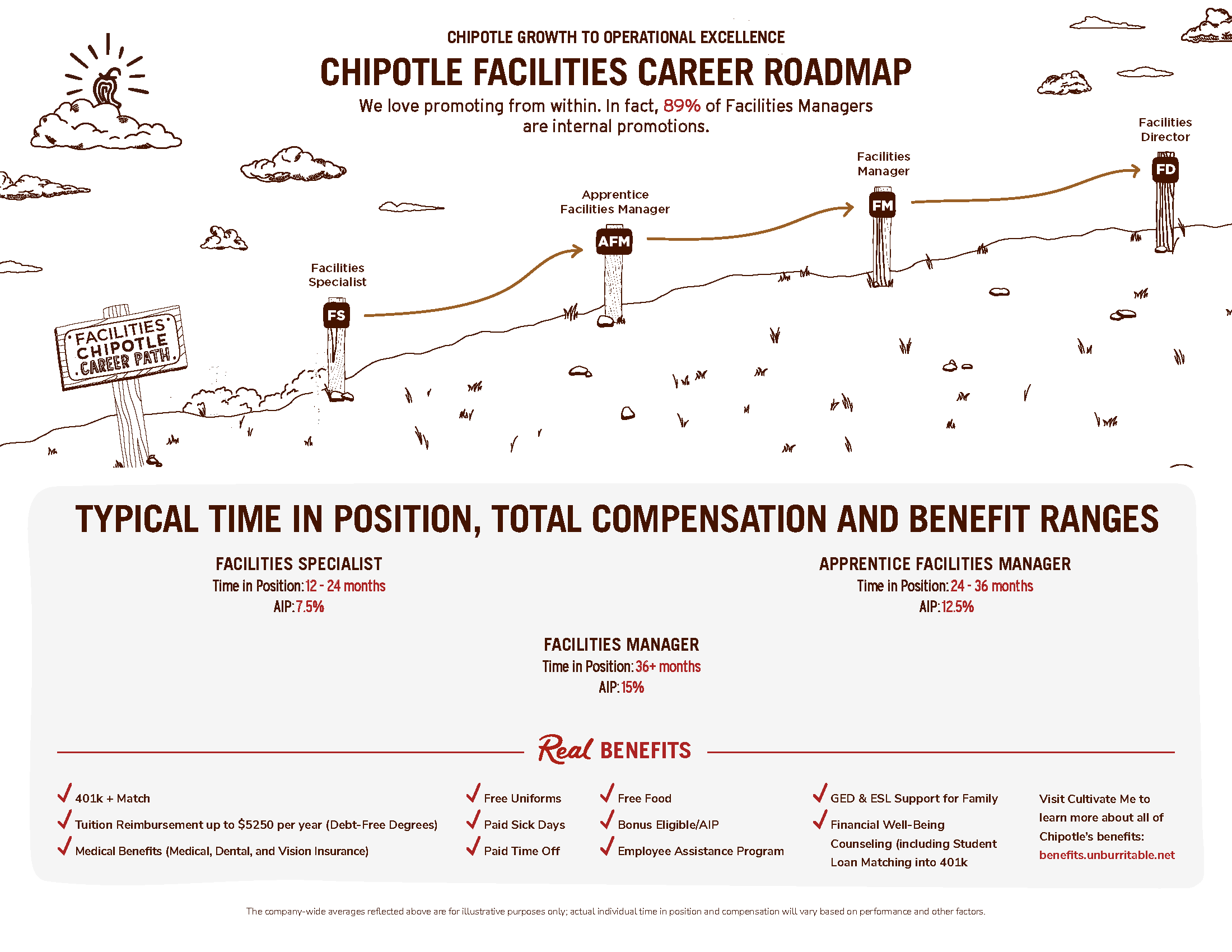
Chipotle’s job board is not just a list of openings. It is a live map of how the company grows people from crew to management, corporate support, and facilities work. For anyone trying to move up without leaving Chipotle, that matters because the portal makes the ladder visible instead of hidden behind a manager conversation or an internal rumor.
A careers page that reveals the company’s structure
Chipotle’s careers homepage describes the company as a “food-focused, people-first” employer that invests in employees with opportunities for career growth. That line is more than branding when you look at how the site is organized: opportunities are split into restaurant crew, restaurant management, corporate/support center, and facilities/support center roles. In other words, the page shows that a Chipotle career is not one track, but several paths that can branch in different directions.

That structure is useful for crew members, kitchen leaders, service leaders, apprentices, and general managers who want a different shift pattern, a different market, or a path into office work later on. It also helps workers see that Chipotle’s labor market is broad enough to include restaurant jobs, corporate jobs, facilities roles, internships, and specialty openings. If you are planning to stay with the company, the portal gives you something many employees never get from a busy restaurant floor: a way to compare your next move against other openings instead of waiting for the next opportunity to land in your lap.
How to read the portal like a promotion map
The practical value of the site is not only that it lists openings, but that it lets you study how Chipotle describes different levels of work. The current job board showed 7,562 open jobs, while the corporate jobs page showed 51 open corporate roles spanning accounting and finance, corporate affairs and food safety, facilities, human resources, information technology, marketing, operations services, and supply chain. That spread tells you the company is hiring across the whole business, not just for the front line.
For workers inside the system, the smart move is to compare the language across crew, leader, and management postings. The differences often reveal what Chipotle values when it decides who is ready for the next step. Job alerts and location filters make that even more useful: you can watch a market you care about, see whether a city is filling up with openings, and track which job families appear most often. If you want to understand where the company is opening the most doors, the portal shows you in real time.
A simple way to use it strategically:
- Set alerts for the job family you want next, not just the job you already have.
- Compare the qualifications in crew, management, and corporate postings side by side.
- Watch location filters to see which markets are adding leadership roles.
- Treat repeated skills or phrases in listings as clues about promotion criteria.
- Look for openings that connect restaurant experience to support-center work.
The numbers point to a company built around internal mobility
Chipotle says internal advancement is central to how it fills jobs. The restaurant careers page says 90% of restaurant management roles were internal promotions. The company has also said it had about 22,000 internal promotions in 2022, and later said it was on track to surpass that number in 2023. In another update, Chipotle said it had 24,000 internal promotions in the prior year, including 90% of restaurant management roles and 87% of field leader positions.
More recent reporting pushed the picture further. Chipotle promoted 23,000 employees in 2024, and 85% of restaurant-management roles were filled internally. That kind of turnover is not just a feel-good metric. It means the job portal is acting like a window into the internal labor market, showing workers where promotions actually come from and where the company is likely to keep investing.
The scale matters too. Chipotle said five of its 11 regional vice presidents started as hourly employees, and those leaders now oversee regions generating more than $1 billion in annual sales. Reporting also said field leaders manage an average of eight restaurants with combined annual revenue of about $24 million. For someone on the line or in a dining room, that tells a clear story: the jump from restaurant work to regional responsibility is real, and the company likes to promote people who already understand how the stores run.
Why expansion creates opportunity
Chipotle’s promotion engine is tied to growth. In 2023, the company said it planned to open 255 to 285 new restaurants that year, which created more openings for hourly managers, general managers, and field leadership roles. When a chain expands that quickly, the internal ladder usually gets more visible because new stores need people who can run them, train them, and eventually supervise them.
That is where the job board becomes more than a recruiting tool. A fast-growing chain has to staff new restaurants, backfill leaders, and build support capacity at the same time. For workers, that means the portal can help you spot not only open jobs, but pressure points in the business. If a market is adding stores, leadership posts often follow. If corporate support roles are opening in a cluster, that can signal a broader push in operations, food safety, technology, or supply chain.
What this means for people already inside Chipotle
If you work at Chipotle, the smartest reading of the portal is not “Which job looks appealing?” It is “What path does this opening suggest?” A crew posting can show you the baseline skills the company expects. A leader post can show you what starts to matter once you are responsible for people, pace, and execution. A management or corporate posting can show you which capabilities transfer beyond the restaurant, whether that is scheduling, food safety, supply chain, or operations.
That is why the portal matters so much for internal mobility. It turns each listing into a clue about the next rung, the next market, or the next department. For a company that publicly measures advancement and promotes it as part of its business model, the board is not simply where Chipotle hires from the outside. It is where workers can read the company’s priorities, anticipate its next moves, and decide whether their own next move stays on the floor, moves into leadership, or heads toward the support center.
This article was produced by Prism’s automated news system from verified source data, official records, and press releases, then run through automated quality and moderation checks before publishing. The system is built and supervised by the people who set the standards it runs under. Read our full AI policy.
Did this article answer your question?