Chipotle says general managers can rise through ranks in 18 months
Chipotle's GM track can move fast, but the job is really about turning crew into leaders while keeping the restaurant accountable.
Chipotle's General Manager pitch is not a desk job in disguise. It is a test of whether you can run a restaurant, hire and coach the next layer of leaders, and still keep the line moving when the rush hits. The company says the path to leadership can take as little as 18 months, and the GM posting frames the role as leading from the front, building culture, and running a strong business.
What business ownership means here
At Chipotle, “business ownership” does not mean equity at the store level. It means carrying the daily load of labor, food quality, hospitality, and culture, while making sure the operation stays steady enough to serve guests and develop the team at the same time. The company’s GM listing calls for entrepreneurial, goal-oriented, proactive problem-solvers who can lead and listen, which is a clear signal that this role is supposed to do more than supervise a shift.
That is why the role sits at the center of retention. A GM who has worked the stations can coach with credibility, spot weak spots faster, and build trust with crew members who know the difference between management theory and a slammed line. Chipotle also says its managers are largely pulled from within, with 80% of leaders starting as crew members, which tells workers that the company values operational fluency as much as title progression.
The ladder underneath the title
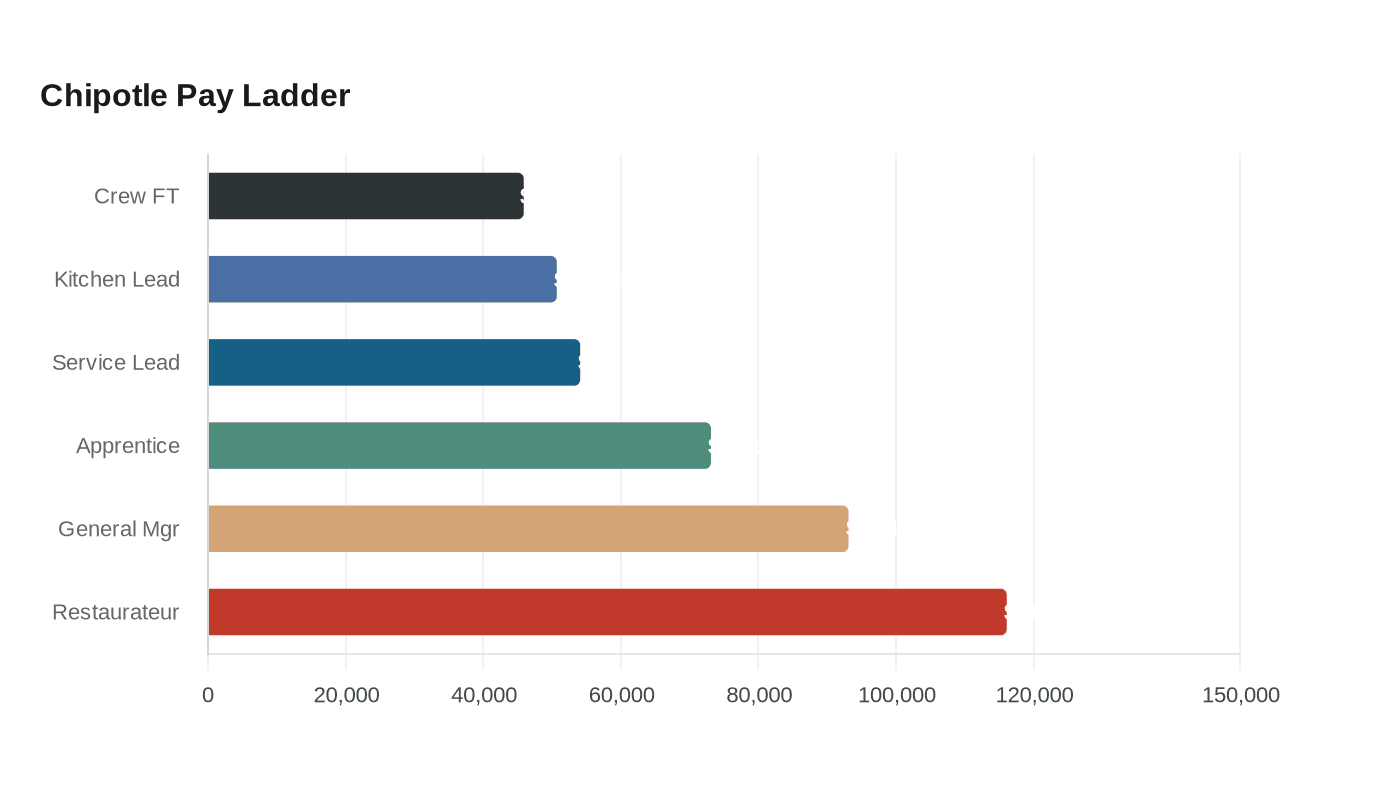
The career path Chipotle shows is unusually explicit: Crew Full Time, Kitchen Leader, Service Leader, Apprentice, General Manager, then Restaurateur. That ladder matters because it maps how the company thinks leadership is earned, not simply granted by tenure. It also shows that the restaurant itself is the training ground, where line-level execution is supposed to feed into management judgment.
The sample total-rewards figures on that page sharpen the point. Chipotle lists Crew Full Time at $45,900, Kitchen Leader at $50,700, Service Leader at $54,100, Apprentice at $73,100, General Manager at $93,100, and Restaurateur at $116,100, with the last level including base pay, bonus, and equity benefits. The company says those values reflect average compensation data as of April 2024 and that actual pay varies by performance and other factors, so the bigger message is not the exact number but the shape of the ladder: each step is meant to carry more authority, more responsibility, and more upside.
Chipotle says 90% of restaurant management roles came from internal promotions, and that is the strongest clue to how the model works in practice. A company that promotes this heavily from inside is betting that retention improves when workers can see a path from the line to the top of the restaurant, not just a job to survive until something better comes along.
What the pay postings show about location and role
The current job board makes clear that compensation shifts by city and by step in the pipeline. In Irondequoit, New York, a posted GM range is $55,000 to $77,500. In Bowie, Maryland, the range is $61,000 to $85,000. In Brooklyn, New York, it rises to $63,000 to $88,500. That spread is a reminder that Chipotle is not using one national number to define the role, and that market differences still matter even when the company talks about a standardized culture.
The company’s apprentice postings show the same idea in hourly form. One Apprentice General Manager listing in Lakeville, Minnesota posts a base range of $19.25 to $21.43 an hour, while a Goleta, California posting shows $23.95 to $26.39 an hour. For workers moving up through the kitchen and service tracks, those posted ranges matter because they show where the floor is in each market and how sharply pay can change once a role shifts from hourly leadership to salaried management.
Training is the bridge between culture and accountability
Chipotle has spent years tying training to growth, and it now says crew members learn skills to grow as people and leaders from day one. The company also says training investment can accelerate careers and improve business outcomes, and Scott Boatwright put that belief bluntly: “Investing in your people is probably one of the smartest decisions you’ll ever make as a leader.” That matters because the GM role only works if the company actually builds the bench beneath it.
The company backed that message publicly in April 2022, when it said increased wages, training, and development were part of support for future growth plans. It followed that with physical infrastructure: in June 2025, Chipotle opened The Pepper Training Center inside its Columbus Restaurant Support Center. The center sits in the 130,000-square-foot office completed in 2022 and the support center houses about 475 employees across finance, guest and employee relations, development, food safety, legal, people experience, technology, facilities, and operations.
That setup helps explain why Eddie Ceballo, a New York City Field Leader, has become part of Chipotle’s own training narrative through JUST Capital. The company uses his story alongside Boatwright’s to argue that internal development is not just a slogan but a management system, one that connects field experience, leadership programs, and the next rung up the ladder.
Why the GM role matters now
The role is central because Chipotle is still scaling. Its jobs site currently shows 77 General Manager listings and 3,662 restaurant-management openings, which is a sign that the company is not treating leadership as a static layer but as a live hiring engine across the system. The broader jobs board also shows thousands of open roles overall, and the company says it is opening a restaurant almost every day.
That growth is visible in the numbers too. Chipotle reported first-quarter 2026 revenue of $3.1 billion, up 7.4% from a year earlier, with comparable restaurant sales up 0.5%. In a company still expanding at that pace, the GM pipeline is not a side story. It is the mechanism that decides whether new restaurants, new leaders, and the company’s “food-focused, people-first” pitch hold up when they meet the pace of the line.
This article was produced by Prism’s automated news system from verified source data, official records, and press releases, then run through automated quality and moderation checks before publishing. The system is built and supervised by the people who set the standards it runs under. Read our full AI policy.
Did this article answer your question?