Chipotle tests new menu and family meals to boost group dining
Chipotle’s tests in menu mix, happy hour, family meals and remodels could make shifts busier before they prove they can lift sales.
Chipotle is quietly stacking one operational test on top of another, and that matters far more for the crew running the line than for the people seeing a new item on the menu board. A Simply Wall St analysis argues the company is not just swapping promotions, but rewiring how it courts group dining, and the latest sales data show why management is leaning into that playbook: traffic softened in 2025, then turned positive again in early 2026.
Why the latest tests matter on the line
The big picture is simple: Chipotle wants more transactions, more speed and more accuracy, and it is willing to keep experimenting across menu, format and off-premise channels to get there. The company said its 2026 “Recipe for Growth” strategy is aimed at rebuilding momentum after full-year 2025 same-restaurant sales fell 1.7% and fourth-quarter comparable restaurant sales dropped 2.5%. Then first quarter 2026 brought a modest reversal, with comparable restaurant sales up 0.5%, driven by 0.6% higher transactions, and revenue up 7.4% to $3.1 billion.
For hourly workers and managers, that mix of results is important because it explains why the company is testing so many levers at once. When sales are under pressure, leadership does not just look for one more ad campaign or one more limited-time offer. It looks for anything that can change the daypart mix, raise the average ticket or pull more groups into the system, and that usually means more prep complexity, more moving parts and more training.
Menu innovation is no longer a side project
Chipotle has been pushing menu changes faster, and that cadence matters on the back line as much as it matters in the marketing calendar. The company said it is increasing its limited-time-offer schedule to four items a year, and Chipotle Honey Chicken is the clearest example of what that means in practice. It was the brand’s best-selling limited-time offering after debuting in 2025, then returned April 28, 2026 across the U.S., Canada, the U.K., France and Germany.
That kind of launch is not just a new protein in the pan. It changes prep flow, ordering habits and how often crew members have to learn a new build, explain a new flavor and keep the line moving while demand spikes. Chipotle also tied Honey Chicken to the High Protein Cup for the first time, which adds another way to package demand around a familiar protein, not just a standard burrito or bowl.
The company’s earlier 2026 menu moves, including the return of Chicken al Pastor and the launch of Cilantro Lime Sauce, point in the same direction: more frequent changes, shorter learning cycles and more pressure on teams to execute without slowing down. That may help Chipotle keep the brand fresh, but it also means the shift can feel less predictable for the people making and assembling the food.
Group dining is the real target behind the tests
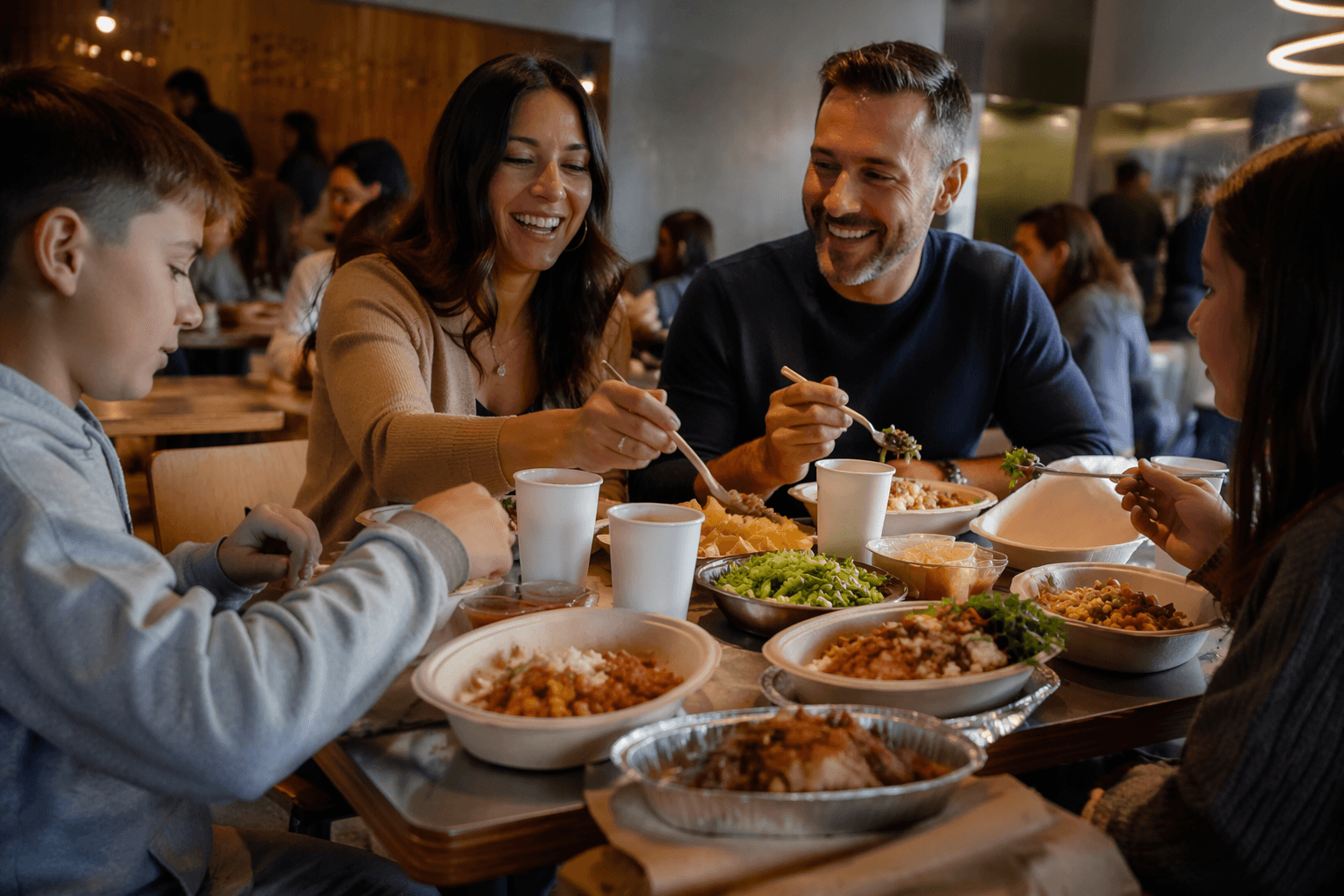
The most revealing part of the story is not the protein launch. It is how Chipotle is trying to win larger occasions. The company’s Build-Your-Own Chipotle format is designed for groups of 4 to 6 people, can be ready in as little as 15 minutes for pickup and is positioned as costing less than $10 per person. Traditional Chipotle catering, by contrast, is for larger groups and requires 24 hours’ advance notice.
That gap tells you where the company sees opportunity. Family meals, fast group orders and larger catering baskets sit between everyday individual orders and formal catering, and they can bring in bigger checks without waiting for a full event order. Simply Wall St noted that a rebranded family meals offer lifted sales in trial markets, which suggests Chipotle may have found a format that works better for households and small groups than the chain’s standard single-entrée flow.
For restaurant teams, those orders are different work. They can mean larger assembly batches, more precise packing, more check-ins on timing and more pressure on the digital make-up station. If the company keeps pushing into this space, managers will need to forecast not just how many orders they will get, but what kind of orders they will get and when.
Happy hour is a test of daypart pressure, not just price
Chipotle’s “Power Up at Chipotle” test makes the operational point even clearer. The promotion ran from 2 p.m. to 5 p.m. Monday through Friday in Kansas City, Orlando and Tampa, and it offered $2.50 soft or crispy tacos with any protein, including Chipotle Honey Chicken. The company said the goal was to understand its “pricing power elasticity” and attract snack-daypart traffic.
That matters because happy hour is not a small promotional tweak. It compresses demand into a narrow window that can collide with prep, lulls, cleaning tasks and the late-afternoon handoff into dinner. If it works, it can fill a slow part of the day and produce incremental sales. If it overwhelms the line or trains guests to wait for discounts, it can create a different kind of headache for the people managing labor and throughput.
In other words, this is a test of whether Chipotle can own a new daypart without turning a quiet stretch into a scramble. That is the real question behind the promo: not whether a $2.50 taco gets attention, but whether the traffic it creates is profitable enough to justify the extra complexity.
Remodels and digital scale could reshape the restaurant itself
The remodel piece is the most sweeping, because Chipotle said it has not had a remodel program in more than 30 years. That makes any package test look less like a cosmetic refresh and more like a possible reset of how the restaurant functions, from guest flow to pickup handoff to line configuration.
The timing is not accidental. Digital sales represented 38.6% of total food and beverage revenue in the first quarter of 2026, and Chipotle opened 49 company-owned restaurants in that quarter, including 42 Chipotlanes. For full-year 2025, it opened 334 company-owned restaurants, including 257 Chipotlanes, and the company says it is now more than halfway to its long-term goal of 7,000 restaurants in the U.S. and Canada.
That scale means even a small operational change can spread fast. A better pickup lane, a more efficient remodel package or a cleaner group-order workflow can be copied across a huge footprint. So can the pain if the change adds steps without adding speed. That is why these tests matter to crew members and managers now, before they become standard.
Chipotle’s recent results suggest the strategy is starting to steady the business, but the real workplace question is whether all this innovation translates into stronger sales without making every shift more complicated. For the people on the line, the answer will show up in prep lists, ticket flow and the amount of coaching it takes to keep the restaurant moving when menu, layout and daypart experiments all arrive at once.
This article was produced by Prism’s automated news system from verified source data, official records, and press releases, then run through automated quality and moderation checks before publishing. The system is built and supervised by the people who set the standards it runs under. Read our full AI policy.
Did this article answer your question?