Costco sales metrics show traffic, ticket pressures before they hit stores
Costco’s sales reports are an early-warning system for the floor. Traffic, ticket, and digital growth reveal where the next rush will land.

Costco’s sales releases do more than tell Wall Street whether the quarter was strong. They give warehouse crews a preview of where the pressure will land first, whether that means more shoppers at the front end, more cases moving through receiving, or more online orders turning into staging and service work. Costco’s investor pages group earnings releases and sales results by date, which makes the pattern easy to track. For a company built on high volume, higher wages, and a promise of solid benefits, the numbers are not abstract. They are the first sign of how hard the floor is about to work.
Start with the headline comp, then ask what is driving it
Costco’s Q3 fiscal 2026 results showed net sales rising 11.6 percent to $69.15 billion and net income climbing to $2.19 billion, or $4.93 per diluted share. The most useful operating clue was not just the top line, but the sales mix underneath it: total-company comparable sales rose 9.8 percent, adjusted comparable sales rose 6.6 percent, digitally-enabled comparable sales rose 21.5 percent, and adjusted digitally-enabled sales rose 20.8 percent. Those are the numbers that tell you whether the company is getting more traffic, bigger baskets, or both.
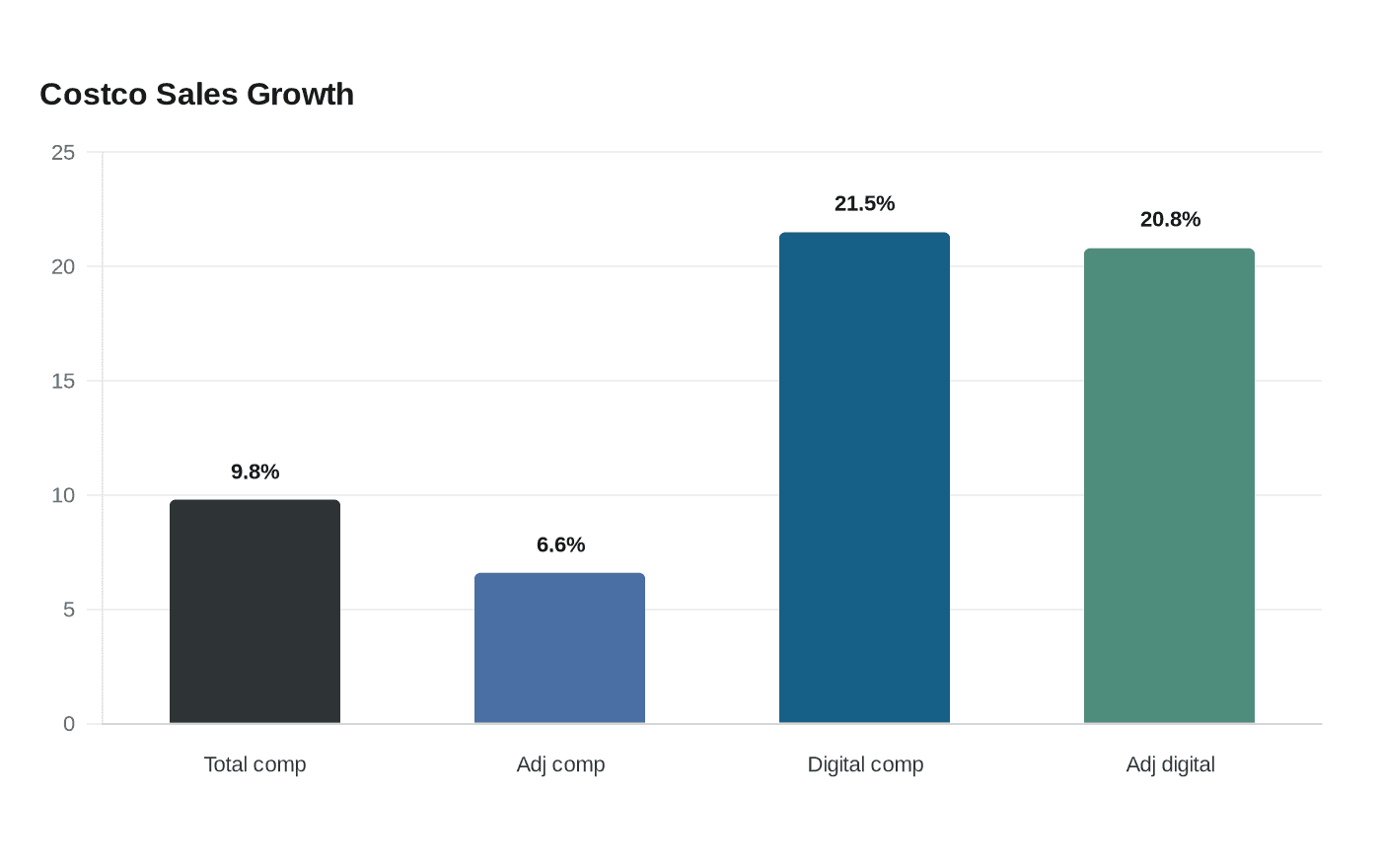
For workers, that distinction matters. If traffic grows faster than average ticket, you are probably looking at more individual transactions, more members in the building, and more pressure at registers and exits. If ticket is climbing with steadier traffic, the day may be less about a flood of people and more about heavier baskets, bulkier items, and more time spent moving high-volume categories. Either way, a strong comp usually means more movement through the warehouse, not less.
Traffic, ticket, and category strength show up in different parts of the building
The simplest translation is this: traffic is member volume, ticket is basket size, and category strength is where the sales are concentrated. A hot comp can show up as front-end strain first, but it can also hit departments unevenly. Meat, bakery, optical, seasonal, and other high-demand areas can feel the change before it shows up in the overall weekly schedule, especially when members are buying more per trip.
That is why sales talk can sound so repetitive in a Costco warehouse. Managers keep coming back to traffic, sales mix, and ticket because those measures forecast labor pressure. When the business is healthy, the floor often feels busier before the schedule catches up. In a company known for paying better than most of retail and for offering health coverage that employees value, the operating question is not just whether sales are up, but whether the labor plan is keeping pace with the pace of the building.
Digital growth is warehouse work in different clothing
Costco’s digitally-enabled comparable sales rose 21.5 percent in Q3 fiscal 2026, and the adjusted version rose 20.8 percent. The company changed the name of its ecommerce comparable sales metric starting with its September 2025 sales release, and the definition is broader than many workers might expect. It includes sales initiated through a digital device and fulfilled through a warehouse or distribution center, plus Costco Travel.
That matters because digital strength is not just a tech story. It can mean more picking, packing, staging, and service work tied to same-day delivery or online order fulfillment. If digital sales are strong while physical traffic is also strong, the warehouse is doing two jobs at once: serving the walk-in member and feeding the fulfillment chain. For stockers and forklift operators, that can translate into tighter replenishment windows and more movement in back-of-house spaces that never appear in an investor slide.
Adjusted sales help separate member demand from outside noise
Costco’s investor materials say comparable sales excluding gasoline and foreign exchange are supplemental information, not a substitute for GAAP net sales. That distinction is useful because gas prices and currency swings can inflate or mute the headline even when underlying warehouse demand is steady. A report that looks softer after adjustment does not automatically mean the floor has cooled; it may mean outside factors are doing some of the talking.
For employees, the adjusted figures are a cleaner read on how hard members are actually shopping. When management leans on those numbers, it is often trying to strip away the noise and focus on what the warehouse itself is producing. That is the same lens workers can use when a week feels unusually heavy or unusually quiet. Sometimes the answer is not a staffing surprise. Sometimes it is just the difference between raw sales and sales after fuel and currency are removed.
Membership fees and renewals tell you how durable the demand is
The sales story also sits on top of Costco’s membership engine. Effective September 1, 2024, the company raised U.S. and Canada Gold Star, Business, and Business add-on memberships to $65 and Executive memberships to $130. Costco said the increase affected around 52 million memberships, a little over half of them Executive. Later, in fiscal 2025, membership fee revenue rose 10 percent, and renewal rates ended the year at 92.3 percent in the U.S. and Canada and 89.8 percent worldwide.
That is the kind of durability workers feel in a busy building. High renewal rates mean members keep coming back, which supports steady traffic and gives the company room to maintain its high-wage model, annual top-out raises, and health benefits without constantly pleading poverty. The flip side is obvious to anyone on the floor: when members are loyal and the company is drawing more fee revenue, expectations rise too. A warehouse that earns premium loyalty is expected to run cleanly, move fast, and keep the experience tight.
Read the monthly update like a weather report for the floor
Costco’s monthly sales releases can be even more revealing than the quarter because they arrive before the longer-cycle patterns settle in. In the June 3, 2026 update for May, the company said net sales rose 14.5 percent to $24.01 billion, total-company comparable sales were 12.5 percent, adjusted total-company comparable sales were 8.0 percent, and digitally-enabled comparable sales were 21.1 percent. Costco also said it operated 931 warehouses worldwide as of May 28, 2026, including 639 in the United States and Puerto Rico.
That footprint matters because a strong month does not hit every warehouse the same way. A busy region can feel like a completely different business than a slower one, even when the corporate headline looks identical. Costco’s presence in Canada, Mexico, Japan, the United Kingdom, Korea, Australia, Taiwan, China, Spain, France, Sweden, Iceland, and New Zealand means the company is always balancing local demand against a global scale that keeps pressure on inventory flow, staffing, and member service. Its e-commerce sites in nine markets add another layer of work that can show up far from the investor call.
What to watch next
If you want the fastest read on what the next stretch of work will feel like, start with four questions:
- Is traffic growing faster than ticket?
- Are adjusted comps staying strong after gas and foreign exchange are stripped out?
- Is digitally-enabled sales growth pushing more work into pickup, staging, and fulfillment?
- Are membership renewals and fee revenue still giving management room to support the wage model?
That is the real value of Costco’s sales reports. They do not just describe what happened in the quarter. They hint at how hard the next shift will land, and in a warehouse built on volume, that is the first warning worth reading carefully.
This article was produced by Prism’s automated news system from verified source data, official records, and press releases, then run through automated quality and moderation checks before publishing. The system is built and supervised by the people who set the standards it runs under. Read our full AI policy.
Did this article answer your question?