Costco says empathy and clear communication keep stores running smoothly
Costco’s people-first message works best on a crowded floor when workers can read the room, explain changes fast, and settle problems before they spread.

A frustrated member at the front end, a sudden aisle change on the stock floor, a shift update that reaches one department late: at Costco, those are the moments when empathy becomes an operating skill. Nicole Price’s communication advice lands because warehouse work depends on more than speed and policy. It depends on workers who can notice tone, body language, and context, then respond clearly enough to keep the building moving.
Clear communication is the job, not the extra
Price, who wrote *Spark the Heart: Engineering Empathy In Your Organization* and leads the coaching firm Lively Paradox, pushes a simple idea that fits a warehouse club: when people know what another person is feeling and needing, they can solve problems faster. That matters for front-end assistants handling a receipt dispute, stockers dealing with a last-minute reset, forklift operators navigating a crowded aisle, or optical and fresh-food workers trying to keep service steady while orders, customers, and schedules all collide.
The habits she points to are practical enough to use in the middle of a rush: listen carefully, show gratitude, be proactive, and give clear instructions when something changes. In a Costco warehouse, that can mean telling a member what happens next instead of leaving them to guess, or telling a coworker exactly which pallets move first after the plan changes. The point is not softness. It is reducing friction so the shift does not turn into a chain of avoidable arguments.
Why Costco keeps coming back to people
Costco Wholesale Corporation has long tied its culture to a straightforward Code of Ethics: obey the law, take care of members, take care of employees, and respect suppliers. The company also says an engaged, challenged, and respected workforce is the foundation of its success. That framing matches the day-to-day reality in U.S. and Canadian warehouses, where one unclear handoff can slow service across several departments.
The company reinforced that idea in 2025 with its second annual Costco Connects campaign, a set of open listening sessions where employees could talk about what was on their minds personally and professionally. Costco’s 2025 annual report also says the company updated its Employee Agreement using feedback from thousands of employees. For workers, that matters because it shows communication is not treated as a slogan at headquarters in Issaquah, Washington. It is part of how the company tries to manage change across a large, high-pressure operation.
Jim Sinegal, Costco’s co-founder, has repeatedly made the same basic point over the years: a company cannot claim people matter most and then treat employees poorly. That philosophy is visible in the way Costco talks about respect, morale, and service together rather than as separate issues. On a warehouse floor, the connection is direct. The more clearly supervisors communicate, the easier it is to keep members moving, keep teams aligned, and keep small tensions from becoming bigger ones.
Pay and scale give the message weight
Costco’s communication culture carries more credibility because it sits on top of a high-wage model. In March 2025, the company raised its starting wage by $0.50 an hour to at least $20.00 for all entry-level positions in the U.S. and Canada. Public reporting on the updated pay agreement said top-of-scale hourly workers would reach about $30.20 an hour starting in March 2025, with additional annual increases planned.
That pay structure matters for the people on the floor. When a company pays above the retail norm, employees are more likely to expect consistency from supervisors, not just courtesy from members. Clear instructions, fair treatment, and fast follow-through stop being nice extras and become part of the contract of daily work. Costco’s fiscal 2025 reporting also said net sales rose 8.1 percent to $269.9 billion, a reminder that the company’s scale depends on thousands of small decisions made by workers who keep interactions calm and accurate.
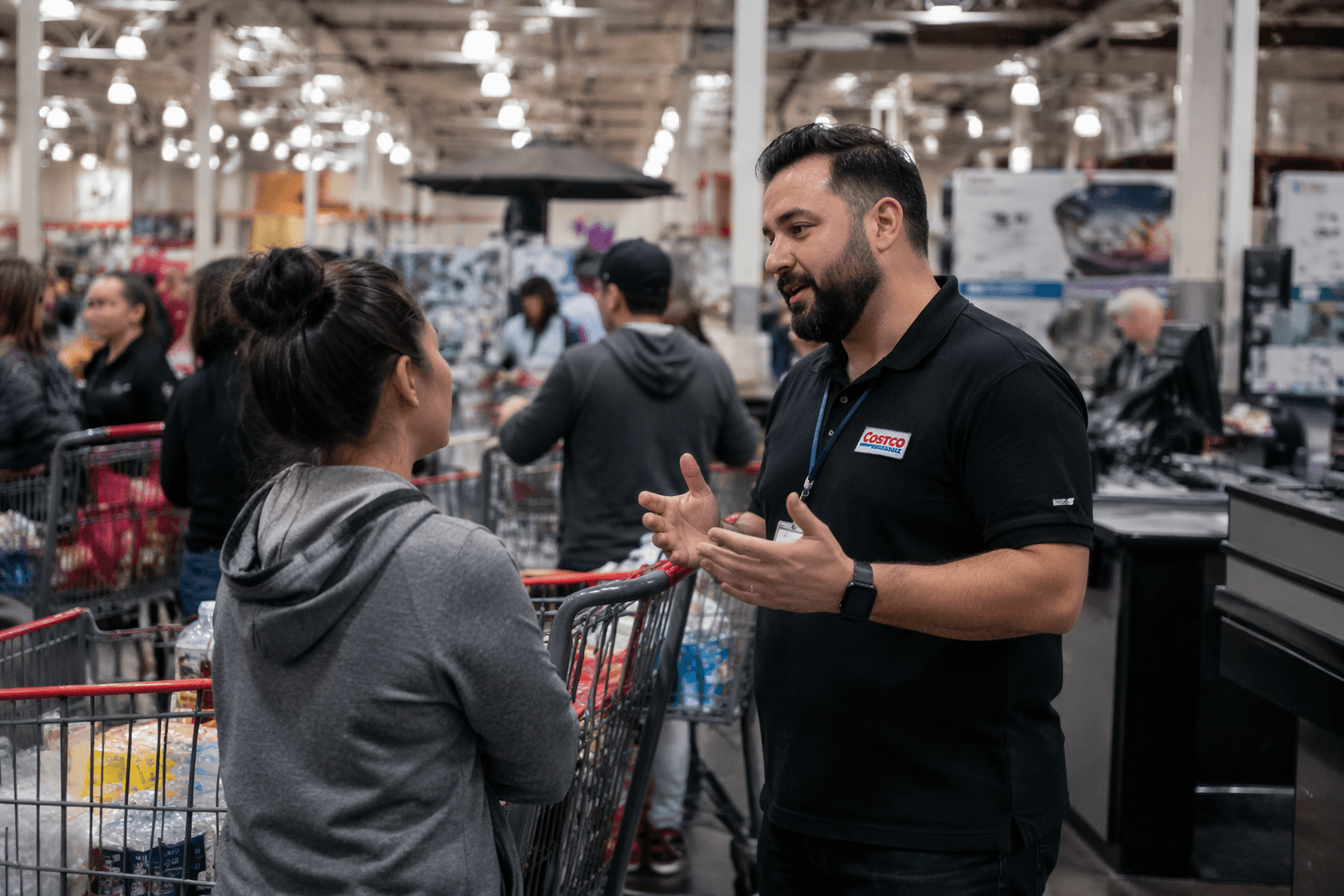
The same employee-development materials that highlight Costco’s wages also say the company has more than 341,000 employees and operates in over 900 locations around the globe. That size makes communication a production issue. A warehouse that large cannot run on informal assumptions. It needs managers who can explain changes cleanly, employees who can read the room, and teams that know how to move from one task to the next without creating confusion for the next shift.
What the advice looks like on the floor
The practical version of empathy is not complicated, but it has to happen quickly. In a member complaint, the worker who first hears the frustration sets the tone for everything that follows. In a shift change, the manager who gives the clearest instructions saves the next crew from guessing. In a busy department, a stocker who says what is changing before it changes can keep coworkers from wasting time or making the same mistake twice.
A simple floor-level checklist comes out of that approach:
- Listen first, before defending the policy or the process.
- Acknowledge what the other person is feeling, especially when the answer is not what they want.
- Explain the next step in plain language.
- Follow through so the member or coworker does not have to repeat the issue.
- Use the right tone, because tone often decides whether a problem calms down or escalates.
That is why the advice matters beyond customer service. Supervisory jobs at Costco are often less about mastering one task and more about coordination under pressure. A lead who can keep a team aligned through a policy update, a late truck, or a complaint at the front end is doing the work that turns a busy warehouse into a functioning system.
How the culture shows up in everyday work
For Costco employees, empathy is not a vague corporate value. It is the difference between a member leaving irritated and a member leaving with the issue resolved, between a coworker feeling ignored and a coworker feeling supported, between a rushed shift and one that stays organized enough to finish cleanly. That is especially true in departments like meat and bakery, optical, and the front end, where service, timing, and accuracy collide all at once.
Costco’s message is strongest when the company’s pay, benefits, employee listening efforts, and communication expectations all point in the same direction. The warehouse model depends on workers who can be firm without being brusque, helpful without being vague, and fast without being careless. At Costco’s scale, those are not soft skills. They are the daily discipline that keeps stores running.
This article was produced by Prism’s automated news system from verified source data, official records, and press releases, then run through automated quality and moderation checks before publishing. The system is built and supervised by the people who set the standards it runs under. Read our full AI policy.
Did this article answer your question?