Dollar General code guides employees on ethics, conduct, and reporting concerns
Dollar General’s code gives store teams a practical shield on complaints, timekeeping, gifts, safety, and reporting. In a 20,000-plus store chain, it can keep a bad call from becoming discipline.
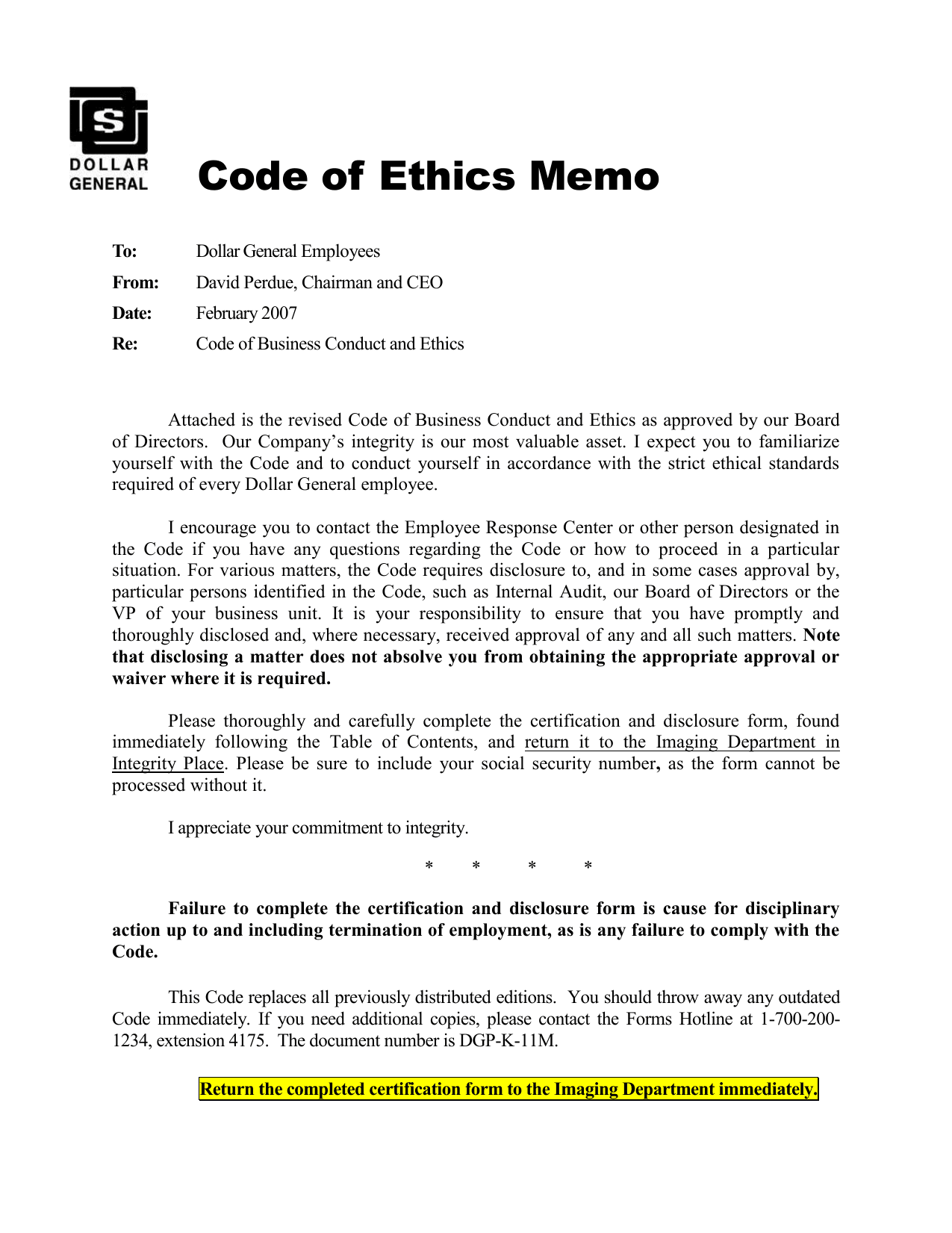
Dollar General revised its Code of Business Conduct and Ethics twice recently, with versions effective August 30, 2023 and May 28, 2024. That makes the code a live operating document for stores, distribution, and support teams. For workers on short-staffed shifts, it sets the standard for handling customers, records, safety, gifts, and retaliation concerns before a tense moment turns into discipline.
What “Serving Others” means on the floor
In the 2023 code’s CEO letter, “Serving Others” means providing customers convenience, quality, and great prices; employees respect and opportunity; shareholders a superior return; and communities a better life. The phrase turns a broad company mission into a day-to-day expectation for how people are supposed to act around customers, coworkers, vendors, and company property. The August 30, 2023 amendments were approved by the Dollar General Board of Directors to codify the company’s existing policy, which shows the code is meant to steer behavior, not sit untouched in an archive.
For store associates, that mission shows up in the smallest decisions. A customer complaint about a missing price tag, a late truck, or a return that does not fit the customer’s expectation is still a test of honesty, fairness, and respect. For district managers and store leaders, the same standard shapes how they respond when a team is frustrated, understaffed, or trying to keep a shift moving with too few hands.
Complaints, conduct, and the pressure of a busy shift
Retail culture at Dollar General often leaves little room for a slow conversation, which is exactly why the code’s conduct rules matter. If a customer is angry at the register, a cashier can lean on the code’s emphasis on respectful behavior instead of improvising a story to make the problem disappear. If a coworker is disrespectful on a crowded night, the code gives managers a basis to correct the behavior before it spreads across the shift.
The same idea applies to customer-facing judgment calls. Associates should not feel pressured to misstate policy just to keep a line moving or to quiet a complaint, because the code ties conduct to fairness and honesty. Dollar General had more than 20,500 stores across 48 states and five cities in Mexico in 2024, and more than 20,800 stores across 48 U.S. states and five cities in Mexico in 2025. Customers and employees do not work in one standardized environment; they work in thousands of them.
Timekeeping and accurate records
Accurate records are one of the code’s most important but least glamorous protections. If a supervisor asks you to change a punch, shave time off a shift, or fix a record after the fact so payroll or labor numbers look cleaner, the code gives you a standard to resist that pressure. In retail, where wages, staffing levels, and labor budgets are sensitive, a bad record can ripple into pay, scheduling, and accountability.
Dollar General’s 2024 annual report listed 20,594 Dollar General, DG Market, DGX and pOpshelf stores across the United States and Mi Súper Dollar General stores in Mexico as of January 31, 2025. Its 2025 annual report listed 20,893 stores across the United States and Mexico as of January 30, 2026. At that scale, accurate timekeeping is part of how Dollar General compares stores and manages labor across very different markets.
Conflicts of interest, gifts, and vendor pressure
The code’s conflicts-of-interest and gifts rules are especially useful for district managers and store leaders, but they reach the sales floor too. A vendor offering meals, favors, or other perks in exchange for shelf placement, extra attention, or inside information is the kind of pressure the code is meant to block. So is a situation where a manager steers business toward a friend, a relative, or a side business that could compromise judgment.
For store workers, the rule is less abstract than it sounds. A free lunch from a vendor during a reset, a gift card slipped in as thanks, or a promise of special treatment can all blur the line between normal business and improper influence. The code gives employees a reason to slow down, disclose the issue, and avoid making a personal benefit look like a business decision.
Safety and company property when staffing is thin
Dollar General’s safety obligations cannot be separated from the code, especially after the U.S. Department of Labor and Occupational Safety and Health Administration announced a July 11, 2024 settlement requiring corporate-wide safety investments in stores nationwide. Conduct codes do not replace safety rules, and safety rules do not enforce themselves. Broken equipment, blocked exits, cluttered stockrooms, and hazards on the sales floor all create problems that can escalate quickly when staffing is thin.
In a store that may be running with one associate covering the register, the floor, and the door, the code still has practical value. If a spill is not cleaned, a ladder is unsafe, or freight is stacked in a way that blocks an aisle, the right move is not to shrug and keep going. The code supports reporting the issue instead of ignoring it.
How to raise a concern without getting boxed in
Dollar General’s governance materials list the whistleblower hotline: 1-800-334-9338. They also list separate channels for contacting the Board or the Audit Committee when the concern involves accounting or a problem that should not be handled only inside the store chain of command. For workers who worry about retaliation, having a written reporting route can make the difference between staying silent and escalating a real issue.
The U.S. Equal Employment Opportunity Commission alleged that Dollar General allowed an Oklahoma regional director to harass district managers about their ages and then fire those who complained. Whether the issue is age bias, scheduling abuse, timekeeping pressure, or a safety concern, the code’s anti-retaliation language gives employees a reference point when they are deciding whether to speak up.
Why outside pressure keeps the code relevant
In 2025, a coalition of Catholic and faith-based investors filed exempt solicitation materials through ICCR. The filing named Mercy Investment Services, Inc., CommonSpirit Health, Friends Fiduciary Corporation, Sisters of St. Joseph of Peace, Sisters of the Humility of Mary, and United Church Funds, and focused on Dollar General’s governance and human-rights practices alongside the company’s own compliance materials.
This article was produced by Prism’s automated news system from verified source data, official records, and press releases, then run through automated quality and moderation checks before publishing. The system is built and supervised by the people who set the standards it runs under. Read our full AI policy.
Did this article answer your question?