Family Dollar closes 350 stores, reshaping Dollar General’s rural competition
Family Dollar has shut at least 350 stores since July, and the fallout is already shifting shoppers, sales and labor pressure onto nearby Dollar General stores.

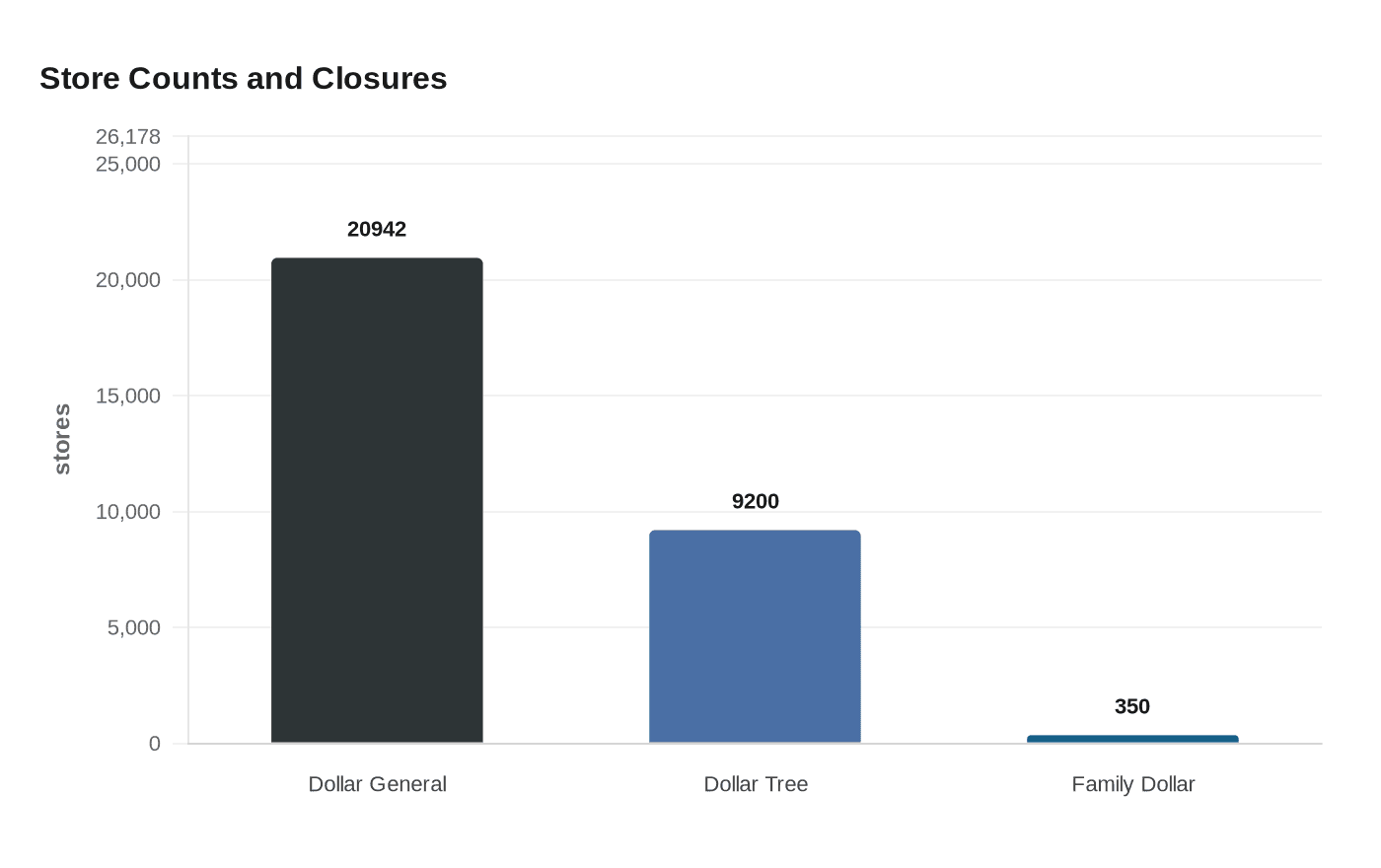
Family Dollar’s shrinking footprint is changing the workday for Dollar General stores in the same small towns and rural trade areas. Local Falcon said Family Dollar closed at least 350 U.S. stores between July 7, 2025 and May 12, 2026, a drop of 4.69 percent, with the heaviest losses in the South and Appalachia, where Dollar General already has deep store coverage.
Texas lost 35 Family Dollar locations in the period Local Falcon studied, followed by Ohio with 28 and Georgia with 26. Arkansas saw the sharpest percentage decline among states that started with at least 50 Family Dollar stores, down 13.9 percent. Arkansas, Alabama, Kentucky and Tennessee accounted for 73 of the closures. Idaho, Massachusetts, Montana, South Dakota, Utah and Wyoming lost none.

That matters inside Dollar General because the nearest Family Dollar often competed for the same exact shopper: the customer buying detergent, snacks, paper goods and a quick refill between paychecks. When a Family Dollar disappears, some of that traffic will move to Dollar General. In other places, the discount option simply gets farther away, which can mean fewer trips, larger one-stop baskets or lost sales altogether.
For store employees, the shift cuts both ways. A closed rival can bring more customers through the door, raising basket size and register lines without any immediate increase in labor hours. That is good for sales volume, but it can also make recovery harder for stores already operating with lean staffing or single-associate shifts. More traffic can mean more front-end pressure, more shelf gaps to fix and less room to absorb callouts, truck delays or safety issues.
Dollar Tree had already signaled the retreat. In March 2024, it said it would close about 600 Family Dollar stores in the first half of fiscal 2024 and about 370 more Family Dollar stores, plus 30 Dollar Tree stores, over the following several years as leases expired. On March 26, 2025, Dollar Tree said Brigade Capital Management and Macellum Capital Management would buy the Family Dollar business for $1.007 billion. The sale closed on July 7, 2025.
Since then, Dollar Tree has become a standalone enterprise focused on the Dollar Tree banner and said in its 2025 annual report that it now operates over 9,200 stores across North America. Dollar General, by contrast, said it had 20,942 stores in 48 states as of February 27, 2026 and reported about $42.7 billion in fiscal 2025 net sales. With its biggest concentration in the South, Southwest, Midwest and East, Dollar General is the chain most likely to catch the spillover, and the stores most exposed are the ones already running close to the edge.
This article was produced by Prism’s automated news system from verified source data, official records, and press releases, then run through automated quality and moderation checks before publishing. The system is built and supervised by the people who set the standards it runs under. Read our full AI policy.
Did this article answer your question?