OSHA retail grocery guide offers safety lessons for Dollar General stores
OSHA’s grocery-store rules fit Dollar General’s crowded aisles and stockrooms, and the agency’s repeated citations show why keeping exits clear still matters.
Dollar General workers do not need a new rulebook to spot the biggest safety problems on a shift. OSHA already wrote one for stores that look a lot like these, including retail grocery stores, combined full-line supermarkets and discount merchandisers, and warehouse retail establishments. The practical lesson is simple: if you stock fast, run narrow aisles, and share space with customers all day, the hazards are going to show up in the same places every time.
Why OSHA’s grocery guide fits Dollar General
OSHA says its retail grocery guideline is aimed primarily at store managers and store employees, with corporate safety professionals also able to use it. That makes it especially relevant for Dollar General, where district managers, store managers, and associates have to think about clutter, storage, customer traffic, and the way fast merchandising cycles can turn a clean aisle into a blocked one by lunch.
The guide is not new, either. OSHA disseminated draft retail grocery guidelines for public comment on May 9, 2003, and held a stakeholder meeting on October 2, 2003. That background matters because it helps explain why the guidance is broad and practical rather than company-specific. It was built for the real-world mess of retail, not a perfect store layout that only exists on paper.
Dollar General’s scale makes that reality harder to ignore. The company was founded in 1939, when Luther and Cal Turner Sr. each invested $5,000 and bought the building for half price. By January 30, 2026, Dollar General said it operated 20,893 Dollar General, DG Market, DGX, and pOpshelf stores across the United States, plus Mi Súper Dollar General stores in Mexico. A safety guide written for high-volume discount retail is not a side issue at that size. It is part of how a store stays open.
The hazards that matter most on the floor
The most common risks are not dramatic. They are the ordinary things that get ignored because they happen during every shift: lifting heavy freight, slipping on spills or loose debris, maneuvering carts in tight aisles, and working around stockroom clutter that slowly creeps into customer space. In Dollar General stores, where freight comes in constantly and space is tight, those small failures can stack up fast.
OSHA’s crowd-management guidance adds another layer for sales events, seasonal resets, and any day when the front end gets congested. The agency says employers should use safety and health programs to identify and eliminate hazards caused by large crowds at retail sales events. For Dollar General teams, that means asking the questions that matter before a rush turns messy: Are exits clear? Are stock carts parked safely? Are endcaps stable? Is the team prepared to manage a line or a crowd without creating a pileup at the front of the store?
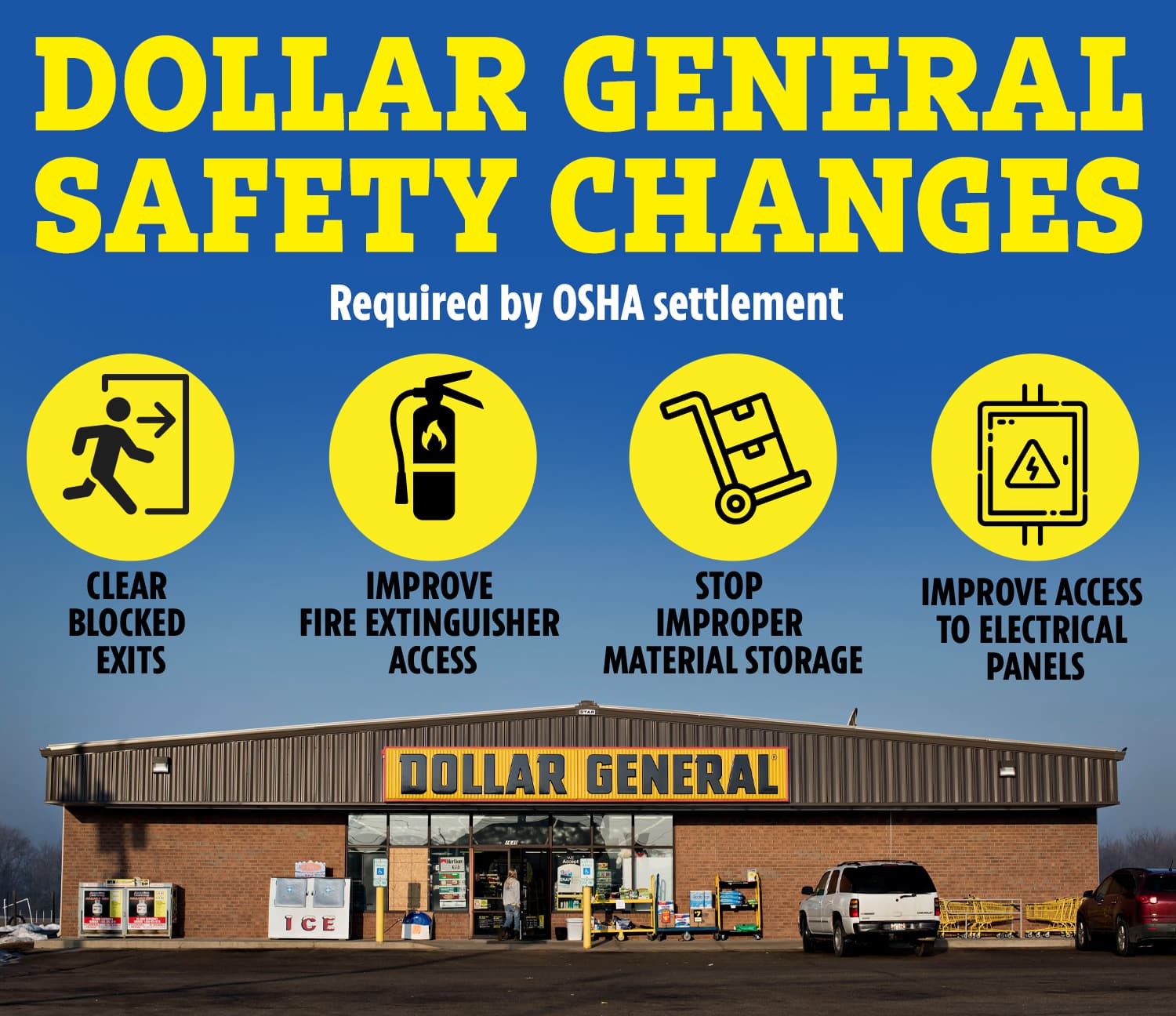
That same thinking applies to emergency access. OSHA and Labor Department releases have described blocked emergency exit routes, blocked fire extinguishers, blocked electrical panels, and stacked merchandise that created fire, entrapment, and struck-by hazards. Those are not abstract violations. They are the kinds of problems that can turn a routine shift into an emergency.
A quick checklist for associates and managers
The safest stores are the ones where workers keep resetting the basics all day, not just after a walk-through. Before and during a shift, look for the problems that OSHA keeps flagging and stop them early.
- Keep emergency exits open and easy to reach.
- Make sure fire extinguishers and electrical panels are not blocked by product, carts, or rolltainers.
- Watch for boxes, shrink wrap, and loose freight on the floor that can cause slips or trips.
- Do not let stock carts or pallets sit where customers or coworkers have to squeeze around them.
- Check stacked merchandise for stability, especially on endcaps or in backstock areas.
- Keep the stockroom from spilling into the sales floor, especially during fast replenishment cycles.
- Slow the pace when the front end gets crowded so carts, customers, and associates are not all funneled into the same narrow space at once.
If a hazard keeps coming back, treat it like a system problem, not a one-off annoyance. The point of OSHA’s guidance is to catch the pattern early, before someone gets pinned, trips, or cannot get out because merchandise has crept into an exit path.
Why enforcement keeps raising the stakes
Dollar General’s OSHA history gives these basics real urgency. In January 2023, OSHA said it had fined the company more than $15 million since 2017 after more than 180 inspections nationwide. By July 2023, OSHA said the total had climbed to more than $21 million after more than 243 inspections nationwide. That is the kind of number that tells workers this is not a rare compliance slip.
The pressure turned into a corporate-wide settlement on July 11, 2024. Dollar General agreed to pay $12 million in penalties and make company-wide safety changes, including hiring additional safety managers, reducing inventory to prevent blocked exits and unsafe storage, providing training, and creating a safety and health committee. OSHA and Labor Department releases also pointed to specific stores in Jersey Shore, Pennsylvania; Kettering, Ohio; Tampa and Dade City, Florida; Casselton, North Dakota; Alabama; and Georgia, where blocked exits, blocked fire extinguishers, blocked electrical panels, and unsafe stacking showed up again and again.
That is the real takeaway for store teams. Safety at Dollar General is not mainly about rare disasters. It is about whether the basics stay intact when freight is coming in, customers are moving through, and the store is running short-handed. In a discount format built on speed and tight space, the workers who know the rules before something goes wrong are the ones most likely to keep a normal shift from becoming the next OSHA case.
This article was produced by Prism’s automated news system from verified source data, official records, and press releases, then run through automated quality and moderation checks before publishing. The system is built and supervised by the people who set the standards it runs under. Read our full AI policy.
Did this article answer your question?