Warehouse robots signal new automation questions for Dollar General workers
HelloFresh put 13 robots into cold storage in 2025, a sign Dollar General workers should watch for more automation in storage, retrieval and replenishment.

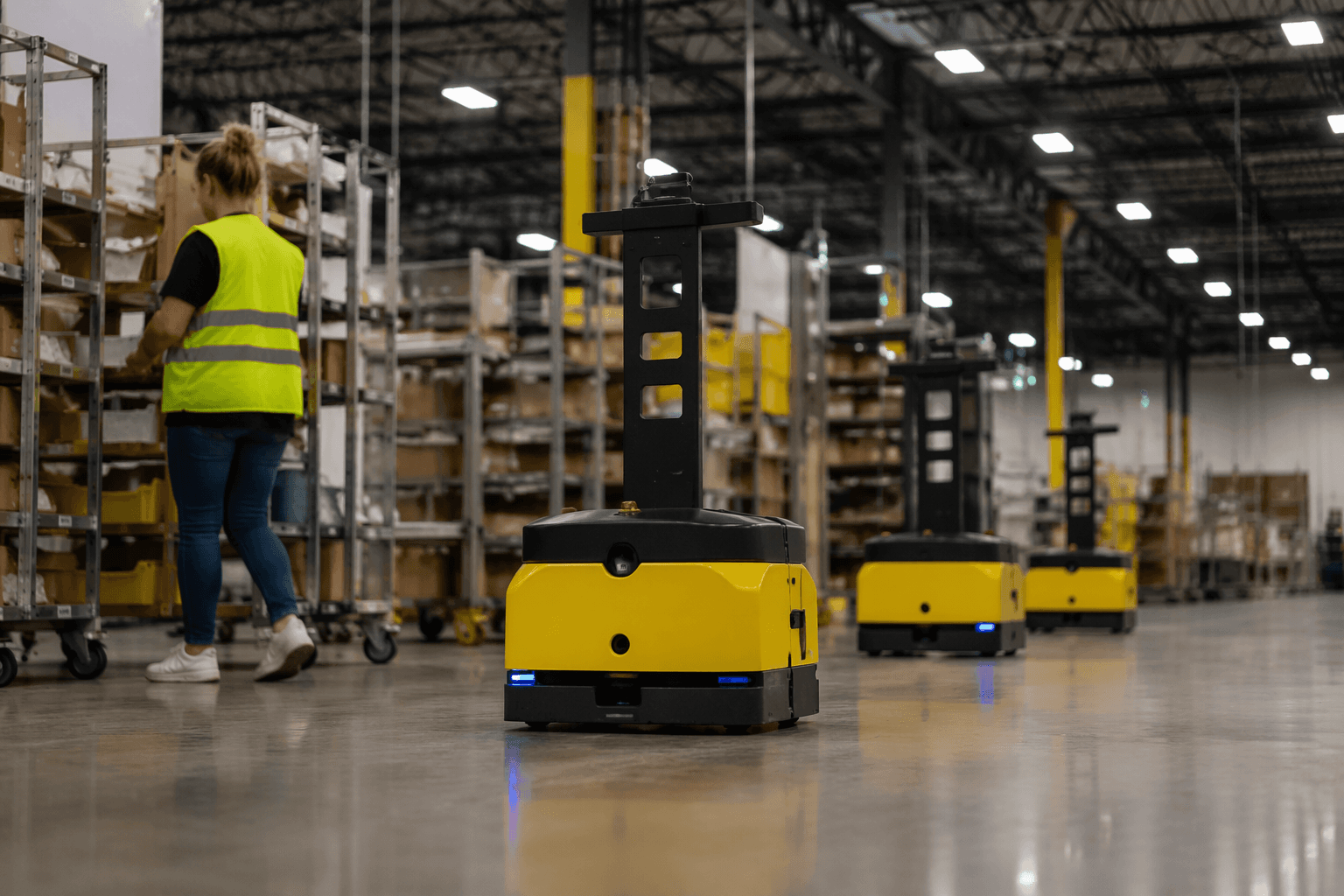
Robots are now handling parts of HelloFresh’s cold-storage warehouse, and that is the kind of shift Dollar General distribution workers should watch closely. The HelloFresh brand Factor first deployed 13 Locus Origin robots in July 2025 as an initial pilot, showing that warehouse automation is no longer limited to giant fulfillment centers.
For Dollar General, the most likely first targets are the same repetitive tasks that eat up time in a distribution center: moving product, storing and retrieving inventory, scanning, and pushing throughput in temperature-controlled areas where speed and accuracy matter. Human work does not disappear in that setup, but it changes. The value moves toward people who can follow process, work safely around equipment, keep inventory systems clean, and handle exceptions when the software or machinery cannot.
Dollar General has already been moving in that direction. On Sept. 8, 2023, the company said its South Carolina distribution center had gone live with large-scale automation. Dollar General said the system would help process thousands of additional SKUs, improve storage, and lower costs. The company also said it planned to invest $25 million in better inventory demand forecasting and grow its private tractor fleet from 1,800 to 2,000 by the end of that year. That was not a one-off experiment. It was part of a broader supply-chain modernization push that also included new distribution centers in Nebraska, Georgia, Texas and New York, with more under construction in Colorado, Arkansas and Oregon.
The next visible step came in February 2025, when Dollar General opened a 1 million-square-foot distribution center in North Little Rock, Arkansas, at a cost of about $160 million. The facility was expected to create 300 jobs in Pulaski County, and the company said it combines DG Fresh and private-fleet functions while using automation to store and retrieve products more efficiently. Todd Vasos has tied that kind of technology to better inventory and order accuracy, while Sarah Sanders has pointed to workforce training as part of the state’s pitch to employers.
Dollar General’s own careers pages still describe distribution as a people-heavy operation. The company says its distribution centers have 30-plus locations, a 62%+ internal promotion rate for DC leadership, and more than 1.1 billion cartons shipped. It also says distribution centers donated the equivalent of 5.1 million meals to Feeding America affiliated food banks in 2024. That mix matters because it shows the company still presents DC work as a ladder, not just a labor pool.
For workers, the clearest signals to watch are less about a robot walking in the door than about what changes around it: more training on equipment and systems, tighter scan discipline, new safety rules around automated zones, and higher expectations for throughput with fewer manual touches. Dollar General employed about 194,000 full-time and part-time workers as of Feb. 27, 2026, so even small gains in warehouse speed and accuracy can ripple through store replenishment across more than 20,800 stores in 48 U.S. states and five cities in Mexico.
This article was produced by Prism’s automated news system from verified source data, official records, and press releases, then run through automated quality and moderation checks before publishing. The system is built and supervised by the people who set the standards it runs under. Read our full AI policy.
Did this article answer your question?