Goldman Sachs Among Lead Banks for SpaceX's Massive Project Apex IPO
SpaceX's 21-bank Project Apex syndicate kicks off Monday, with Goldman among five active bookrunners on a deal targeting a $1.75 trillion valuation.
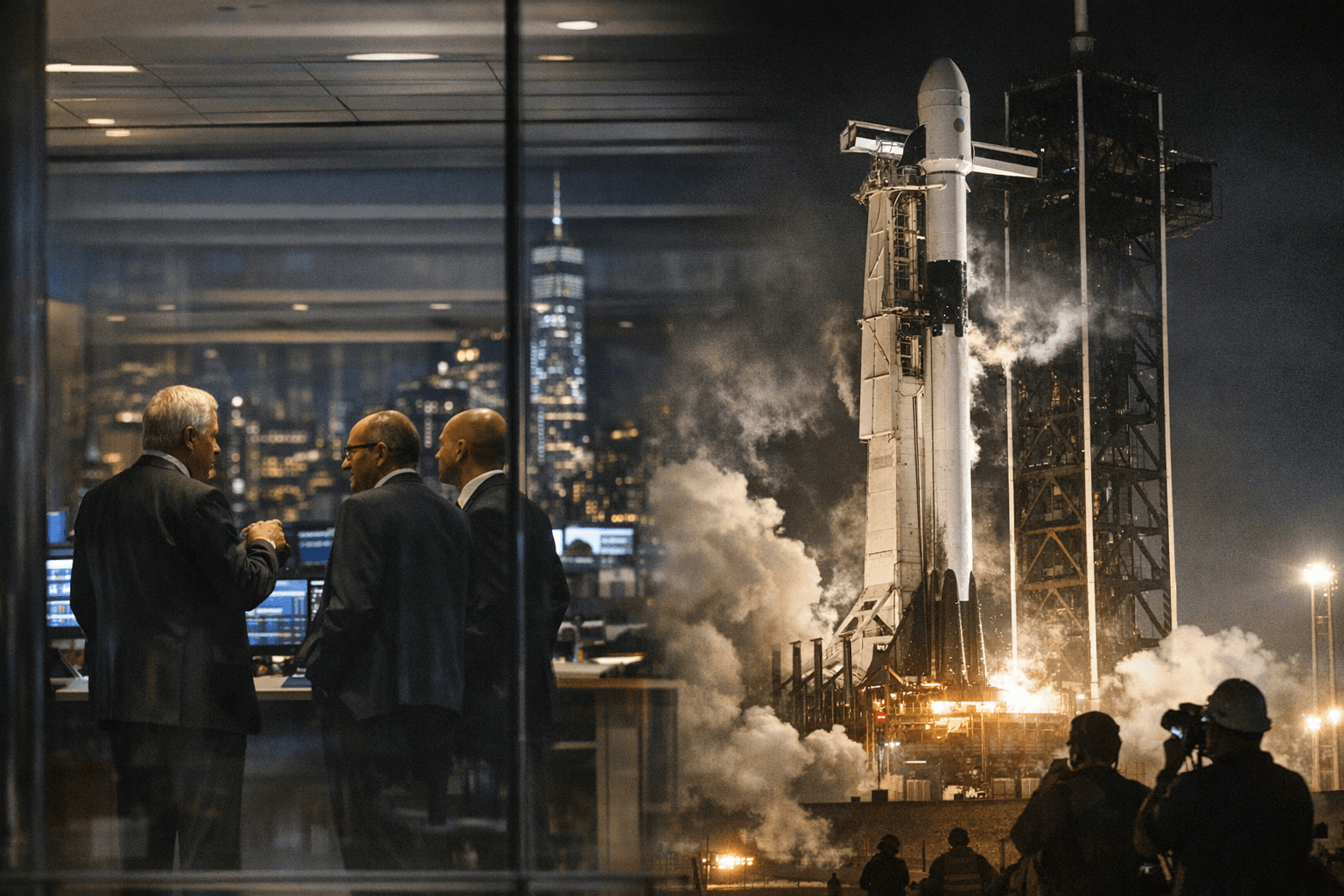
The most consequential equity offering in a generation has a codename, a 21-bank syndicate, and a kick-off meeting tomorrow.
SpaceX filed a confidential draft registration statement with the SEC on April 1, setting in motion Project Apex, a listing targeting a $1.75 trillion valuation and a June debut. Goldman Sachs is one of five active bookrunners, alongside Morgan Stanley, JPMorgan Chase, Bank of America, and Citigroup, forming the senior tier of a syndicate that extends to 16 additional banks in smaller roles. The lead banks are scheduled to convene with the broader group on April 6, the first formal coordination step in what is shaping up as the most operationally complex ECM assignment in recent memory.
The syndicate architecture itself tells a story. Most major IPOs tap four or five lead banks and a handful of co-managers. Twenty-one banks signals both the sheer volume of investor outreach required to place this deal and the political reality of a company operating across defense contracts, satellite broadband, and space launch, sectors with distinct institutional bases. Regional names in the syndicate likely serve as distribution conduits into markets where the top five bookrunners lack deep reach.
Active bookrunner status for Goldman means owning a meaningful share of execution workload from here through pricing: roadshow logistics, book-building mechanics, investor allocation design, and global coordination across time zones. Behind the ECM team, legal and compliance will need to clear disclosures tied to SpaceX's defense relationships and the company's all-stock merger with xAI, Elon Musk's artificial intelligence venture, which contributed to the $1.75 trillion valuation. Operations and settlement must prepare infrastructure for a potential record allocation event.
The confidential S-1 process allows SpaceX to conduct early-look investor meetings and test valuation sensitivity before the filing becomes public, giving the lead banks a read on demand before the roadshow clock starts. How that appetite holds, particularly given current market volatility, will determine whether the June window stays intact and at what price.
For Goldman analysts and associates drawn into the deal, the assignment offers the kind of execution credit that stands out in year-end performance reviews: high-visibility, marquee client, and a transaction that will top ECM league tables regardless of how fees are structured. The tradeoff is predictable. War-room hours from now through pricing, with intensity peaking at S-1 go-public and roadshow. On the compensation side, underwriting fees on mega-IPOs are typically compressed on a percentage basis relative to smaller deals, but the absolute dollar pool on a transaction of this scale, split among five lead banks, still reaches into the hundreds of millions.
The broader market impact deserves attention. At $1.75 trillion, SpaceX would instantly rank among the most valuable publicly traded companies on earth, surpassing Saudi Aramco's $29.4 billion 2019 offering as the largest IPO by implied market cap. That scale creates a supply event with real consequences: institutional risk budgets tend to rotate toward a deal of this magnitude in the weeks surrounding pricing, which compresses available capital for other IPOs. Anticipated listings from OpenAI and Anthropic, both widely expected to come to market in 2026, could find their windows narrowed or repriced depending on how Project Apex is absorbed. For Goldman's ECM franchise, landing a top-three role on the deal that resets every benchmark is exactly the kind of mandate that matters, measured in league table credit, fee revenue, and the relationships that follow.
This article was produced by Prism’s automated news system from verified source data, official records, and press releases, then run through automated quality and moderation checks before publishing. The system is built and supervised by the people who set the standards it runs under. Read our full AI policy.
Did this article answer your question?