Goldman Sachs faces task redesign as AI reshapes finance jobs
Goldman’s AI shift is less about job cuts than task cuts. Routine work gets automated, while judgment, controls and client skills gain leverage.
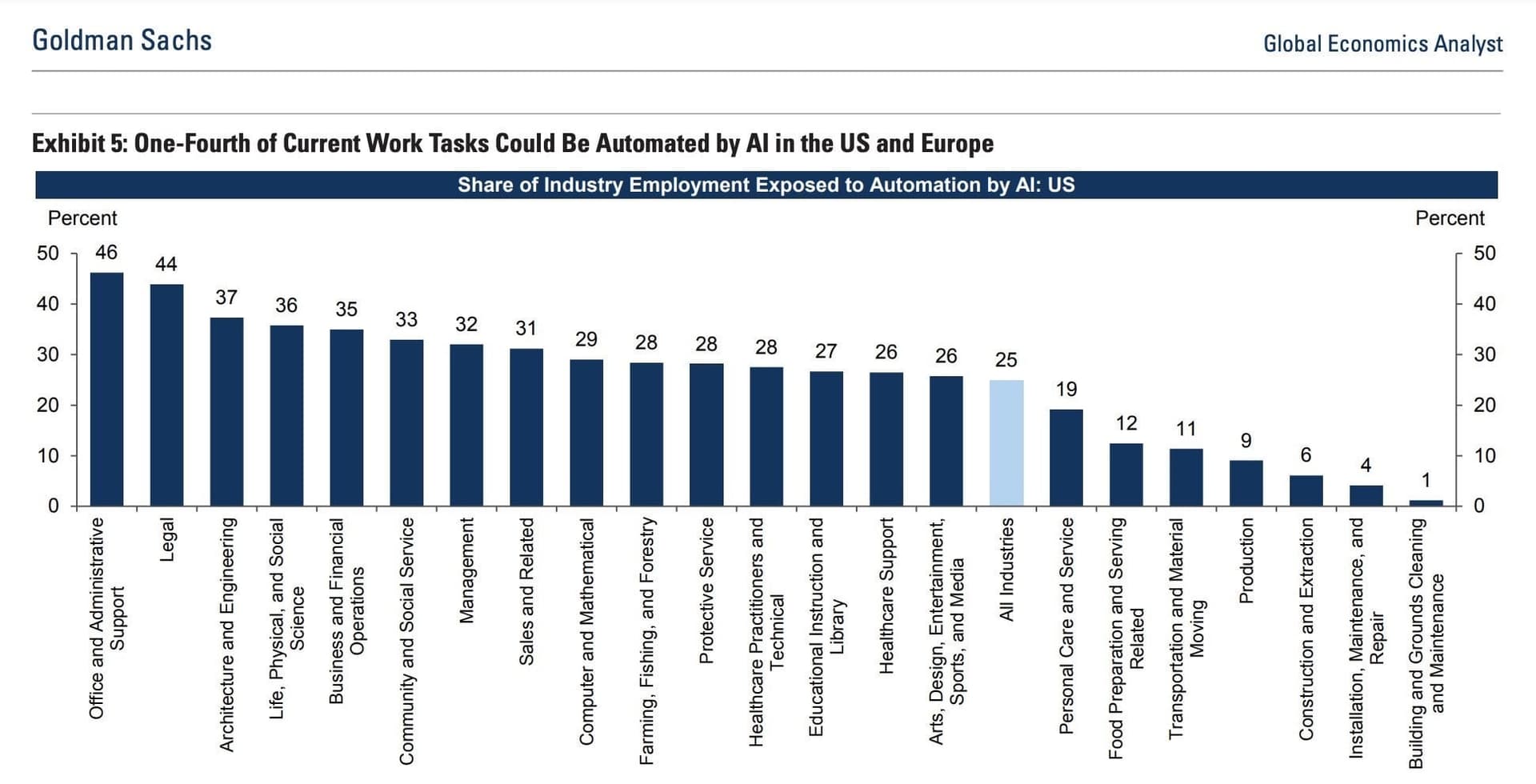
Goldman Sachs is moving into a version of AI adoption that feels less like a tech story and more like a management problem: which tasks disappear, which get faster, and which become more valuable because a machine can now do the first pass. The new Financial Services Skills Commission report makes the point bluntly, saying up to 50% of the tasks that underpin most roles could be automated, while experienced professionals stay central as the human in the loop for governance, assessment and challenge.
From headcount fears to task redesign
That shift matters inside Goldman because the firm does not sell labor in the abstract. It sells judgment, speed, risk control and client responsiveness, all of which are built from dozens of smaller tasks that can now be broken apart and repackaged. The Financial Services Skills Commission’s A Workforce Transformed report, published on 21 May 2026 and commissioned by the UK government in November 2025, frames the issue as a full redesign of work, not a simple replacement story.
The report is useful because it does not stop at theory. It includes case studies from PwC, Danske Bank, Lloyds Banking Group and Zurich Insurance showing firms using AI to upskill employees, test AI systems and scale productivity. That mix of experimentation and operational rollout is the real signal for Goldman employees: the question is no longer whether AI exists in finance, but which desk, which workflow and which review step gets rebuilt around it first.
What changes first inside a Goldman workflow
At Goldman, the first obvious targets are the repetitive, high-volume tasks that sit underneath polished client work. The firm’s own GS AI Assistant was designed to help with summarizing complex documents, drafting initial content and performing data analysis, which tells you where management sees the immediate productivity gains. Those are not glamorous tasks, but they are the ones that can consume a large share of analyst and associate time, especially when the workweek is already long and the bonus cycle rewards output that looks seamless on the surface.
That is why the report’s 50% task exposure number is more useful than any headline about jobs being “replaced.” In practice, it points to a reshuffling of responsibility: AI will likely take more of the first draft, the first scan, the first summary and the first pattern match in research, compliance, client servicing and operations. Experienced bankers, traders and managers then become the people who decide whether the output is good enough, risky, incomplete or simply wrong.
Goldman’s internal logic makes that especially important. The firm’s apprenticeship culture has always relied on junior staff producing the raw material and senior staff applying judgment and quality control. AI compresses the first part of that pipeline, which means the premium will rise on people who can review, challenge and improve machine output rather than merely produce it.
The skills mix is shifting faster than the job titles
The Financial Services Skills Commission says almost every role in financial services will be changed by AI, but only 1.5% of workers will require “expert” AI skills. That is a crucial distinction for Goldman employees who worry that the future belongs only to coders. It does not. The bigger change is that a much wider group will need enough AI fluency to use tools well, spot weak output and know when not to trust it.
The commission also says demand for conversational AI skills has risen 17.5-fold, while relationship management and empathy remain more in demand than most technical skills. For Goldman, that points to a very specific blend of capabilities that will carry leverage in the next promotion cycle: AI literacy, judgment, communication, controls and business context. The people who gain the most will not just be those who can prompt a model. They will be the ones who can explain a model’s output to a client, defend it to a risk committee and translate it into a decision.
That also means the winners are likely to be employees who can move across functions. A strong analyst who understands the business, a compliance professional who can interrogate a model and a vice president who can redesign a process around AI may become more valuable than someone who only knows how to produce more slides faster. The report’s emphasis on growing and declining skill mixes makes that point clearly: firms need to think about upskilling, not just replacement.
Goldman is already moving, and the rollout tells you where leverage is shifting
Goldman has not waited for the theory to become fashionable. In January 2025, it was rolling out the GS AI Assistant to bankers, traders and asset managers. By June 2025, Reuters reported that the tool had been launched firmwide after about 10,000 employees had already used it in pilot form, with the aim of reaching all knowledge workers rather than triggering immediate layoffs.
That rollout matters because it shows how AI enters a large bank in practice. It starts as a productivity tool, then becomes an expectation, and then becomes part of the performance baseline. Once that happens, the real differentiator is no longer who can produce a memo or a first draft by hand. It is who can use AI to move faster without cutting corners, and who can still catch the mistakes that matter.
There is also a compensation angle here, even if it is not always discussed openly. In a firm where total comp depends on perceived value creation, employees who can use AI to improve throughput, reduce errors and improve client response times will have more leverage than peers who simply complete the same tasks faster. The work may get lighter in some places, but the bar for what counts as high-value contribution will rise.
The bigger warning from Goldman’s own research
Goldman has been warning for years that this was coming. In 2023, Goldman Sachs Research estimated that generative AI could expose the equivalent of 300 million full-time jobs globally to automation, with roughly two-thirds of current jobs exposed to some degree. In March 2026, the bank said AI is already affecting jobs in the tech, knowledge and creative sectors, and reiterated that 300 million-job exposure estimate. It also expects AI’s macroeconomic impact to become measurable in the United States in 2027.
That backdrop gives the skills report a sharper edge. This is not a distant planning exercise. It is the run-up to a measurable productivity shift that will show up in output, staffing models and internal career ladders. The firms that benefit most will not be the ones that simply buy more AI tools. They will be the ones that redesign work early, retrain fast and preserve the human judgment that finance still depends on when the model is wrong.
Goldman’s own rollout suggests the firm understands that. The next question is whether its people move with it, or get trapped doing tasks the machine now does first.
This article was produced by Prism’s automated news system from verified source data, official records, and press releases, then run through automated quality and moderation checks before publishing. The system is built and supervised by the people who set the standards it runs under. Read our full AI policy.
Did this article answer your question?