Goldman Sachs leans on agility and talent density to keep workers growing
Goldman treats talent density like an operating system: hire hard, move people faster, and keep the best learning. The catch is whether that model can work outside its own pressure-cooker scale.

Goldman’s talent strategy is really a culture strategy
Goldman Sachs is not just selling prestige. It is trying to prove that a hard-charging bank can still be a place where people keep getting better, and keep moving. The firm’s head of human capital management, Jacqueline Arthur, sits at the center of that argument: Goldman says her job is to attract, develop and manage a global workforce, and the bank is using that mandate to frame talent as an operating advantage, not a support function.
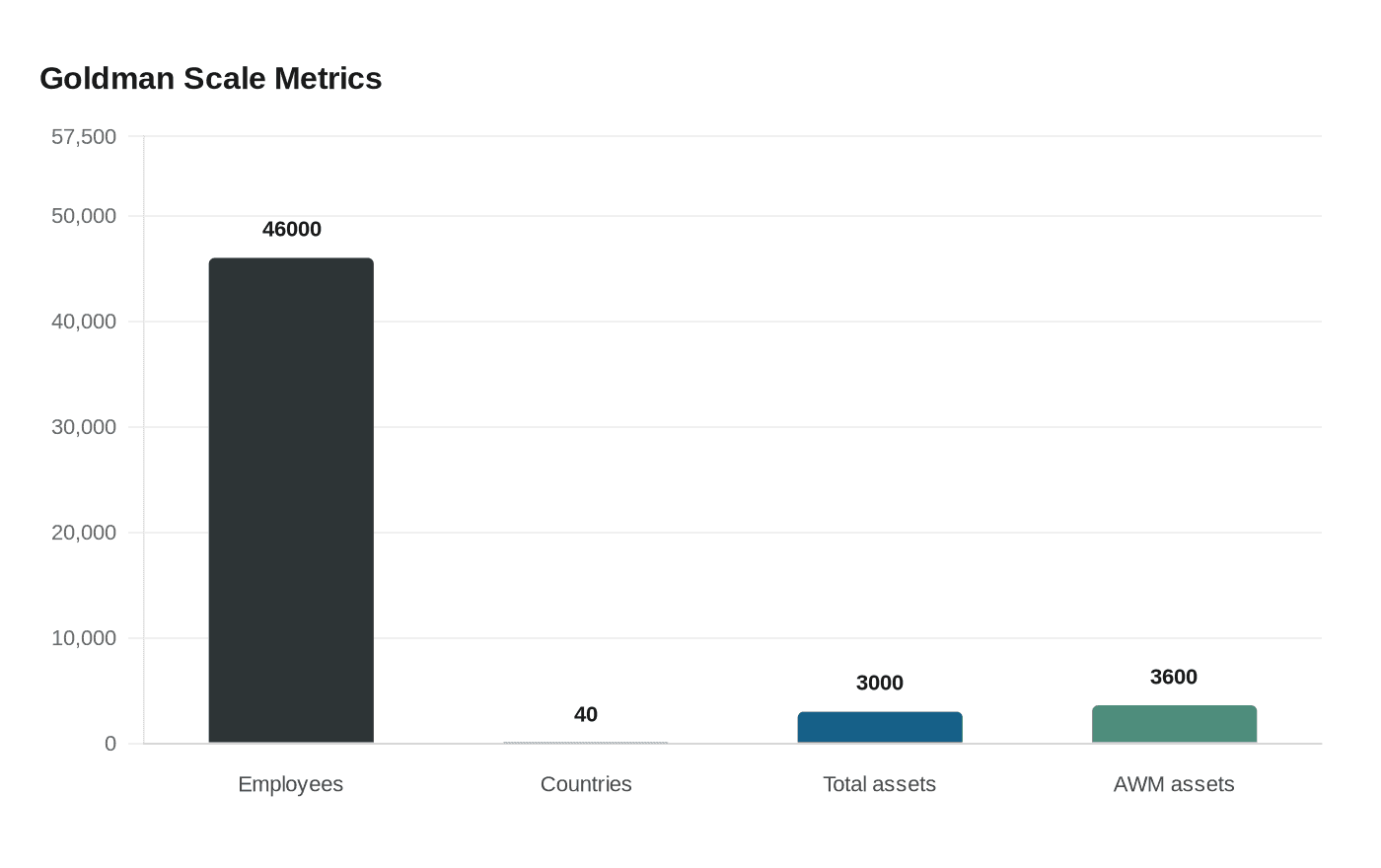
That matters because the scale is enormous. Goldman says it has more than 46,000 employees across more than 40 countries and supervises roughly $3 trillion in total assets. Its 2025 annual report puts Asset & Wealth Management alone at $3.6 trillion in assets under supervision. For a firm that large, “talent density” is not a slogan. It is the difference between a workforce that adapts quickly and one that calcifies under the weight of deal cycles, market shocks and technology change.
What Goldman means by agility
The strongest signal in the MIT Sloan Management Review analysis is not that Goldman is big. It is that it ranked first among peer financial-services and asset-management firms on agility, scoring nearly two standard deviations above the industry average. That ranking was built on CultureX analysis of more than 250,000 employee reviews across 50 firms, which gives the result more weight than the usual corporate self-description.
In practical terms, Goldman is saying it has built an organization that can keep changing while the market around it keeps moving. The annual report itself describes 2025 as a year marked by uncertainty and disruption, and that framing matches the culture argument. If the bank wants to stay resilient through geopolitical turbulence, technology shifts and product innovation, then it needs people who do not freeze when the playbook changes.
That is where Arthur’s idea of talent density comes in. Goldman’s employees are described as intelligent, ambitious, hardworking and resilient, but the deeper point is behavioral: they are expected to welcome feedback and handle hard conversations without turning defensive. In a bank where a missed call or slow response can ripple into revenue, risk or client relationships, that kind of operating tone is not cosmetic. It is part of how the firm tries to stay fast.
The management mechanics behind the culture
Goldman’s pitch becomes more concrete when you look at the mechanisms it uses to support it. Arthur’s message is not simply “work harder.” It is that the bank fights complacency by hiring ambitious people who challenge the status quo, then building a system that rewards growth, internal mobility and development. That combination is the real management model.
The firm’s learning materials say new hires get digital learning and orientation, while employees are prepared for career milestones through tailored programs. Its careers site says Human Capital Management takes a strategic approach to developing the workforce and helping people create the career they want. Goldman also explicitly says it champions apprenticeship, which signals that it still sees learning as something that happens inside live work, not only in formal classes.
For employees, that translates into a clear internal bargain: if you can keep up and keep learning, the firm wants to move you. That is especially meaningful in a place where bonus cycles and title progression can shape compensation, exit opportunities and long-term trajectory. A strong internal mobility story gives associates and VPs a reason to stay another cycle, even when the hours are punishing and outside recruiters are calling.
Why the Returnship matters
Goldman’s mobility play is not limited to lateral moves inside the firm. In 2021, it launched a reimagined Returnship program for professionals restarting careers after extended workforce absences or pandemic displacement. That is a notable signal in a business that has traditionally prized uninterrupted, high-intensity careers.
The Returnship broadens the talent pool and tells a useful story about resilience. It suggests Goldman is willing to re-enter the market for talent, not just recruit from the usual feeder channels, and that it is trying to convert career breaks into second chances. For a big financial firm, that is also a practical hedge against tight labor markets: if the best people are not all coming straight out of the same pipeline, the bank has to get better at re-onboarding talent that has been away.
What works at Goldman, and what other employers can copy
Not every company can copy Goldman’s model, and that is exactly why it is worth studying. The bank’s scale, selectivity and brand create a feedback loop that most employers cannot replicate. More than 120,000 alumni in 115+ countries, including 650+ in C-suite roles as of January 2026, means Goldman can credibly promise that a stint inside the firm has lasting career value. That alumni network is itself part of the talent proposition.
But some of the mechanics are portable.
- Set clear expectations that feedback is normal, not exceptional.
- Build internal moves into the career path instead of treating them as exceptions.
- Use tailored learning at predictable career milestones so development does not depend on luck.
- Rehire talent through structured return programs, especially after career breaks.
- Make apprenticeship real by pairing new people with live responsibility, not just training modules.
What is harder to copy is the part that depends on Goldman’s intensity. High talent density works when the organization can actually replace complacency with motion. In a slower or less selective firm, constant challenge can turn into churn if managers do not have the judgment or credibility to make development feel worth the strain.
The tension behind the prestige
The most revealing part of the story is the tension between opportunity and balance. Public review aggregators cited in the broader analysis show Goldman scores relatively well for career opportunities but lower on work-life balance. That is consistent with what workers already know about the bank: the brand can open doors, but the tradeoff is still real.
That tension is why internal mobility matters so much. If the job is demanding, the bank has to offer a believable path forward, not just a name on a resume. Arthur’s background underscores that logic. She joined Goldman in 2007, became managing director in 2012 and partner in 2018, after serving as global COO of Goldman Sachs Asset Management and chief of staff to the co-heads of the Investment Management Division. She is also on the Management Committee, Partnership Committee and Global Inclusion and Diversity Committee, which puts her inside the firm’s most consequential conversations about talent and culture.
Goldman’s message is ultimately straightforward: the bank wants workers who can grow inside pressure, not just survive it. The hard part for everyone else is deciding which pieces of that model are worth copying, and which only work when the institution already has the scale, brand and intensity to make talent density self-reinforcing.
This article was produced by Prism’s automated news system from verified source data, official records, and press releases, then run through automated quality and moderation checks before publishing. The system is built and supervised by the people who set the standards it runs under. Read our full AI policy.
Did this article answer your question?