Goldman Sachs Projects $13.8 Billion Pension Fund Equity Buy, Largest in Years
Goldman's trading desk projects a $13.8B pension equity buy by quarter-end, a figure surpassing 97% of monthly purchase flows tracked over three years.
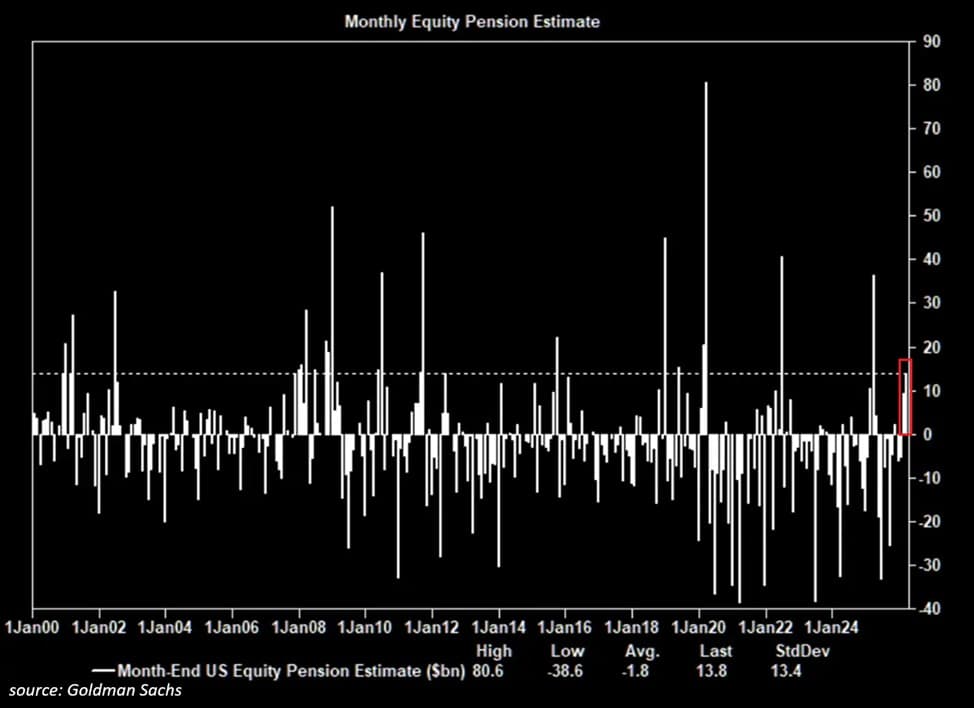
A single number from Goldman Sachs's trading desk reframes the near-term equity picture: $13.8 billion. That is the projected scale of U.S. pension fund equity purchases by quarter-end, the largest rebalancing-driven buy program in years and one that clears the 97th percentile of monthly purchase volumes Goldman has tracked over the past three years.
The mechanism is structural, not speculative. Pension funds operate against fixed asset allocation mandates, typically weighted toward a target equity-to-bond ratio. When stocks fall and bonds outperform simultaneously, as they did through much of Q1 2026, those portfolios drift below their equity targets. The only way back to compliance is to buy equities, and the size of the required purchase scales with how far the drift ran. Goldman's projection of $13.8 billion reflects exactly that math playing out at an unusually large magnitude.
Quarter-end timing transforms a gradual drift into a concentrated event. Unlike month-end rebalancing, which can be distributed across more sessions, quarterly portfolio reviews force institutional hands into a narrower window. With Q1 closing March 31, the bulk of this buying was expected to execute in the final days of the month, compressing a mechanical flow of historic proportions into a handful of trading sessions. The 97th-percentile ranking puts it in sharp relief: Goldman's own comparable data shows this buy program is larger than 97 out of every 100 monthly rebalancing observations over the past three years.
The directional context matters. Goldman projected $32 billion in pension equity sales at Q1 2024's close, when a sustained equity rally had left funds overweight stocks and forced selling to rebalance back toward bonds. The reversal to a $13.8 billion buy signal in Q1 2026 captures precisely how much equity value eroded relative to fixed income in the intervening period.

For anyone watching near-term price action, concentrated institutional buy programs at this scale tend to create predictable support in large-cap, index-heavy names where pension allocations run deepest. The flow is mechanical, not momentum-driven, which means it arrives regardless of macro sentiment and can temporarily anchor prices even as broader uncertainty persists. Goldman employees on equity execution and prime brokerage desks will recognize the pattern: quarter-end pension rebalancing of this magnitude tends to absorb supply and compress realized volatility in the days immediately surrounding the close, before the effect fades as positions normalize.
The broader read for Goldman's workforce is also worth noting. Defined benefit pension participants and employees with retirement portfolios structured around similar allocation targets are subject to the same rebalancing logic. A quarter that punishes equities triggers automatic buying on their behalf, effectively dollar-cost averaging into the drawdown without requiring a discretionary decision. At $13.8 billion, the institutional version of that process is large enough to leave a visible mark on the tape.
Know something we missed? Have a correction or additional information?
Submit a Tip
