Goldman Sachs AI Agents Reshape Workflows, Putting Some Roles at Risk
Goldman's Claude-powered agents now oversee $2.5 trillion in assets and cut client onboarding time by 30%, putting trade reconciliation and KYC roles directly in automation's crosshairs.
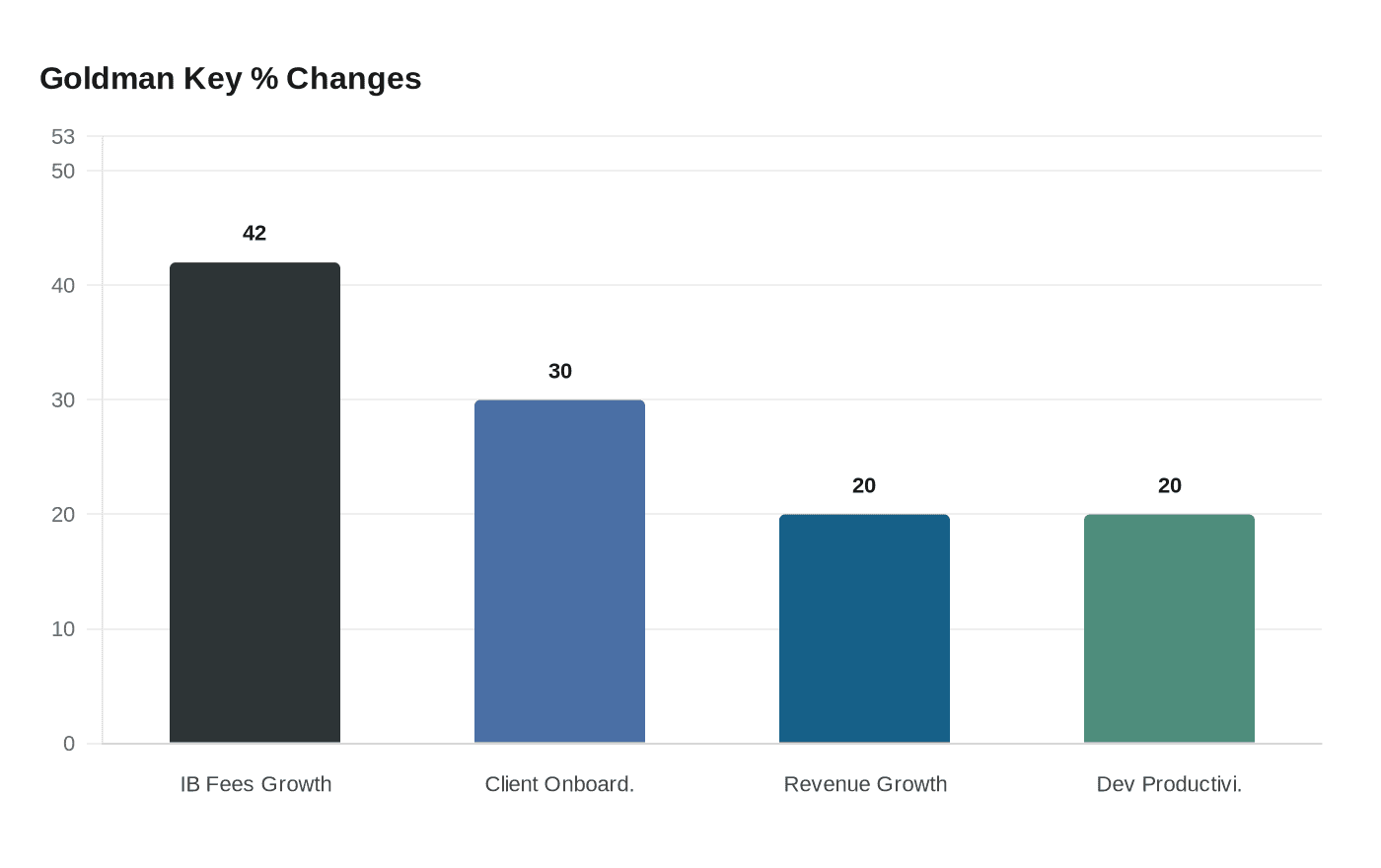
CIO Marco Argenti did not mince words when describing what Anthropic's Claude model was becoming inside Goldman Sachs: "a digital co-worker for many of the professions within the firm that are scaled, are complex and very process intensive." That framing matters for anyone in Goldman's operations, compliance, or technology divisions. The firm spent six months embedding Anthropic engineers directly inside its operations to co-develop autonomous agents now handling workflows tied to $2.5 trillion in assets under supervision. The results are concrete: client onboarding time cut by 30%, developer productivity up more than 20%, and a structural shift in what human labor inside the bank is actually for.
What OneGS 3.0 Is, and Why It Hits Now
OneGS 3.0 is Goldman's firmwide operating model overhaul, framed by CFO Denis Coleman as a multiyear effort to "convert some of that effort into digitized and automated systems and rethink how those engines work." It is not a technology project in isolation; it is a process redesign initiative that treats AI-driven productivity as a core pillar, explicitly aiming to automate repeatable and rule-based tasks while redeploying human talent toward judgment, client relationships, and complex structuring.
The timing is deliberate. Goldman cut more than 1,000 positions in 2025 and constrained headcount growth through year-end, even as it posted record profits with revenue climbing 20% to $15.18 billion and investment banking fees surging 42%. When CEO David Solomon acknowledged the pace of change was "quicker" than prior technology cycles and that it could cause "a little bit more volatility or an unsettled transition around certain job functions," he was describing the friction already visible inside the firm. The AI deployment is not waiting for the organization to catch up.
What Gets Automated First
The workflows targeted earliest are those with the highest ratio of rule-based processing to judgment. Goldman's Claude agents are currently in pilots or early production across five specific areas:
- Trade accounting and reconciliation: agents parse large bundles of trade records, identify discrepancies, and route exceptions for human review, handling a portion of the firm's $2.5 trillion supervisory book.
- Client onboarding and KYC/AML: agents cross-reference global databases with internal compliance rules to complete know-your-customer checks, cutting onboarding time by 30% in tests.
- Code generation and developer productivity: Goldman first piloted an autonomous AI coder called Devin before expanding to Claude, which has delivered 20%-plus productivity gains across its 12,000-strong developer population.
- Contract and document review: agents extract entity relationships, flag exceptions, and surface clauses requiring legal or compliance attention.
- Compliance monitoring: agents handle certain screening workflows where the underlying logic is rule-based and volume is high.
Argenti noted the firm was "surprised" at how capable Claude was at tasks beyond coding, specifically in accounting and compliance functions that require reasoning through complex problems step-by-step. That surprise is what accelerated the rollout. For operations analysts, reconciliation specialists, and KYC reviewers, the structural message is clear: the volume of routine processing is the first thing absorbed by agents. What remains on the human side is exception escalation, edge-case judgment, and oversight of the agent itself.
What Becomes More Valuable
The inverse of what gets automated is equally important to map. Roles centered on exception management, client engagement, model governance, and cross-functional orchestration are not shrinking; they are expanding. Compliance and legal professionals who can design audit trails, build escalation flows, and operationalize human-in-the-loop checks are increasingly critical as agents take on regulatory workflows. Argenti's own framing of Claude handling "micro-decisions" in KYC cases, where fixed rules do not give a clear answer, illustrates exactly where human judgment anchors the system.
For technologists, the shift is from writing bespoke scripts to owning product-level metrics: precision, recall, and false exception rates for deployed agents. Goldman's engineers are now asked to productionize safe, observable agents and to maintain the infrastructure of observability and guardrails. That is a higher-complexity role with better exit optionality into AI-ops and model risk functions that did not exist at scale three years ago.
Regulatory exposure is also reshaping the compliance and legal functions. Agents operating over client data and regulatory workflows create supervisory risk that requires tighter collaboration between legal, compliance, and technology teams. The demand for employees who understand model-risk frameworks, can document SOPs, and can structure escalation policies is rising relative to headcount in the underlying transaction workflows those agents are replacing.
Compensation and the Bonus Pool Reality
Goldman averaged $399,000 in per-employee compensation in 2025, up from $359,000 the prior year. But the distribution is not uniform, and automation is beginning to reshape how bonus pools are allocated across divisions. Front-office roles in revenue-generating businesses continue to receive the largest allocations. Middle- and back-office teams are entering a period where bonus formulae are more likely to reward oversight, exception reduction, and agent governance than raw transaction volume.
Headcount discipline through OneGS 3.0 means productivity gains do not automatically translate into proportional hiring or compensation growth. For those in exposed roles, the near-term risk is not just job loss but being locked into a shrinking cost center with diminishing negotiating leverage. Proactively moving toward oversight or product-orchestration roles, even laterally, changes the compensation trajectory by anchoring your profile in functions that are growing.
Role-Based Action Plan
The difference between employees who thrive through this transition and those who stall comes down to timing and specificity. Here is how to act by level:
Analysts
- Audit your current week: quantify what percentage of your tasks involve repetitive data extraction, document review, or reconciliation checks. If it exceeds 40%, your role composition is high-exposure.
- Begin SQL and Python training now. Familiarity with data tooling is the baseline credential for any AI-adjacent move.
- Volunteer for cross-functional pilots involving agent workflows. Being an early participant in a Claude-based reconciliation or onboarding pilot puts you in the room where governance norms are being set.
- Make yourself visible to client-facing managers. Revenue-side anchoring is the clearest protection against being classified as a back-office cost center.
Associates
- Build a redeployment case. Identify oversight, AI-ops, or automation product manager roles within your division and initiate a 6-to-12-month conversation with your manager about transitioning into one.
- Learn the model-risk framework. Understanding how Goldman evaluates agent reliability, constructs audit trails, and manages escalation flows is a durable skill that crosses divisions.
- Take ownership of documented SOPs in your current workflow. Management will increasingly reward employees who can translate business rules into evaluation criteria for agents, and that work starts with clean documentation.
- Pursue cross-training into product orchestration. Associates who can bridge business logic and technical implementation are the connective tissue of agent deployment teams.
VPs
- Sponsor pilots at the team level. VPs who lead internal AI adoption initiatives become the internal owners of the productivity gains those pilots generate, which positions them favorably in performance reviews and promotion cases.
- Engage compliance and legal on governance frameworks. VPs in operations, technology, and risk who understand audit trail requirements and escalation policies will lead the oversight functions that agents create, not eliminate.
- Reframe your team's performance metrics. Work with your manager to establish exception-reduction rates, agent precision, and oversight quality as core performance indicators alongside traditional output measures. This shapes how your team's value is measured in a post-automation baseline.
- Build fluency in the commercial case. Understanding how agent deployments map to Goldman's revenue and cost structure positions you to advocate for your team's role in the next planning cycle.
The firms that have deployed AI most effectively in financial services have consistently found that the transition creates net new roles at higher skill levels, but the window for employees to position into those roles is short. OneGS 3.0 is not a distant roadmap item. The agents are already running on Goldman's $2.5 trillion book. The employees who treat that as a signal to act, rather than a threat to wait out, are the ones who will be setting terms in the next promotion cycle.
This article was produced by Prism’s automated news system from verified source data, official records, and press releases, then run through automated quality and moderation checks before publishing. The system is built and supervised by the people who set the standards it runs under. Read our full AI policy.
Did this article answer your question?