Goldman Sachs Revises Oil, E&P Forecasts After Strait of Hormuz Flows Collapse
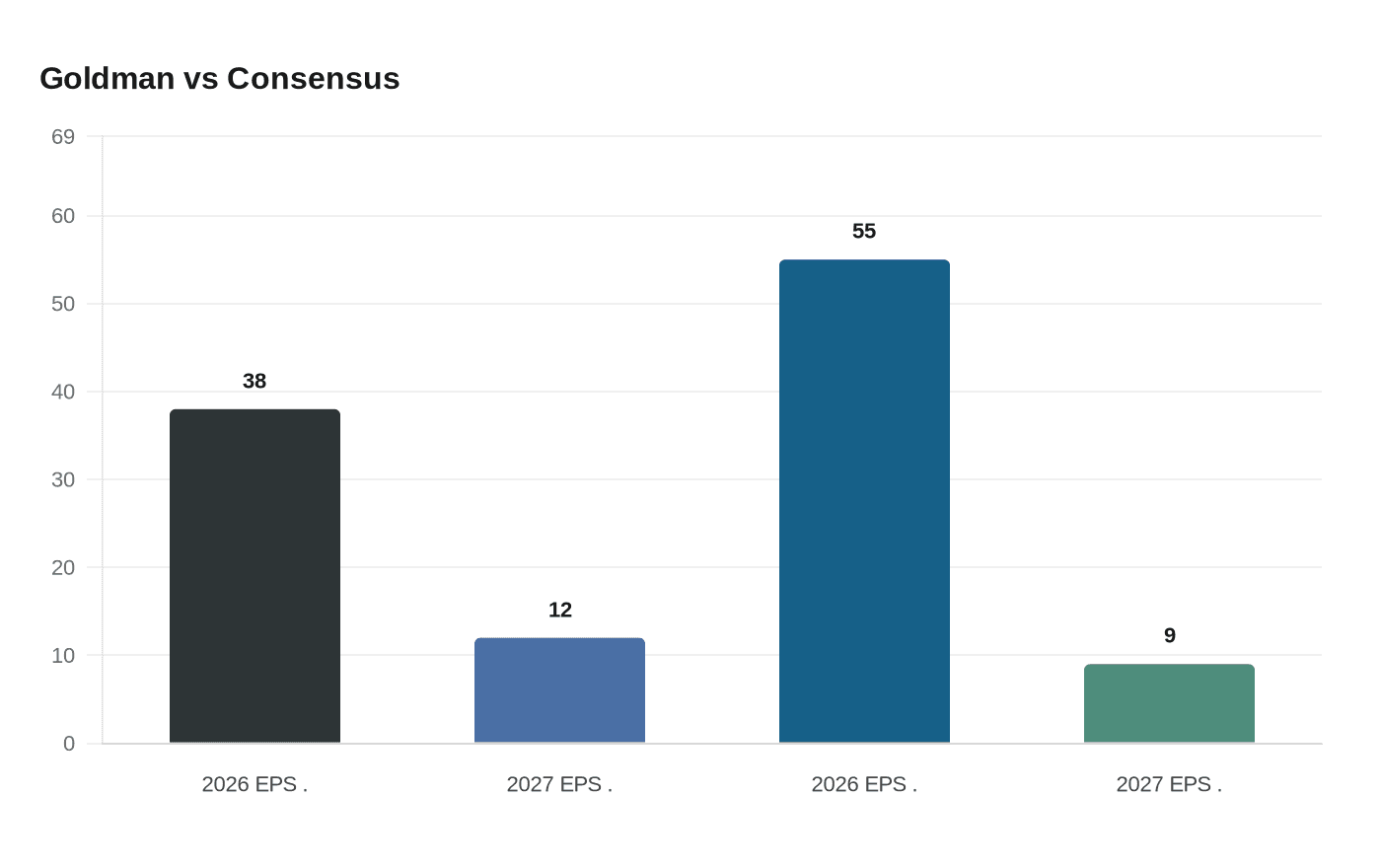
Goldman's one-month Hormuz shutdown scenario pushed its 2026 EPS estimates for covered oil majors 38% above LSEG consensus, with flows already down 18 Mb/d.

An 18-million-barrel-per-day collapse in oil flows through the Strait of Hormuz, roughly 10% of normal transit volumes, forced Goldman Sachs' commodity research and sector teams to overhaul their price and earnings models for European oil majors and the broader exploration and production sector on March 9.
The bank realigned its oil, gas, and refining price assumptions for 2026 and 2027 with the forward curve as of March 6, 2026, anchoring its baseline around Brent in the $80s for March and the high $70s in the second quarter. From there, Goldman applied a more severe stress case: a one-month total shutdown of the Strait of Hormuz.
"We are also factoring in the negative impact on production related to disruptions in the Strait of Hormuz, assuming a one-month total shutdown in the region. Consequently, our earnings per share (EPS) estimates for 2026 and 2027 increase by an average of 55% and 9%, respectively. This places us 38% above the LSEG consensus for 2026 forecasts, but only 12% above for 2027," Goldman Sachs stated.

The revised coverage spans bp, Eni, Equinor, Repsol, Shell, and TotalEnergies. The 38-point gap between Goldman's 2026 EPS outlook and the LSEG consensus reflects how far the bank's shutdown scenario diverges from where the broader analyst community had been positioned before the flow disruption emerged.
Goldman's commodity analysts framed their upside concerns around what the firm labeled "The 4 Pillars of Upside Risk," identifying four reasons why the probability of a major price spike above their baseline was intensifying rapidly. The bank stopped short of formally revising its oil-price forecasts at the time of publication, instead issuing a conditional warning: if flows through the Strait of Hormuz show no signs of gradual normalization in the coming days, a formal price-forecast revision would follow shortly.
The market response was immediate. Around 3:30 PM on March 9, European oil majors were trading higher across the board: Shell led the group at +1.92%, followed by Eni at +1.51%, bp at +1.4%, Repsol at +0.72%, and TotalEnergies at +0.69%.
The narrower spread between Goldman's 2027 EPS estimates and LSEG consensus, just 12% versus 38% for 2026, suggests the bank's analysts viewed the disruption as more acute in the near term, with some normalization built into the outer year even under the shutdown scenario. Whether that assumption holds depends entirely on how quickly, or whether, flows through the strait recover.
Know something we missed? Have a correction or additional information?
Submit a Tip