Goldman Sachs says AI economics are more questionable as costs rise
Goldman says AI spending is outrunning returns, a warning that could tighten budgets and force Goldman teams to prove every automation bet.
Goldman Sachs is getting more blunt about the gap between AI excitement and AI earnings: in a June 2 podcast, Jim Covello said the economics are “more questionable today than two years ago” because enterprise buyers, model companies and hyperscalers still have not shown returns on what they are spending.
That matters inside Goldman as much as it does in the market. If the return case keeps weakening, AI projects will face a harder test in budget season, vendor reviews and headcount approvals, especially for teams asking for more tools, more compute and more support staff on the promise that automation will pay back later. Covello said the industry has gotten “further away” from generating returns over the past couple of years.

Goldman’s May 11 note drew a sharper line between consumer enthusiasm and business reality. The bank said AI adoption among consumers has been “spectacular,” but most users are still on free versions, which leaves enterprise adoption as the real determinant of whether the business model works. Goldman also said most companies elsewhere in the AI ecosystem still have not made money, while hyperscalers are burning through cash and increasing borrowing.
So far, the clearest winners have been the semiconductor companies that supplied the boom. Goldman said they have captured most of the economic gains, but it does not think that pattern can last. The bank now expects hyperscalers to outperform semiconductor companies from here, a notable shift that reflects how quickly the value chain is moving from chip shortages and infrastructure spending toward the harder question of who actually earns durable profits.
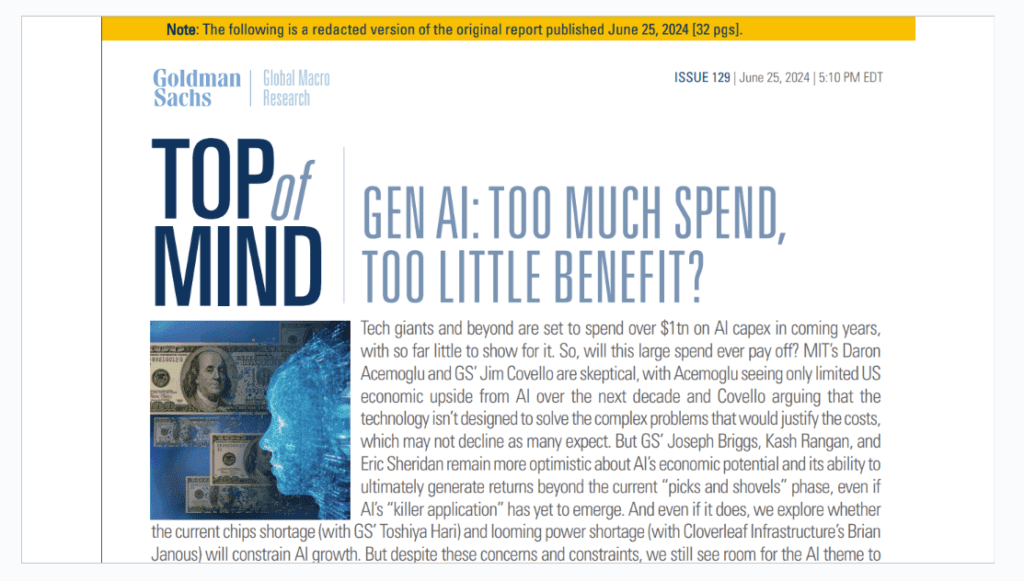
Goldman has been making that point for years. In June 2024, it estimated the AI buildout implied roughly $1 trillion in capex over coming years, including data centers, chips, other AI infrastructure and the power grid. In April 2025, it said Google, Microsoft, Amazon and Meta were expected to spend a combined $315 billion on capex that year, much of it on AI, even as model costs were falling. The February 2025 debate over low-cost rivals such as DeepSeek only intensified the pressure on that spending thesis.
For Goldman employees, the practical takeaway is simple: AI projects that once benefited from momentum now need measurable proof. If the industry’s returns remain concentrated in chips while the rest of the stack keeps spending, the next round of internal automation bets, client pitches and platform investments will face a far tougher hurdle than hype.
This article was produced by Prism’s automated news system from verified source data, official records, and press releases, then run through automated quality and moderation checks before publishing. The system is built and supervised by the people who set the standards it runs under. Read our full AI policy.
Know something we missed? Have a correction or additional information?
Submit a Tip