Goldman Sachs says AI is already slowing payroll growth, hitting young workers
AI cut monthly payroll growth by about 16,000 jobs and hit younger workers hardest, while Goldman found AI-augmented roles added 9,000 jobs.

AI is already trimming payroll growth in Goldman Sachs Research’s labor-market lens, and the first people feeling it are younger workers. In its April 24 note, economist Elsie Peng said AI cut monthly payroll growth by roughly 16,000 jobs over the past year and lifted the U.S. unemployment rate by 0.1 percentage point, while roles where AI augments human work added about 9,000 jobs a month.
The split matters inside a firm like Goldman Sachs, where the same technology can compress routine work and expand higher-value work at the same time. Goldman’s framework separates substitution from complementarity: occupations with high substitution risk are losing jobs, while roles with more augmentation potential are gaining them. The bank said industries with high AI substitution scores have seen unemployment rise on average, a warning sign for entry-level talent pools that depend on analyst and associate hiring to get into the firm and move up.
Goldman also excluded healthcare, education services and government from the April 24 estimate because those sectors were distorted by post-pandemic catch-up effects, a reminder that the headline number is not a clean read on the whole economy. Even so, the bank said offsetting demand from data center construction and AI-driven productivity and income gains means the aggregate drag from AI may be smaller than the payroll hit alone suggests.
That nuance is the reality check for white-collar workers. Goldman’s latest work does not describe a sudden collapse in hiring; it describes task redesign. AI can lower the cost of producing research, code, documents and client materials, which can increase demand and create new work even as it automates pieces of existing workflows. For junior bankers, consultants and operations staff, that means the first jobs to feel pressure are often the ones built around repeatable tasks, while judgment, client context and domain expertise become even more valuable.
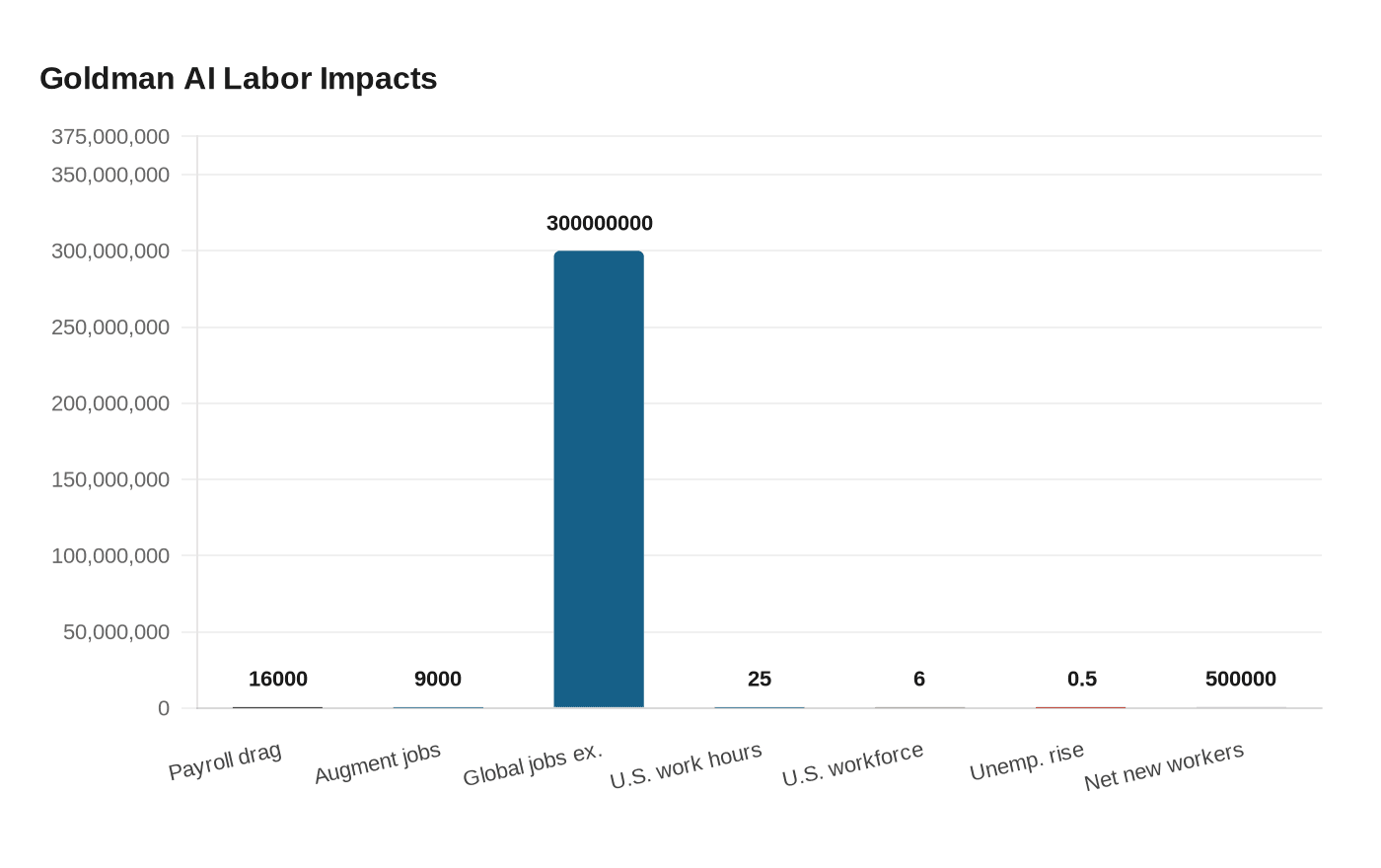
The April 24 note also fits into Goldman’s broader AI research. On March 18, the firm said 300 million jobs globally were exposed to automation by AI and that the technology could automate tasks accounting for 25% of all work hours in the U.S. Earlier, on August 13, 2025, Goldman estimated AI could displace 6% to 7% of the U.S. workforce in a wide-adoption scenario, with unemployment rising by about half a percentage point during the transition before labor-market dislocation faded over time.
Goldman’s own research also points to another labor market winner: the infrastructure needed to power AI. The bank said the U.S. may need roughly 500,000 net new workers by 2030 to meet demand tied to AI buildout, including construction, engineering, electrical contracting, HVAC, utilities construction and linework. For Goldman employees trying to position their careers, the message is stark: AI is no longer just a productivity theme. It is already changing which white-collar jobs get squeezed, which get enhanced and where the next hiring wave may land.
This article was produced by Prism’s automated news system from verified source data, official records, and press releases, then run through automated quality and moderation checks before publishing. The system is built and supervised by the people who set the standards it runs under. Read our full AI policy.
Know something we missed? Have a correction or additional information?
Submit a Tip