Goldman Sachs says China, India will overtake US by 2075
Goldman Sachs sees China passing the US around 2035 and India by 2075, a shift that could redraw where bankers build teams and control functions.
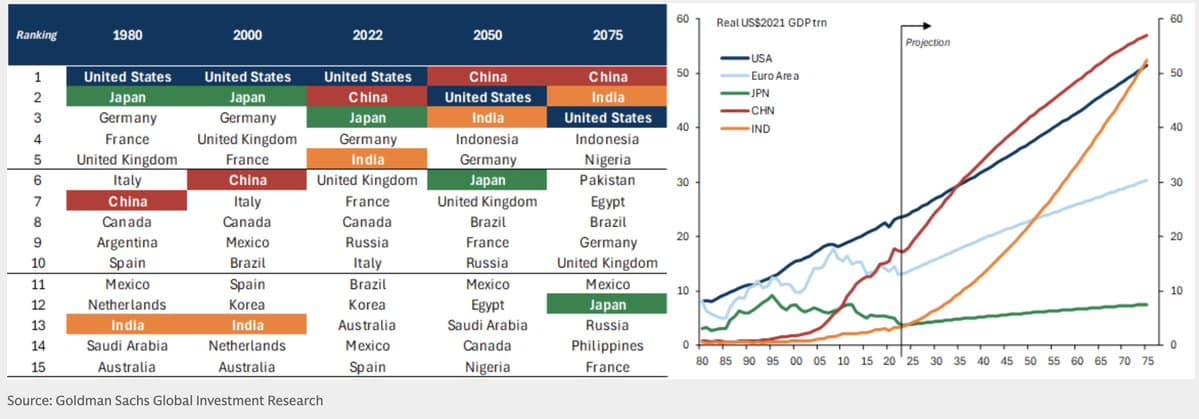
Goldman Sachs Research projected that China will overtake the US as the world’s largest economy around 2035, with India edging past the US by 2075. It also said that by 2050 the five biggest economies will be China, the US, India, Indonesia and Germany, and that seven of the top ten economies in 2075 could be emerging markets if policy and institutions hold.
The forecast came in Goldman Sachs Research’s December 8, 2022 paper, which expanded the firm’s long-run growth model to 104 countries. The report argued that the world had passed the high-water mark of global potential growth because population growth is weakening: global population growth has fallen from about 2% a year over the past 50 years to less than 1%, and Goldman expects it to fall close to zero by 2075. For Goldman’s bankers, that means the firm’s next big operating question is not just where GDP is rising, but where leadership benches, client coverage and control functions need to deepen fastest.
Goldman also said the US had just come through a decade of exceptional performance that is unlikely to be repeated. Even so, the bank later said the US would remain the world leader in wealth and stock-market size even if its GDP ranking slips. That split matters inside a firm that lives on both capital flows and market rankings: a country can lose the top spot in output while still anchoring balance sheets, listings, asset management and compensation pools.

India sits at the center of Goldman’s long-range case. In a 2023 India note, Kevin Daly, Tadas Gedminas and Santanu Sengupta said the country could become the world’s second-largest economy by 2075, overtaking the US, Japan and Germany. Goldman said that rise would be supported by India’s 1.4 billion population, a relatively low dependency ratio over the next two decades, higher capital investment, innovation, technology gains and rising worker productivity. The bank also said India’s dependency ratio would be among the lowest of regional economies over the next two decades, while infrastructure spending and manufacturing capacity would be crucial to the window of opportunity.
For Goldman employees, the practical takeaway is that the next generation of prestige work may tilt further toward emerging markets, where market access, local hiring, regulatory control and senior talent pipelines become as important as New York or London deal flow. Goldman’s own long-term view has been remarkably consistent for nearly two decades, and its 2075 forecast suggests the firm expects the center of gravity for global finance to keep moving with it.
This article was produced by Prism’s automated news system from verified source data, official records, and press releases, then run through automated quality and moderation checks before publishing. The system is built and supervised by the people who set the standards it runs under. Read our full AI policy.
Did this article answer your question?