Goldman Sachs says stronger UK social mobility could boost growth
Goldman’s latest UK social mobility report casts mobility as a growth lever, arguing that wider access to talent and better productivity can strengthen the economy and its hiring pool.
Goldman Sachs is recasting UK social mobility as a hard-nosed talent and growth issue, not a side note to public policy. In a new research note, the firm argues that stronger mobility could widen the pool of high-potential hires, lift productivity and spur innovation, making the case that access matters as much for Goldman’s own recruiting engine as it does for the wider economy.
The report, The Potential Economic Gains from Boosting UK Social Mobility, was published on June 15, 2026. It also pointed to defined contribution pension assets, saying they appear to have performed comparably with some of the better-performing asset classes, a reminder that inequality is shaped not only by wages but by long-term participation in capital markets.

That perspective fits Goldman’s research model. Goldman Sachs Research says its coverage spans more than 3,000 securities across more than 45 economies, and the bank has long used that platform to turn local labor-market questions into broader arguments about competitiveness. Goldman says it opened its first London office in 1970, now has offices in London and Birmingham, and had more than 6,000 people in the UK as of 2025.
The Birmingham push is especially relevant to the talent argument. When Goldman said in 2021 that its build-out there would give it access to a strong, deep new talent pool, excellent academic institutions, a growing technology sector and longstanding leadership in STEM industries, it was effectively describing a search for ability beyond the traditional City pipeline. For analysts, associates and vice presidents, that matters because the firm’s future bench depends on where it can find people before pedigree hardens into a hiring shortcut.
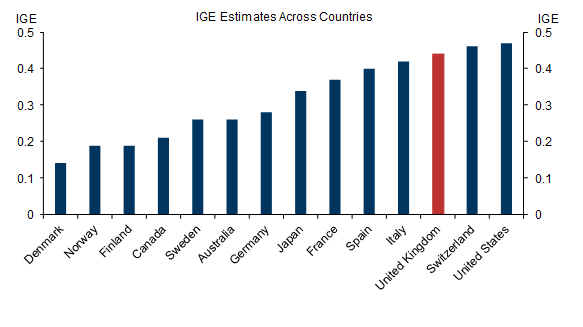
Goldman has been making this case for years. A February 2022 piece said the UK performed poorly on social mobility and inequality comparisons, and in April 2022 researchers Sharon Bell and Steffan Ball said the country ranked near the bottom of the international league table for social mobility, with the pandemic worsening the picture and energy-price inflation likely to make it worse again.
Independent data keeps reinforcing the point. The Social Mobility Commission’s State of the Nation 2025 report, published on December 18, 2025, tracks 40 indicators across childhood, intermediate outcomes and long-term mobility. It found extreme regional disparities, especially in former industrial and mining areas in the North East of England, Yorkshire and the Humber, the West Midlands, Wales and Scotland, even as 48.2% of young people aged 25 to 29 were in professional occupations between 2022 and 2024, up from 36.1% between 2014 and 2016.
Goldman’s 10,000 Small Businesses UK program gives the argument another layer. The firm says the program has supported more than 2,500 businesses since 2010, and that those alumni businesses account for an estimated 82,000 jobs and £10.6 billion in annual revenue. For Goldman, the broader message is straightforward: when mobility improves, the candidate pool gets bigger, the business gets more productive, and the City gets a little less dependent on the same narrow channels of privilege.
This article was produced by Prism’s automated news system from verified source data, official records, and press releases, then run through automated quality and moderation checks before publishing. The system is built and supervised by the people who set the standards it runs under. Read our full AI policy.
Know something we missed? Have a correction or additional information?
Submit a Tip