Goldman Sachs shareholders elect directors, back pay, reject proposals
Shareholders re-elected Goldman’s entire 13-member board and backed David Solomon’s $47 million pay package, even as three governance proposals failed.
Goldman Sachs came out of its annual meeting with its leadership slate intact and its compensation program still standing, a sign that investors were willing to give the firm room to keep its current strategy in place.
Shareholders elected all 13 director nominees to one-year terms expiring at the 2027 annual meeting, approved the advisory say-on-pay vote on executive compensation, and ratified PricewaterhouseCoopers LLP as the firm’s independent auditor for the year ending Dec. 31, 2026. The meeting was held at Goldman’s offices at 111 South Main Street, 14th Floor, in Salt Lake City, Utah, with the record date set for the close of business on March 2, 2026. The proxy statement had been filed March 20.
The board slate included Michele Burns, Mark Flaherty, Kimberley Harris, John Hess, Kevin Johnson, Ellen Kullman, KC McClure, Thomas Montag, Peter Oppenheimer, David Solomon, Jan Tighe, David Viniar and John Waldron. Goldman had previously said Lakshmi Mittal tendered his proposed retirement from the board under the firm’s age-based retirement policy, leaving the slate at 13 rather than expanding it.

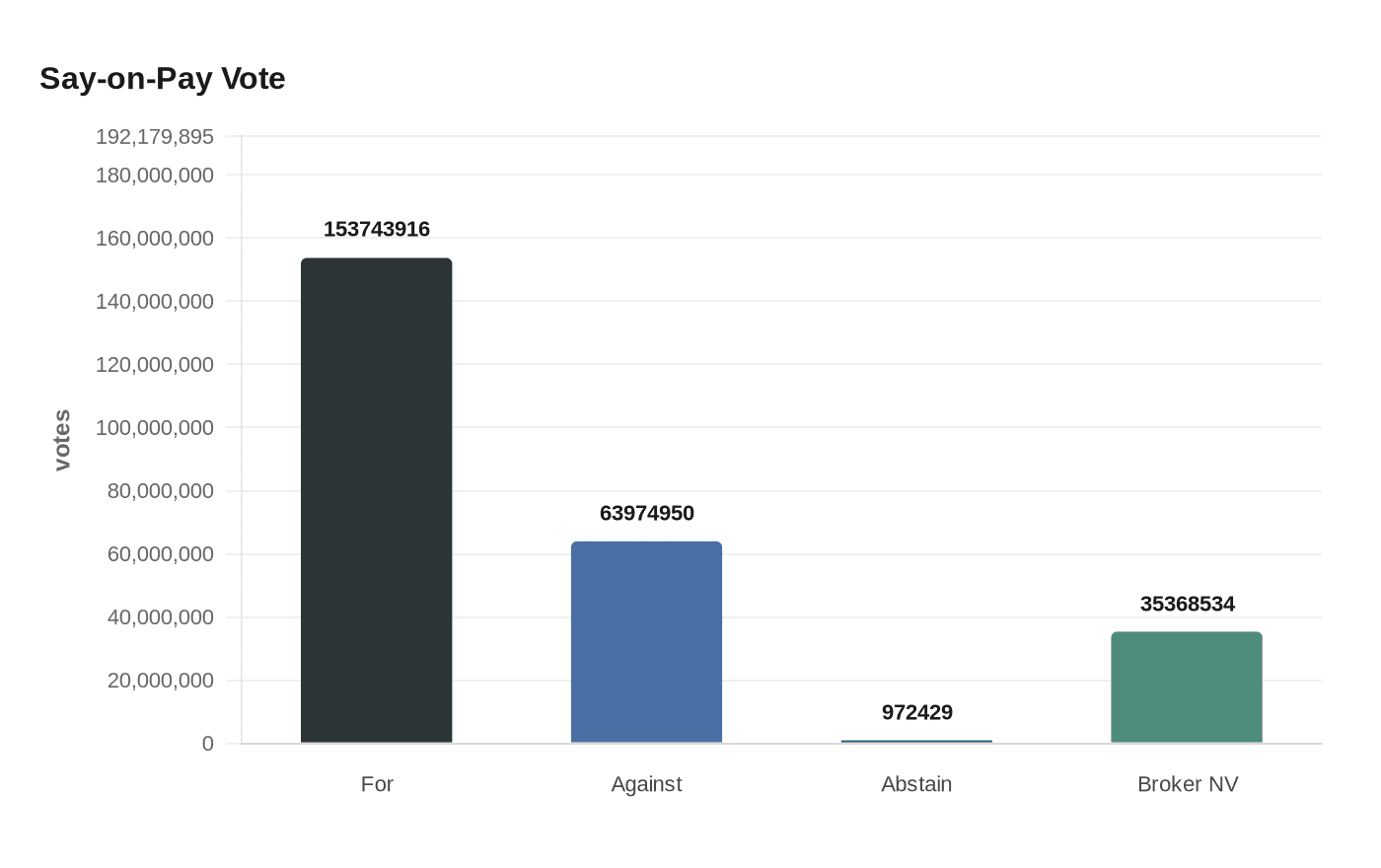
The clearest signal for executives was the pay vote. Goldman said shareholders approved say-on-pay with 153,743,916 votes in favor, 63,974,950 against, 972,429 abstentions and 35,368,534 broker non-votes. The firm had disclosed that Solomon’s 2025 total annual compensation was $47 million. That support matters inside a business where bonus pools, year-end comp and title progression can shape careers as much as headline salary. It also gives the board breathing room to keep its compensation philosophy in place after a year in which Goldman said net revenues rose 9% to $58.3 billion, earnings per share climbed 27% to $51.32 and return on equity improved to 15.0%.
Three shareholder proposals did not pass, reinforcing that investors were not eager to push a broader governance reset. A proposal on special shareholder meeting thresholds failed by 80,499,426 votes to 137,565,083. A proposal on energy supply ratio disclosure failed by 39,993,303 to 177,047,898. A proposal on lobbying disclosure failed by 82,476,204 to 134,698,724.
The pattern is familiar for Goldman: investors are still pressing on transparency and governance, but not enough to disrupt management continuity. After a stretch in which the company’s pay practices drew more scrutiny and 2025 say-on-pay support was reported at 66% on a preliminary count, the 2026 vote showed firmer backing for Solomon and the board. For a firm built on stability at the top and intense scrutiny at every level below it, that is as close to a clean readout as shareholder votes usually get.
This article was produced by Prism’s automated news system from verified source data, official records, and press releases, then run through automated quality and moderation checks before publishing. The system is built and supervised by the people who set the standards it runs under. Read our full AI policy.
Did this article answer your question?