Goldman Sachs turns bullish on SpaceX as Nasdaq-100 buying looms
SpaceX’s Nasdaq-100 entry set off a Goldman loop: underwriting, bullish research and passive index buying all hit at once, with $4.3 billion in inflows eyed.
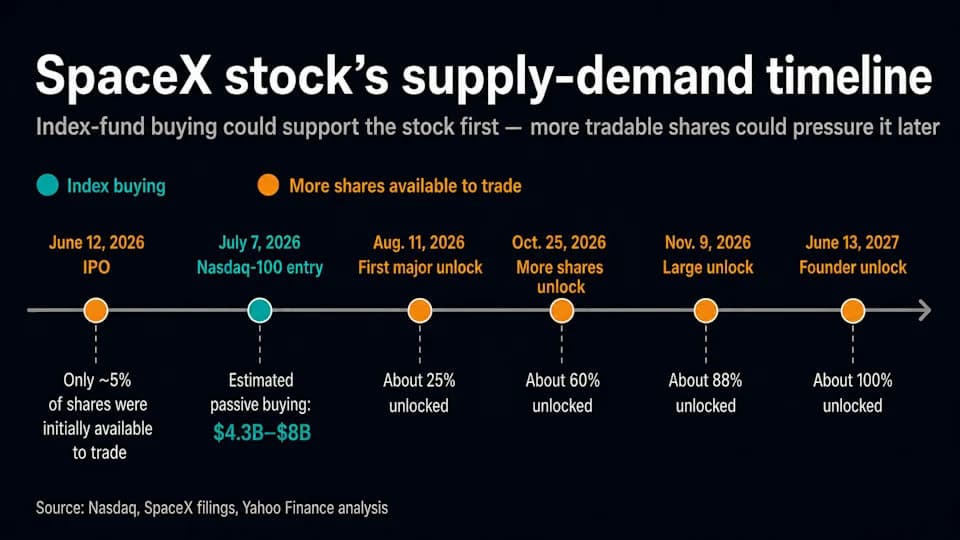
SpaceX’s addition to the Nasdaq-100 on July 7 set up a fast-moving trade for Goldman Sachs, where the company’s underwriting ties, fresh research call and the index’s passive-buyer base all lined up at once. Nasdaq said SpaceX would join before the market open, making it one of the quickest additions the benchmark has ever made under its newer fast-track rule for newly public companies.
That mattered because the Nasdaq-100 is tracked by more than 200 investment products with more than $800 billion in assets under management globally. Index-tracking funds such as Invesco QQQ Trust could begin buying after the market close on July 6, and J.P. Morgan estimated the change could draw $4.3 billion in passive inflows. Even with a relatively small float, the stock’s weight was enough to force rebalancing, with market estimates ranging from less than 1% to 1.34% in LSEG data.
Goldman’s coverage was bullish. Analysts said, “We see the company as well-positioned to scale its differentiated advantages across space, connectivity, and AI.” They argued those markets could each become multi-trillion-dollar opportunities over a five-plus-year horizon, a framing that put SpaceX squarely in the same category as other long-duration technology stories that can support premium valuations even when near-term earnings are messy.

The timing also showed how tightly Goldman’s businesses can reinforce one another. Morgan Stanley, Goldman Sachs and JPMorgan were among the SpaceX IPO underwriters, and the same franchise now has a role in how the stock is framed after the deal. Equity research helps set the narrative, sales and trading desks have to absorb the flow from index funds, and the bank’s private-company access becomes a public-market revenue engine instead of a one-time transaction. More than a dozen brokerages launched coverage with top ratings, turning the first conventional valuation exercise into a coordinated market event.
The stock still had its own gravity. SpaceX, which debuted on June 12 and swung between sharp losses and small profits over the prior three years, posted a net loss of $4.9 billion last year. Short sellers had already sold about 40 million shares, roughly 5% to 7% of the float, and were paying about 60 basis points to borrow them. Mark Hackett of Nationwide said expectations looked too high and the stock could stay pressured until earnings arrive, a reminder that index demand, analyst enthusiasm and actual trading performance do not always move together.
This article was produced by Prism’s automated news system from verified source data, official records, and press releases, then run through automated quality and moderation checks before publishing. The system is built and supervised by the people who set the standards it runs under. Read our full AI policy.
Did this article answer your question?