Goldman Sachs warns stock market concentration has reached historic levels
Goldman says the top 10 S&P 500 stocks now make up 36.5% of the index, while the bank still sees the market rising this year.
A rally powered by a small cluster of megacaps is now so narrow that Goldman Sachs says U.S. equity concentration has reached historic levels. The bank’s latest warning said the top 10 stocks in the S&P 500 account for 36.5% of the index by market capitalization, a setup that leaves research, sales, trading and wealth teams with an increasingly concentrated story to explain to clients.
Goldman framed the risk less as an automatic overvaluation call on Nvidia, Apple or Microsoft than as a market structure problem. Its analysis said the danger is that investor sentiment can turn and trigger a rotation out of the names that have carried the index. That matters inside Goldman because a concentrated market is harder to trade around, harder to diversify away from, and harder for active managers to express views on smaller stocks. Goldman also said the issue is most pronounced in the United States, while developed markets outside the U.S. have seen concentration decline over time.

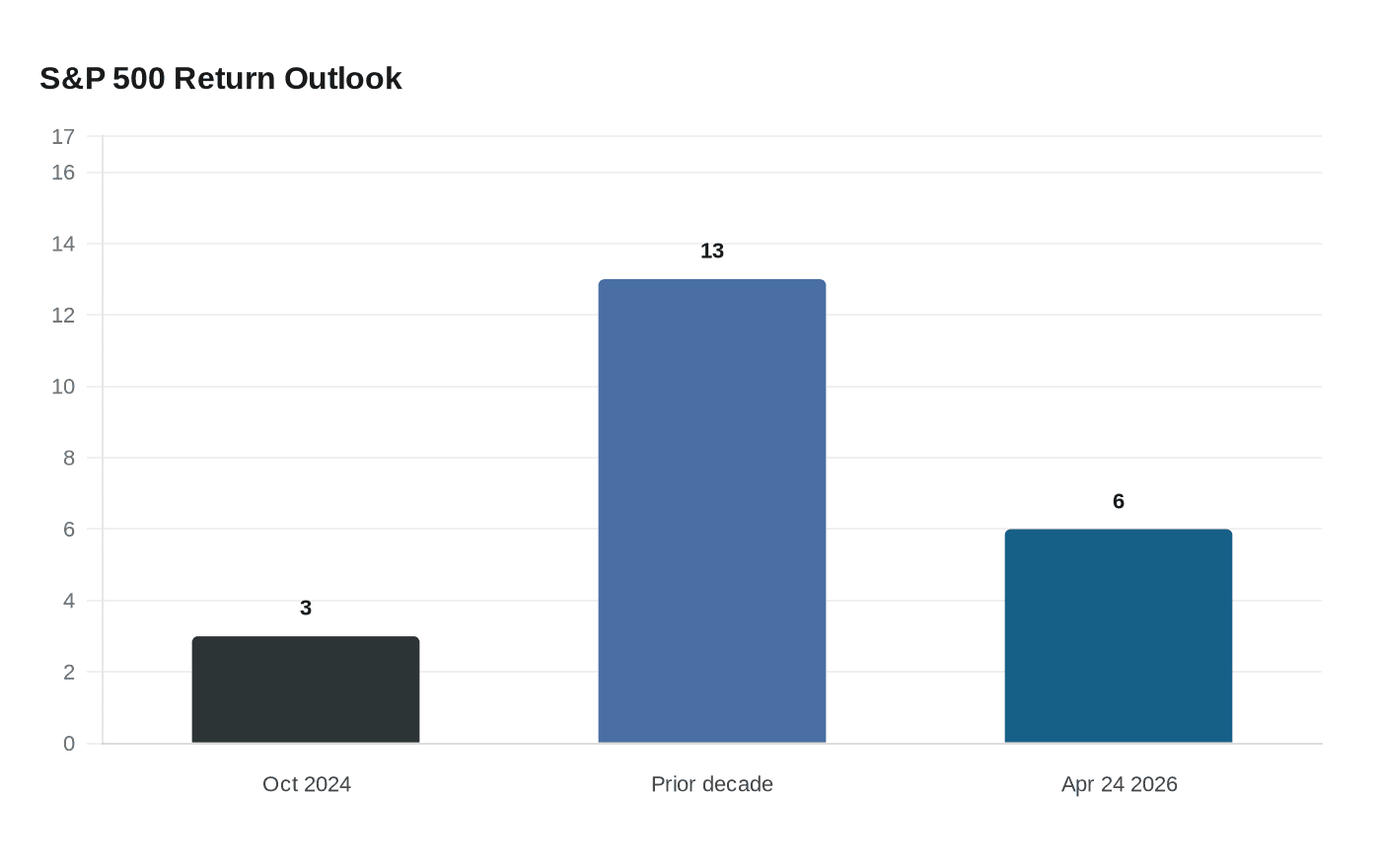
The bank has been pressing that point for more than a year. In October 2024, Goldman estimated the S&P 500 would produce just 3% annualized nominal total return over the next 10 years, far below the 13% annualized pace of the prior decade. Goldman said removing the effects of concentration would lift that forecast by 4 percentage points, and it argued that market concentration was near its highest level in 100 years. It also said the S&P 500 equal-weight benchmark could beat the cap-weighted index by 200 to 800 basis points a year over the next decade.
Goldman’s November 2024 Top of Mind discussion put a sharper number on how top-heavy the market had become. The Magnificent 7 had returned 41% year to date and accounted for 47% of the S&P 500’s gains in 2024, underscoring how much index performance rested on a few technology leaders. The bank has tied that outperformance to the rise of artificial intelligence and hyperscaler stocks.
Even so, Goldman’s 2026 U.S. equity outlook remains constructive. As of April 24, 2026, the bank still forecast the S&P 500 to rise 6% to a year-end target of 7,600, backed by expected earnings growth of 12% in 2026 and 10% in 2027. For Goldman employees, that leaves a familiar tension: the market can still go up, but if leadership stays this narrow, every client conversation, portfolio recommendation and relative-performance score gets more dependent on whether a handful of stocks keep doing the heavy lifting.
This article was produced by Prism’s automated news system from verified source data, official records, and press releases, then run through automated quality and moderation checks before publishing. The system is built and supervised by the people who set the standards it runs under. Read our full AI policy.
Did this article answer your question?