Goldman Sachs warns tech-driven layoffs leave lasting wage scars
Goldman economists Pierfrancesco Mei and Jessica Rindels found tech-displaced workers take about one month longer to find work and suffer more than 3% lower real wages on reemployment.

Goldman Sachs economists Pierfrancesco Mei and Jessica Rindels quantified a persistent penalty for workers who lose jobs to technological change: about one month longer to find a new position and more than a 3% drop in real wages at reemployment. The research, based on roughly four decades of individual-level data, frames those shortfalls as the opening act of a decade-long drag on earnings for affected workers.
The note tracked more than 20,000 individuals across two cohorts, workers born in the 1950s and 1960s and workers born in the 1980s, using the National Longitudinal Surveys sponsored by the U.S. Bureau of Labor Statistics. Over a 10-year horizon the economists find real earnings growth for technology-displaced workers lags nearly 10 percentage points relative to never-displaced peers and about 5 percentage points relative to workers displaced for other reasons.
Goldman isolates occupational downgrading as the primary mechanism: displaced workers are more likely to move into routine occupations that require fewer analytical and interpersonal skills because the same technological shifts that eliminated prior roles also erode the market value of existing skills. The research further warns that macroeconomic conditions amplify the effects: recession-era technology displacement adds roughly three weeks of unemployment and raises the risk of returning to unemployment and of exiting the labor force by about five percentage points each.
The authors summarize the policy challenge plainly: "AI-driven displacement could impose lasting costs on affected workers." Those costs extend beyond paychecks; the analysis links early-career displacement, roughly ages 25-35, with slower wealth accumulation, delayed home buying and lower marriage rates at comparable ages, outcomes that crystallize the long-term fiscal and social consequences of labor-market scarring.
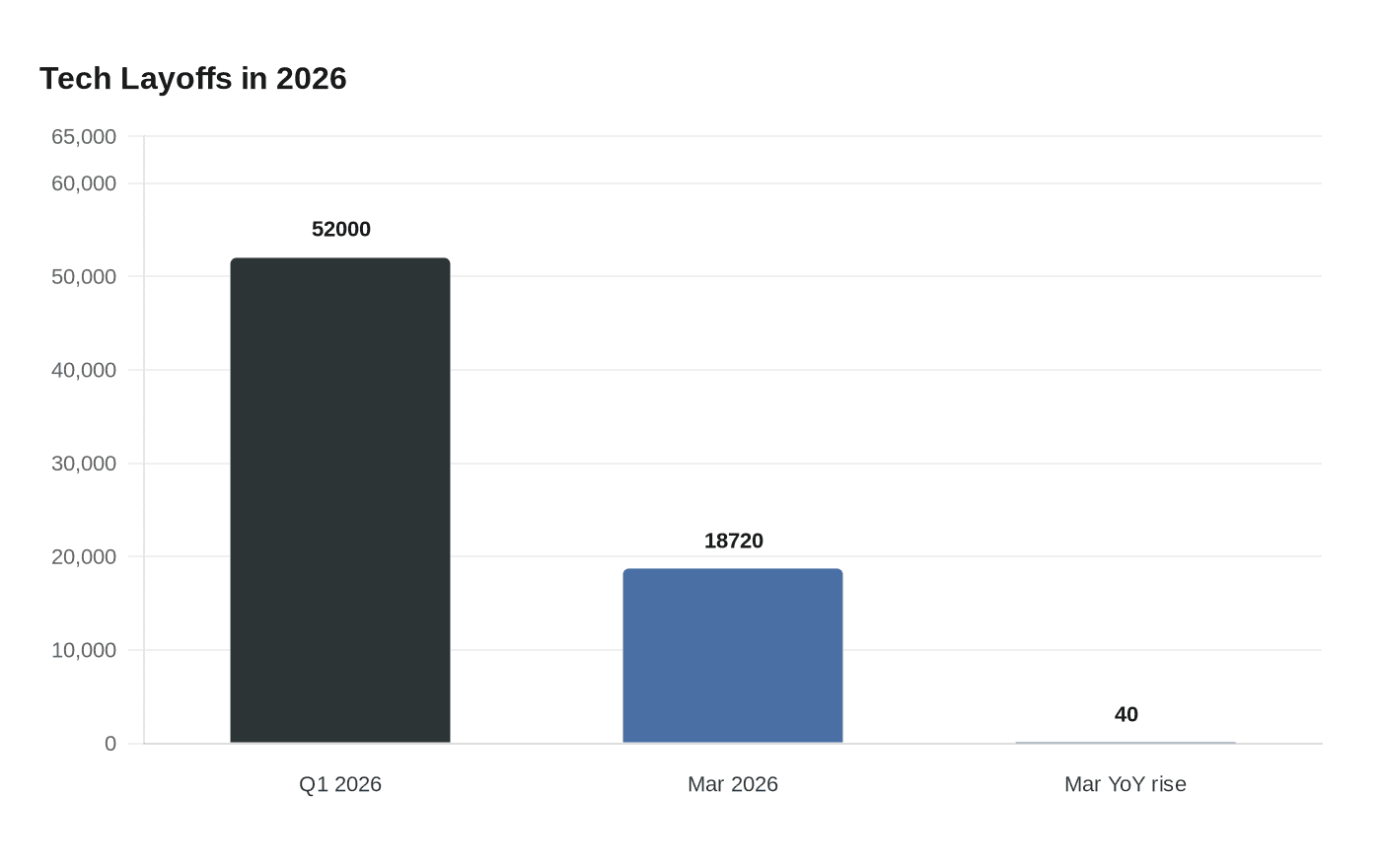
Industry signals make the findings immediate for Goldman staff. Challenger, Gray & Christmas estimates more than 52,000 U.S. tech employees were laid off in the first three months of 2026, with March cuts of 18,720, up about 40% year over year, and Andy Challenger said companies are shifting budgets toward AI investments "at the expense of jobs". Block CFO Amrita Ahuja urged finance leaders to be "curious" about automation, noting you often don't get an "aha moment" until you automate work that used to take days down to hours or less.
For Goldman employees the research has concrete implications: it reinforces internal AI upskilling and mobility programs as retention tools, argues for targeted redeployment into roles such as AI-enabled product management, data governance, model risk and human-in-the-loop oversight, and signals that exits into sectors with rapid AI substitution carry added long-term earnings risk for junior analysts and associates. The note also sits alongside Goldman Sachs Research work from March 26, 2023, which estimated two-thirds of U.S. occupations are exposed to AI and that generative AI could substitute up to one-quarter of current work while raising annual U.S. productivity growth by just under 1.5 percentage points over a decade.
Management faces a clear trade-off: automate to improve margins and centralize workflows, while scaling retraining and internal mobility to avoid a measurable hit to talent retention and the firm’s employer brand. The research turns a familiar productivity pitch into an explicit personnel risk that compensation committees, mentors and HR must now factor into career-planning and workforce strategy.
This article was produced by Prism’s automated news system from verified source data, official records, and press releases, then run through automated quality and moderation checks before publishing. The system is built and supervised by the people who set the standards it runs under. Read our full AI policy.
Did this article answer your question?