Goldman says central banks will keep boosting gold purchases into 2026
Goldman lifted its central-bank gold-buying view to 60 tons a month in 2026, keeping commodities desks busy as reserve managers keep buying.

Goldman Sachs raised its view on official-sector gold demand, saying central banks are likely to buy about 60 tons a month in 2026, up from a prior estimate of 29 tons. In a May 15 note by Lina Thomas and Daan Struyven, the bank said its revised framework put the 12-month moving average of purchases at 50 tons in March 2026, with part of the change tied to gaps in trade data, including missing gold outflow records from London that began in August 2025.
For Goldman’s commodities staff, that matters because it keeps gold from becoming just another tactical call. Persistent central-bank buying gives traders, salespeople and strategists a cleaner narrative to take to clients: dips can still be buying opportunities, hedging costs can stay in focus, and short-term weakness in rates or the dollar does not automatically break the longer-term case. It also keeps the precious-metals complex tied to the bank’s macro and client coverage work, where reserve diversification and geopolitical risk often matter as much as price momentum.

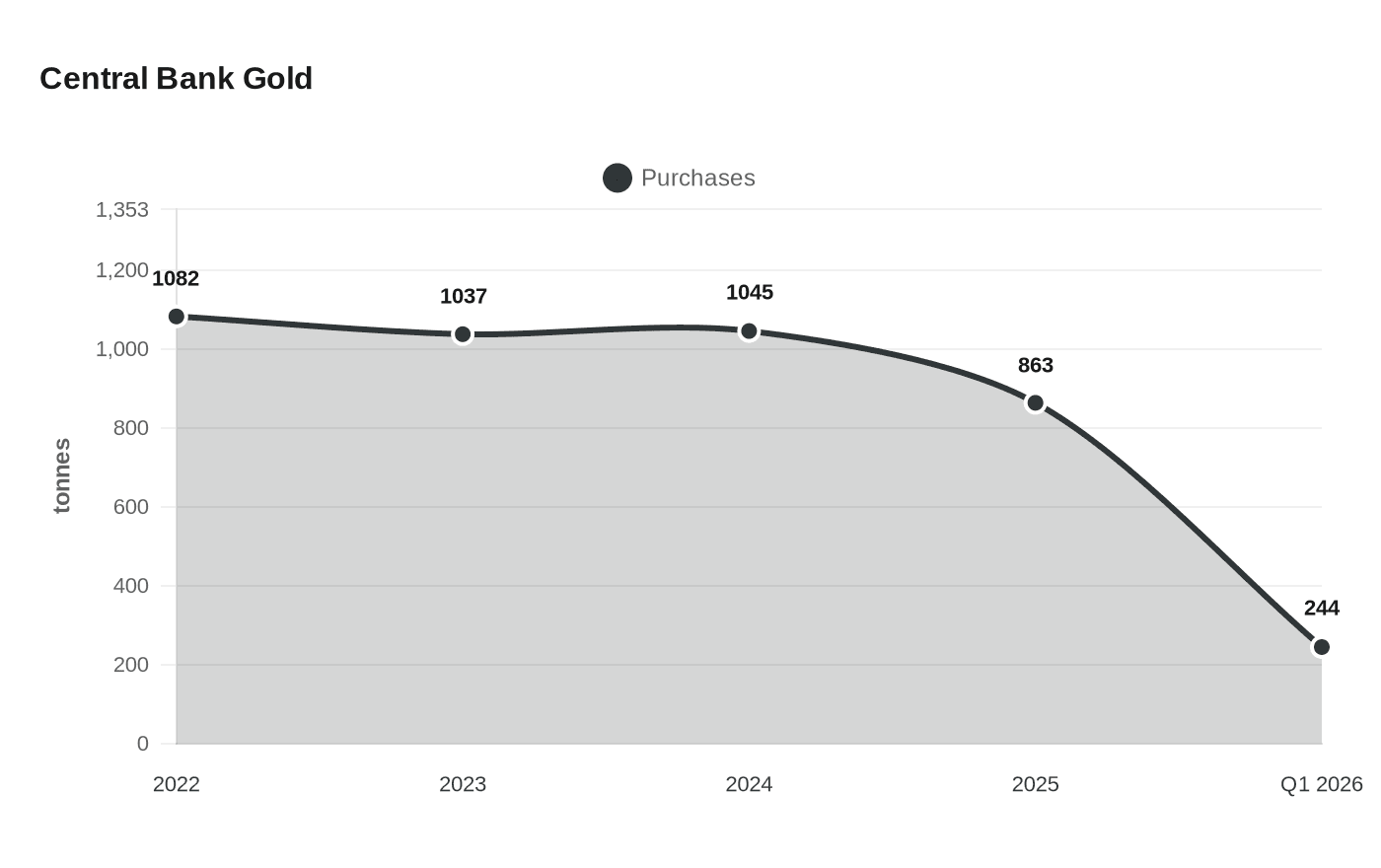
The broader backdrop supports that view. The World Gold Council said central banks bought 863 tonnes of gold in 2025, after 1,045 tonnes in 2024, 1,037 tonnes in 2023 and a record 1,082 tonnes in 2022. In the first quarter of 2026, estimated net purchases were 244 tonnes, a pace that exceeded the previous quarter and the five-year average. Goldman’s 60-ton monthly estimate would imply roughly 720 tonnes of official buying over a full year, enough to keep one corner of the market structurally bid even if speculative flows fade.

Reserve managers are still signaling more demand. In the World Gold Council’s 2025 survey, 95% of respondents said they expected global gold reserves to rise over the next 12 months, and a record 43% said their own reserves would increase. The Bank of England remained the most popular storage location in that survey, underscoring how much of this market still runs through London, even as the data picture has gotten noisier.
Some of the buying has been especially visible. The National Bank of Poland was the largest reported net buyer in 2024, adding 90 tonnes, while Turkey bought 75 tonnes and India 73 tonnes. Poland’s governor, Adam Glapiński, has said the bank wants gold to make up a larger share of reserves. For Goldman, that kind of behavior keeps commodity research relevant well beyond the metals desk, because gold still sits at the intersection of inflation credibility, fiscal anxiety and reserve management, exactly the mix that can keep clients calling even when the broader market story changes.
This article was produced by Prism’s automated news system from verified source data, official records, and press releases, then run through automated quality and moderation checks before publishing. The system is built and supervised by the people who set the standards it runs under. Read our full AI policy.
Did this article answer your question?