JPMorgan sees fee growth, Goldman faces tougher competition and costs
JPMorgan’s fee outlook points to a busier quarter, but higher expenses suggest Goldman bankers may see more work before they see easier money.

Jamie Dimon’s call for 10% or more growth in JPMorgan Chase’s investment-banking fees is a bullish sign for the Street, but it also comes with a warning that Goldman Sachs bankers know well: more revenue usually means more pitch work, more travel, and more pressure to execute before anyone gets to talk about a cleaner bonus season. Dimon also said JPMorgan’s 2026 expenses could finish about $1 billion above earlier expectations, closer to $106 billion than $105 billion, a reminder that fee momentum can get swallowed quickly by higher compensation, technology spending, and the cost of keeping teams fully staffed.
For Goldman’s M&A, equity capital markets, and financing desks, that matters because it suggests the pickup in client activity is broad enough to keep mandates flowing, but not broad enough to make the business easy. Dimon said he was still looking for a large acquisition and suggested JPMorgan could put about $10 billion to $20 billion to work over the next couple of years. He also described Wall Street clients as “gung ho” and said a lot of big deals were being discussed. That is the kind of commentary that tends to ripple through coverage groups and product teams at Goldman, where every faster-moving client conversation tends to create more internal coordination, more late-night revisions, and more competition for the same advisory assignments.

Goldman’s own first-quarter numbers showed why the signal matters. On April 13, the firm said investment-banking fees rose 48% to $2.84 billion, about $340 million above expectations, helped by a surge in advisory revenue from completed merger transactions. Goldman also posted record equities trading revenue and its second-highest quarterly revenue ever, a combination that showed how quickly activity can lift multiple parts of the franchise at once.
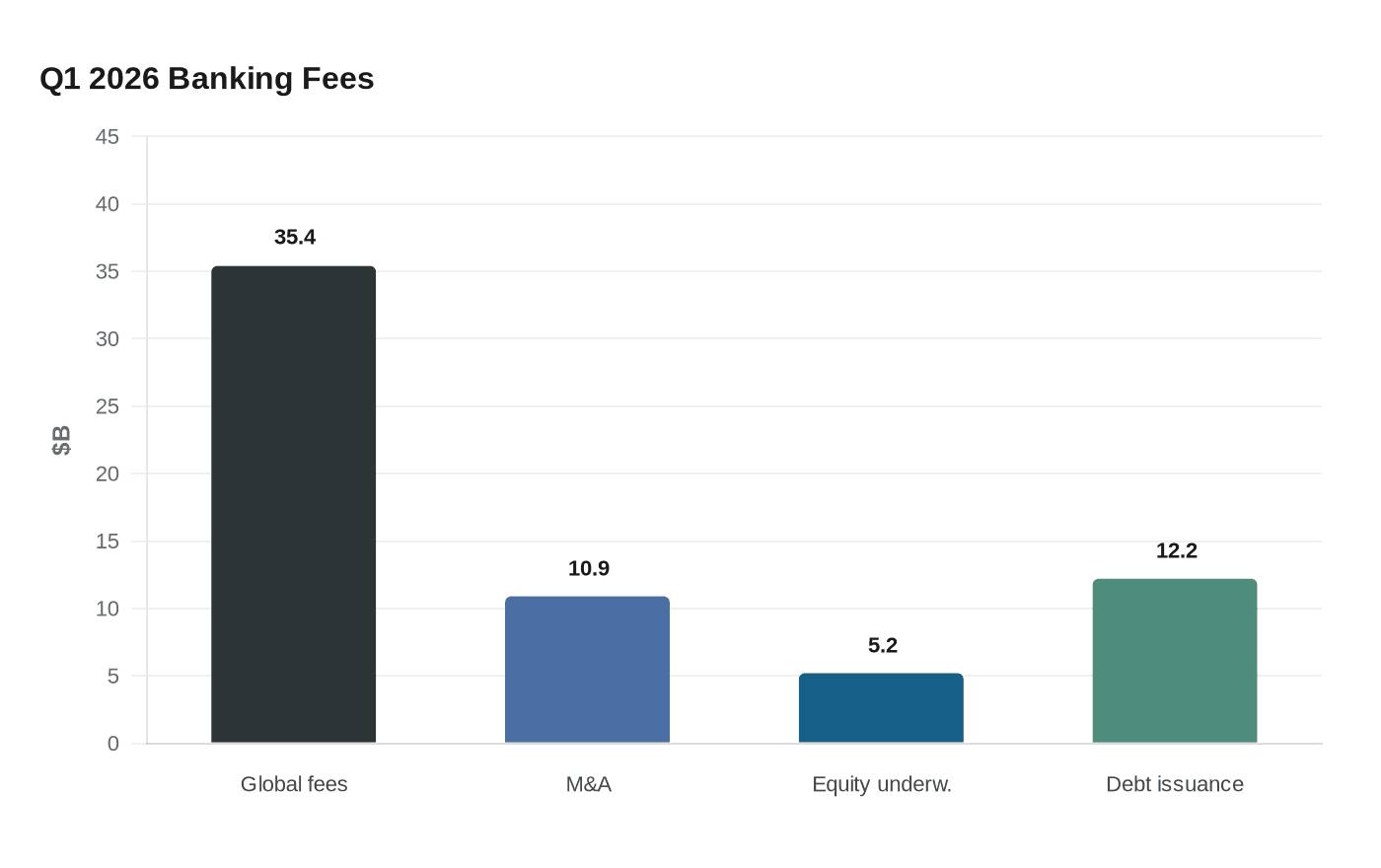
The broader market backdrop is also improving. LSEG data showed global investment-banking fees rose 9% year over year to $35.4 billion in the first quarter of 2026. Within that, M&A fees climbed to $10.9 billion, equity underwriting fees jumped 51% to $5.2 billion, and debt-issuance fees increased 5% to $12.2 billion. In other words, the pipeline is not just holding up in one corner of the market; it is getting better across advisory and capital markets.
The competition is getting sharper too. Financial Times league-table data showed JPMorgan led first-quarter global investment-banking fees with $3.10 billion, while Goldman Sachs ranked second at $2.49 billion. Goldman’s fees were up 31% from the prior period, while JPMorgan’s rose 24%. That leaves Goldman in a familiar position: well placed to benefit from a stronger deal cycle, but still fighting for share against a bank that is spending heavily, shopping for acquisitions, and signaling that the race for wallet will stay intense.
This article was produced by Prism’s automated news system from verified source data, official records, and press releases, then run through automated quality and moderation checks before publishing. The system is built and supervised by the people who set the standards it runs under. Read our full AI policy.
Did this article answer your question?