US consumer confidence edges up as job market fears deepen
Consumer confidence rose to 91.2, but the share saying jobs are hard to get jumped to 22.5%, a warning sign for Goldman’s clients and recruiting outlook.
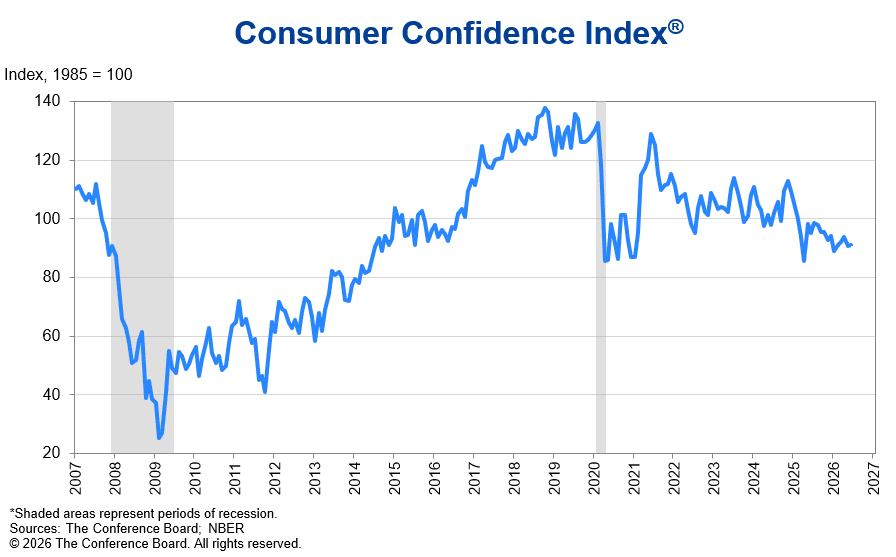
Consumer confidence in the United States edged up in June, but the labor market reading moved the other way, a split that should matter for Goldman Sachs teams watching consumer demand, hiring plans and deal chatter. The Conference Board’s index rose to 91.2 from a downwardly revised 90.6 in May, while the share of consumers saying jobs were hard to get climbed to 22.5%, its highest level since January 2021.
That divergence is the part to watch. The Present Situation Index fell 3.0 points to 116.4, while the Expectations Index rose 3.0 points to 74.4, leaving households a little less gloomy about the present but more uneasy about what comes next. The Conference Board said the June survey ran from June 1 through June 23 and overlapped with the extension of the U.S.-Iran ceasefire agreement, a backdrop that helped keep energy prices in check.
Dana M. Peterson, chief economist at The Conference Board, said falling oil prices had provided some relief to consumer inflation fears. She also said perceptions of current labor market conditions softened and that consumers expected little change in the labor market six months from now. The labor market differential fell to plus 2.4%, a sign that confidence in job availability weakened even as the headline confidence measure improved.
For Goldman, that mix is an early warning signal, not a recession call. Households that feel less secure about work often become more cautious on discretionary spending, and that shows up first in retail, housing and consumer credit conversations before it reaches broader headline data. It can also affect how corporate clients talk about hiring, pricing and inventory, especially when they are trying to read whether demand is softening or simply becoming more selective.

The June reading also came in below expectations. Economists had forecast the confidence index at 94.7, a gap that suggests consumers were more cautious than Wall Street had anticipated. A fragile truce in the Middle East helped push gasoline lower, with AAA saying the national average fell below $4 a gallon on June 18 to $3.99, easing inflation worries but not restoring confidence in job prospects.
The official labor data have not yet cracked in the same way. The U.S. Bureau of Labor Statistics said May job openings stood at 7.594 million, a two-year high, while total nonfarm payrolls rose by 172,000 and unemployment held at 4.3%. Goldman Sachs’ 2026 U.S. outlook still calls for 2.5% GDP growth and unemployment stabilizing at 4.5%, but it flags labor market weakness as a key risk. That gap between solid headline numbers and shakier perceptions is now visible in the consumer data, and it is likely to shape how clients and employees read the next round of hiring, spending and compensation decisions.
This article was produced by Prism’s automated news system from verified source data, official records, and press releases, then run through automated quality and moderation checks before publishing. The system is built and supervised by the people who set the standards it runs under. Read our full AI policy.
Did this article answer your question?