Home Depot 2026 Pay Rates Range From $15 to $26 Per Hour
Home Depot's $15-to-$26 hourly range hides a real earnings ladder; here's how to benchmark your rate, earn certifications that shift you up, and prep for your next pay conversation.

A $15-an-hour floor is just the starting line. At Home Depot, the distance between a first-day cashier wage and what a certified appliance installer or overnight freight lead earns can be more than $10 per hour, and that gap is navigable if you know which skills and shifts unlock it. A guide published by Gridwise on March 30, 2026, compiling crowd-sourced pay reports from Glassdoor, PayScale, and other public sources, lays out the current landscape across roles. The numbers matter less as a scorecard and more as a map: here is where you stand, and here is how you move.
Where the $15–$26 Range Comes From
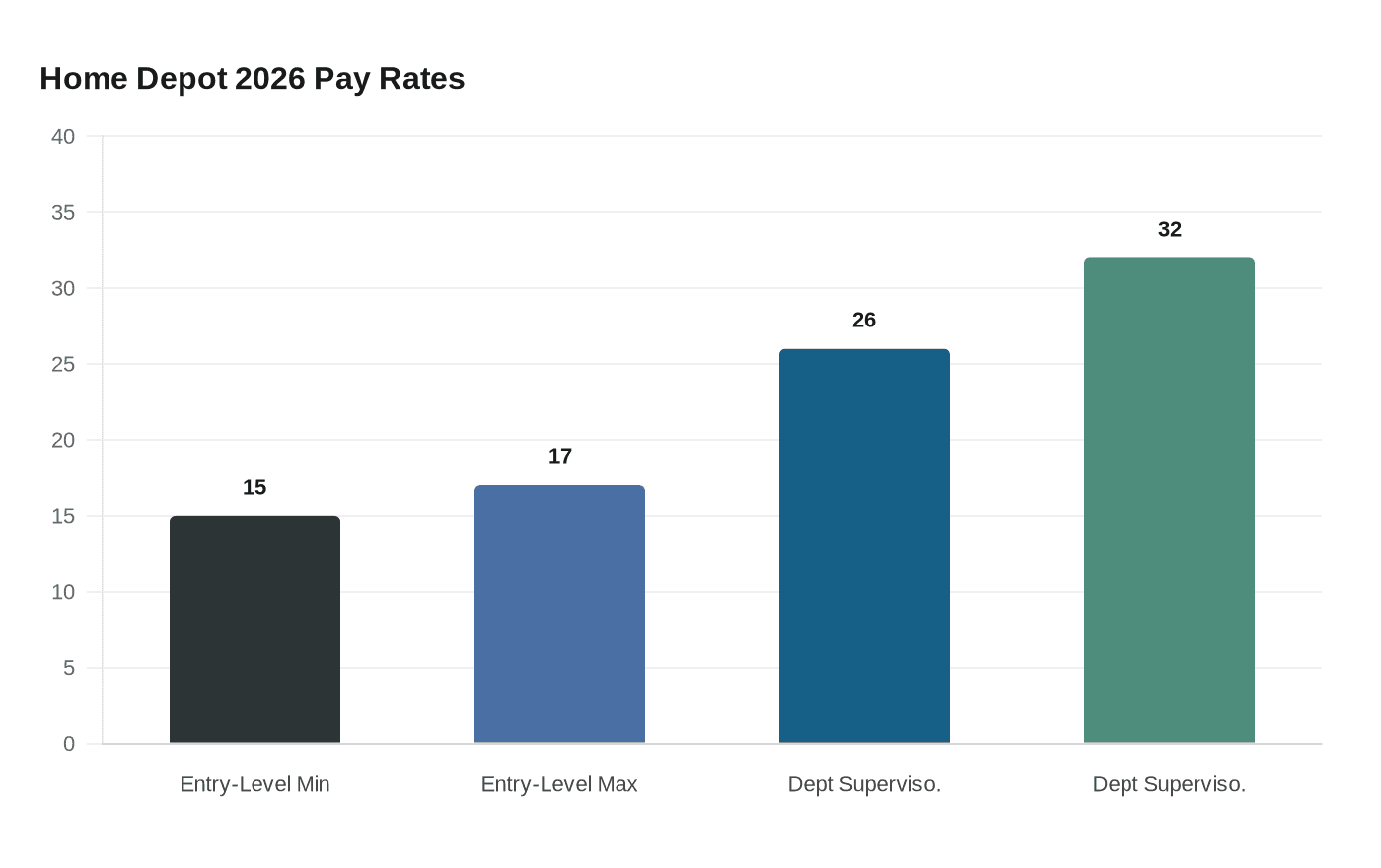
Home Depot set a companywide hourly minimum of $15 in 2023, and that floor holds across all U.S. stores regardless of state or local minimums that have since risen above it. Entry-level roles, including cashier, lot associate, and basic customer service positions, typically land between $15 and $17 in most U.S. markets. That reflects starting pay for roles with lower barriers to entry, not a ceiling on where an associate in those departments ends up.
Specialized and certified roles tell a different story. Repair and installation technicians, lot associates carrying forklift certifications, overnight freight associates, and merchandising execution associates consistently report wages in the upper portion of the band. In high-cost-of-living markets such as California, New York, and metro areas in the Pacific Northwest, wages for those roles push toward the mid-$20s even before shift differentials are applied. Glassdoor data based on more than 103,500 salary submissions as of March 2026 confirms that department supervisors average approximately $26 per hour nationally, with top earners in that role reporting up to $32 per hour.
The Gridwise guide is explicit that these are aggregated, publicly reported ranges rather than an official company pay table. Pay varies by store, market, tenure, and specific certifications. For precise role minimums and internal pay grids, associates and managers should consult myTHDHR and careerdepot.
What Shifts Your Rate
Three variables move an hourly associate up the pay range in a meaningful way: skill certifications, shift selection, and supervisory responsibility.
Skill certifications are the most direct lever. An associate cross-trained in HVAC basics or licensed for appliance installation brings verifiable technical value that Home Depot's stores cannot easily replace from a general candidate pool. The same logic applies to forklift and powered industrial truck certifications on the lot and in the receiving area. These are not abstract credentials; they map directly to job functions the store depends on daily, and pay reflects that dependency. Overnight freight associates also receive shift differentials that can add meaningfully to a base hourly rate, making late-night receiving shifts one of the faster paths to a higher effective hourly wage without requiring a formal promotion.
Cross-training in multiple departments accelerates both of those pathways. An associate who can cover the tool rental desk, the pro desk, and standard department coverage gives a store manager flexibility that has real staffing value. That breadth, especially when paired with a specific technical credential such as certified paint professional or a tool repair qualification, puts an associate in a strong position to request a rate review ahead of any formal promotion cycle.
Supervisory hourly roles, including department lead and head cashier, represent the formal step into management-tracked pay. More than 87% of Home Depot store leaders started as hourly associates, which means the pipeline from the floor to a salaried leadership role is documented and well-traveled.

Benchmarking Your Current Rate
Before walking into a pay conversation, you need to know whether your current wage reflects your market. The steps are straightforward:
1. Identify your role's reported range using aggregated sources such as Glassdoor or the Gridwise guide. Note both the national average and any state-specific or metro-specific figures that apply to your location.
2. Compare your hourly rate to that range, factoring in your tenure and any certifications or specialized duties you hold.
3. Check careerdepot for any posted internal requisitions in your department or adjacent ones. Posted pay ranges on active job listings are one of the clearest indicators of what your store's market rate actually is for your skill set right now.
4. Document the specific skills, certifications, and responsibilities you hold that go beyond your job title's basic description. Forklift certification, bilingual customer service, tool repair, appliance install experience: all of these are negotiating assets.
If your rate is below the midpoint of your role's reported range and you have tenure or specialized skills, that gap is the core of your pay conversation.
Total Compensation Beyond Hourly
The hourly rate is the headline, but the full picture at Home Depot includes several named programs that change the math on total annual earnings.
Success Sharing is the program most hourly associates know by name but sometimes undervalue in their compensation calculus. Home Depot's bi-annual cash bonus for eligible hourly associates is tied to store and company performance. According to PayScale data, Success Sharing bonuses have ranged from roughly $225 to $22,500, with an average around $1,512 per payout. Home Depot has distributed nearly $2 billion through the program over the past four years. Two payouts per year, even at modest store performance levels, represent a meaningful addition to base hourly earnings.
On the benefits side, all associates, including part-time, receive Vision coverage with the $120 plan available at no cost. Full-time associates are eligible for Medical and Dental coverage and spending accounts. The company's stock purchase plan allows associates to buy Home Depot shares at a 15% discount through payroll deductions, which is a straightforward wealth-building mechanism that is frequently overlooked by newer associates.
The tuition reimbursement program covers tuition and mandatory fees for eligible degree and certain non-degree programs. Part-time associates can access up to $1,500 annually; full-time associates receive higher limits. Critically, the program also covers certificate programs, meaning the same technical certifications that raise your hourly rate can be partially funded by the company while you pursue them. Associates must earn a grade of C or better to qualify for reimbursement. Applications must be submitted to the Tuition Reimbursement Administrator within 90 days of course completion.
The Homer Fund rounds out the total package as an employee assistance program for associates facing unexpected hardship. It is peer-funded and associate-focused, a distinction worth knowing before a personal crisis forces the conversation.
What to Ask HR or Your Manager
Use this checklist when preparing for a pay conversation, a promotion discussion, or a new hire offer:
- What is the posted pay range for my current role in this store or district?
- Where does my rate fall within that range, and what factors were used to set it?
- Which specific certifications or training completions would trigger a rate review or reclassification?
- Is there a current or upcoming cross-training opportunity in a higher-paying department?
- What is this store's overnight or evening shift differential, and how is it applied?
- Am I eligible for Success Sharing this cycle, and what performance metrics determine my payout?
- What is the tuition reimbursement annual cap for my employment classification, and which certificate programs qualify?
- How does careerdepot reflect current internal openings that might represent a lateral move to a higher-rated role?
For Department Leads and Store Managers
The Gridwise pay data is useful for more than individual negotiation. It gives department leads and store managers a defensible market-context document when explaining starting wages to candidates, particularly for roles that attract experienced tradespeople, such as appliance service, electrical, or plumbing departments. Candidates with pump truck experience, licensed HVAC work, or appliance installation credentials will benchmark their expectations against the same public data. Going into those recruiting conversations without that context is a disadvantage.
Regional variation is also worth internalizing. Metropolitan markets and states with elevated costs of living routinely require starting wages above the national average for the same job title. A lot associate or overnight freight position in coastal markets may need to open at $20 or higher to be competitive. Using local market data from careerdepot and internal pay grids to justify targeted wage adjustments for hard-to-fill roles, rather than waiting for the position to sit vacant, is the operationally sound approach.
The certification pathway is also a retention tool. Associates who see a clear connection between acquiring a skill and earning more per hour are less likely to leave for a competitor offering a modest raise. Identifying high-value in-store training opportunities, particularly those aligned with the tuition reimbursement program, and actively promoting them to associates is one of the lower-cost, higher-return investments a store manager can make in workforce stability.
The $15-to-$26 range is not arbitrary, and it is not fixed. It is a documented reflection of what specific skills, schedules, and markets are worth. Knowing where you sit and what moves you forward is the first step to making it work in your favor.
This article was produced by Prism’s automated news system from verified source data, official records, and press releases, then run through automated quality and moderation checks before publishing. The system is built and supervised by the people who set the standards it runs under. Read our full AI policy.
Did this article answer your question?