Home Depot Foundation boosts veteran housing and trades training
Home Depot's Foundation ties veteran housing, trades training, and disaster relief to the associate story, giving store teams a concrete way to explain what the company stands for.
Home Depot’s Foundation work is not a side project tucked away in corporate philanthropy. It is part of the company’s identity on the sales floor, in the break room, and in the communities around each store, because it connects three things Home Depot employees see up close: veterans who need housing, customers who need people with real trades skills, and neighborhoods that get hit hard when disasters strike.
Why the Foundation matters to the workforce
The Home Depot Foundation says its mission is to improve the homes and lives of U.S. veterans, train skilled tradespeople to fill the labor gap, and support communities affected by natural disasters. Those three areas fit together in a way that makes sense for a home-improvement company, where associate knowledge, contractor relationships, and service culture all matter.
For associates, that means the Foundation is not just a donor vehicle. It is a public statement about what the company believes should come from a home-improvement workforce: practical help, hands-on skills, and local trust. For store leaders, it also gives a clearer answer when applicants or customers ask what kind of company Home Depot is trying to be.
Veteran housing is the clearest example of that mission
The Foundation’s Veteran Housing Grants Program awards grants to nonprofit organizations for new construction or rehabilitation of permanent supportive housing for veterans. Awards typically range from $100,000 to $500,000, and the grants are available throughout the United States and Puerto Rico.
The housing work is aimed at a problem that is still visible despite progress. The Foundation says veteran homelessness has declined by more than 55 percent since 2010, but more than 33,000 veterans still lacked a safe place to sleep on any given night in 2023. That is the kind of number that gives the Foundation’s housing grants practical urgency rather than symbolic weight.
In November 2025, the Foundation said it had invested more than $30 million in new veteran housing grants to help thousands of veterans secure and maintain safe, accessible housing. The money backed critical home repairs, smart home modifications, and programs for veterans exiting homelessness. Earlier, in 2023, the Foundation said it would add more than 750 units of supportive housing for veterans facing homelessness through $10.4 million in grants.
Since 2011, the Foundation says it has invested more than $650 million in veteran causes and improved more than 70,000 veteran homes and facilities. It has also pledged $750 million in veteran causes by 2030, which puts veteran support at the center of the company’s long-term giving, not just its seasonal campaigns.
Path to Pro is the trades story behind the retail story
The trades-training side matters just as much to Home Depot’s day-to-day business. Path to Pro is described as including training and hands-on experience, scholarships, and entrepreneurship programming for youth, high school students, underserved communities, and separating service members. In 2026, the Foundation said the Path to Pro Education Grants program was open to accredited K-12 schools, community and technical colleges, and nonprofit organizations with existing construction skilled trades programs.
That detail matters for associates because the company sells into a market that depends on people who can actually build, repair, and remodel. When Home Depot says it is helping fill the skilled-labor gap, it is also investing in the customer base that powers the pro desk, the tool aisle, the contractor relationship, and the project work that keeps stores busy through seasonal peaks.
The Foundation has pledged $50 million for Path to Pro, which ties workforce development to the company’s broader identity. For a store manager, that is useful beyond branding. It gives the store a stronger story to tell in hiring, community outreach, and pro-customer relationships because it shows the company is trying to grow the next generation of the trades, not just sell to it.

Disaster response is where the store network becomes community infrastructure
The Foundation’s disaster-relief work shows how a retail footprint can turn into response infrastructure. Home Depot says the Foundation and Team Depot support communities affected by natural disasters through preparedness, short-term response, and long-term recovery. Before storms strike, the company says it pre-stocks nonprofit partner warehouses and distribution centers with relief supplies, and its stores can become command centers for first responders and relief agencies.
That logistics role is part of why Home Depot shows up so often in storm conversations. Stores are where people go for plywood, generators, tarps, batteries, and repair materials, but the Foundation’s work extends that commercial role into coordination, supply staging, and recovery support.
The Foundation partners with Team Rubicon and contributes to the American Red Cross’ Annual Disaster Giving Program. Those relationships matter because disaster relief is not only about donations after the fact. It is about having a standing system that can move quickly when supplies, volunteers, and local partners are all needed at once.
Team Depot gives associates a visible role
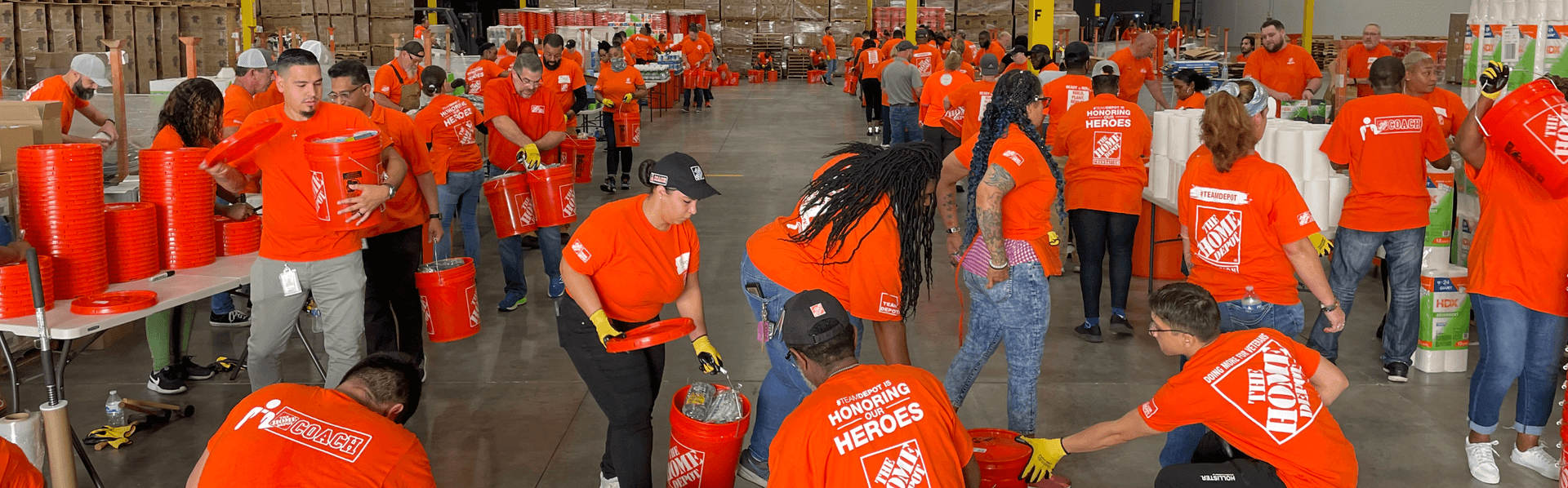
If the Foundation sets the mission, Team Depot makes it tangible for associates. Home Depot says Team Depot, its associate volunteer force, has worked with nearly 15,000 nonprofits since 2011 and completes an average of five projects a day in local communities.
That scale gives store teams something concrete to point to when they talk about pride in the company. It also helps explain why the Foundation’s annual Celebration of Service campaign has run for 15 consecutive years. Veteran service is not being treated as a one-time event or a campaign message that disappears after the holiday season. It is built into the company’s rhythm.
For associates, this matters because it ties the job to real outcomes that go beyond transaction counts. A store can support a veteran housing partner, send volunteers through Team Depot, help a trades student get training support, or serve as a staging point during a storm. Those are different missions, but they all reinforce the same thing: a Home Depot workforce is being asked to know products, solve problems, and show up for the community when it counts.
What this means for Home Depot employees
The strongest part of the Foundation story is that it connects pride, recruiting, and community credibility in one place. Veterans, trades training, and disaster relief are not separate buckets. Together they describe a company that wants to be seen as useful in the most practical sense possible, which fits a workplace built around expertise, service, and local relationships.
That is why the Foundation message lands inside Home Depot stores. It gives associates a reason to see the work as more than retail, and it gives store leaders a clearer way to explain the company’s role in the places where customers live, build, recover, and work.
This article was produced by Prism’s automated news system from verified source data, official records, and press releases, then run through automated quality and moderation checks before publishing. The system is built and supervised by the people who set the standards it runs under. Read our full AI policy.
Did this article answer your question?