Home Depot's AI Investments Make Store Associates More Vital, Not Less
Home Depot's $25 billion digital business runs through the store. AI isn't replacing the 470,000-plus associates who make it work; it's raising the stakes for what they know and do.
Home Depot's $25 billion ecommerce operation doesn't end at the checkout button. It ends at the store.
That's the operational reality behind the wave of AI tools the company has rolled out over the past year, from Magic Apron's aisle-level product guidance to the industry's first real-time delivery tracker for big-and-bulky materials. Each of these tools points back to the same conclusion: the more Home Depot invests in digital, the more indispensable its 470,000-plus associates become. A RetailDive analysis makes this case directly, arguing that AI is not a store replacement but a force-multiplier for on-the-ground associates. The store is where AI outputs are transformed into finished, delivered jobs.
Three Moments That Are Changing on the Floor
Moment 1: Finding the right product
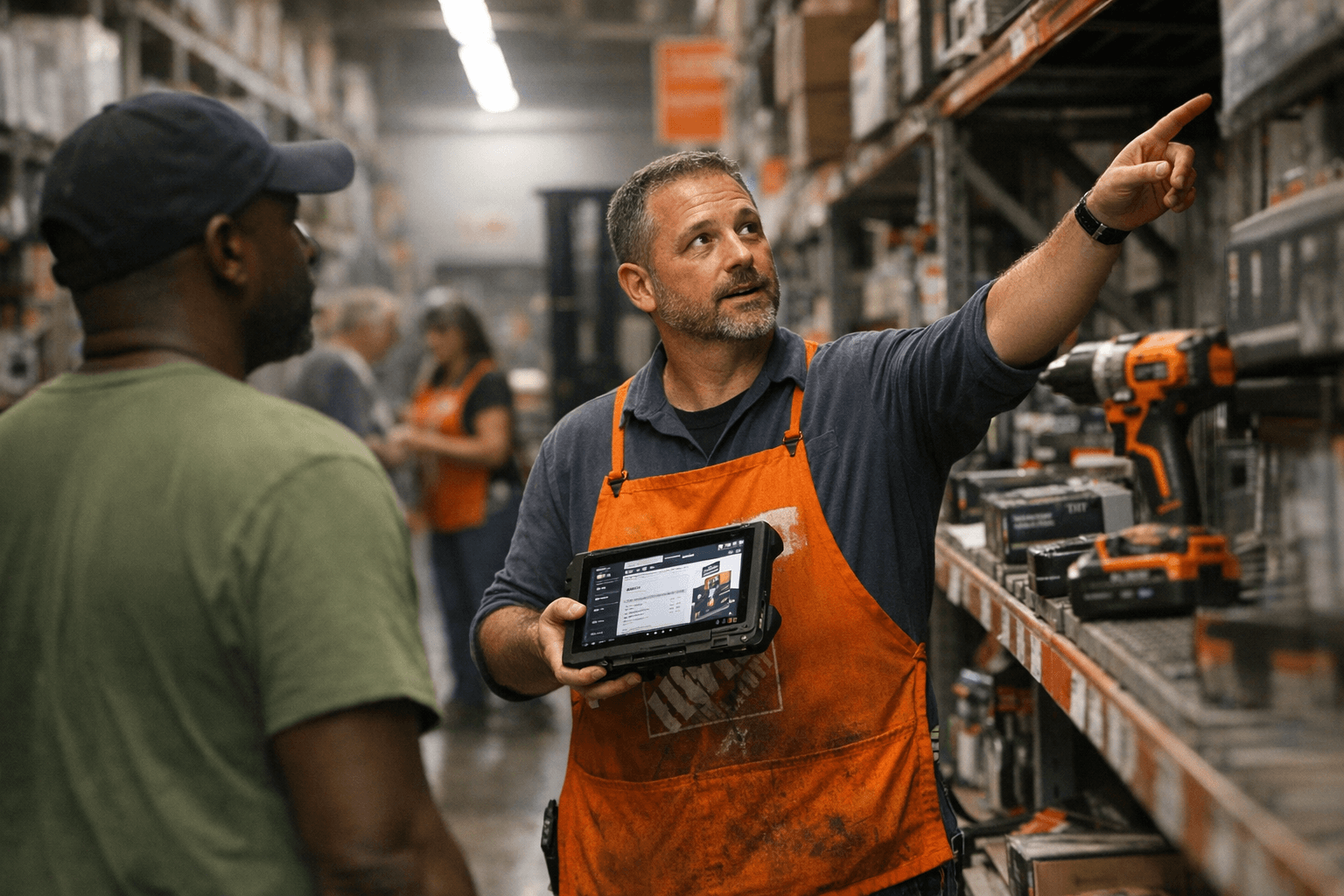
The Magic Apron assistant, built on Google Cloud's Gemini models and expanded in early 2026, now operates with aisle-level precision. If a customer asks what grout works best with glass tiles, Magic Apron doesn't just answer the question; it directs the customer to the exact bay, surfaces related materials they may need, and provides technical guidance in-aisle. The experience is currently being tested at select stores ahead of a nationwide rollout.
For associates, this changes the texture of floor interactions. Customers arrive better-prepared, which means the conversations that follow tend to be more substantive. An associate fielding a follow-up from someone who already received an AI recommendation doesn't need to start from scratch. They need to know when to confirm, when to course-correct, and when to add the kind of project judgment that no algorithm has acquired from standing in front of a leaking pipe at 7 a.m. That's the differentiation Home Depot is banking on.
Moment 2: Fulfilling Pro and online orders
In January 2026, Home Depot launched AI-powered materials list building for Pro customers. A contractor can describe a project by voice or text, upload an existing list, and receive a generated product list within minutes. The tool is designed to eliminate the back-and-forth that slows job prep for renovators, remodelers, and contractors who can't afford to lose a morning on sourcing.
But every list generated eventually needs to be picked, staged, and confirmed by someone in a store. That's where the associate's role sharpens. The RetailDive analysis notes that AI-powered Pro takeoffs increase the volume of accurate, complex orders moving through stores, creating more high-ticket sales opportunities and, by extension, more Success Sharing upside when store performance rises. Associates will be asked to validate those AI-generated lists before orders ship. The accuracy of what leaves the store determines whether a crew shows up on site fully equipped or waiting on a critical item.
Store managers are advised to carve out dedicated staging zones for Pro-project orders and to designate a Pro workstream champion who can troubleshoot exceptions when a digital list doesn't match what's actually on the shelf. That gap, when it exists, lands on an associate to resolve.
Moment 3: Resolving delivery and returns
On March 5, 2026, Home Depot announced the industry's first real-time delivery tracker for big-and-bulky materials, with rollout targeted by the end of the first quarter. The tracker provides minute-by-minute updates, including visibility into the truck route and remaining stops, accessible through the mobile app and homedepot.com.
The stakes here are real for Pros. According to an Autodesk industry analysis, construction professionals spend 35 percent of their time, more than 14 hours a week, on non-productive activities. A concrete or drywall delivery that arrives late can bring an entire crew to a standstill. Giving a contractor minute-by-minute visibility means fewer calls to the store and more time coordinating labor on site.
For associates, real-time tracking redirects energy away from status calls and toward exceptions: damaged deliveries, substitutions, or items that need to be pulled from floor stock to complete a late-arriving order. The tool doesn't eliminate the associate's role in delivery resolution; it makes it more precise.
What Associates Are Being Asked to Adopt Next
The Sidekick app, deployed on the ruggedized Zebra hdPhones that associates carry on the floor, uses computer vision to scan shelf bays and detect out-of-stock products in real time. Associates photograph shelves; the machine learning algorithm analyzes the images, updates inventory signals, and reprioritizes tasks accordingly. The feedback loop improves accuracy over time, meaning each scan an associate performs makes the next prediction more reliable.
Senior Executive Vice President Ann-Marie Campbell has framed the broader ambition: "We are introducing new tools using generative AI that… provide store associates quick access to operational and product knowledge via their HD phone." That quick access is the expectation being built into every new tool. Associates who can move fluidly between AI-assisted lookups and customer conversations become the connective tissue between what's promised digitally and what's delivered in person.
Training is the bridge. The RetailDive analysis recommends short, hands-on demos as the most effective introduction to new associate-facing AI tools, and positions digital literacy as a genuine on-ramp for career advancement. For store managers, that means carving time out of shift schedules for real-tool practice, not policy overviews. The associates who reach fluency earliest are the ones who will handle the more complex Pro interactions that these tools are designed to generate.
The metric that signals it's working
All of these tools converge on a single operational outcome: fewer out-of-stocks, more accurate Pro orders, and on-time deliveries that don't require a store employee to spend 20 minutes untangling a correction call. Online comparable sales have already grown approximately 8 percent year-over-year, and that volume has to be fulfilled somewhere. The RetailDive analysis ties this directly to Success Sharing outcomes: when AI-assisted workflows reduce rework and improve order accuracy, stores hit the performance benchmarks that drive bonus payouts.
The company's hybrid model, strong physical stores layered with AI, is built to preserve and amplify the skills and Pro relationships that no pure digital competitor can replicate. Learning these tools isn't just job protection. For associates with the trade knowledge and customer instincts to use them well, it's the clearest path to doing more of the work that actually moves the needle.
This article was produced by Prism’s automated news system from verified source data, official records, and press releases, then run through automated quality and moderation checks before publishing. The system is built and supervised by the people who set the standards it runs under. Read our full AI policy.
Did this article answer your question?