KPMG and UKG Research Finds Global Payroll Leakage Costs Employers Millions Annually
Nearly 2 in 5 multinational employers lose $1M-$5M yearly to fixable payroll errors, KPMG and UKG research shows, as fragmented vendor stacks and missing controls drive leakage.

When payroll fails a worker, the fallout rarely stays contained. A miscalculated deduction triggers a tax discrepancy; a missed benefit contribution generates an HR ticket; a cross-border classification error creates compliance exposure that can take quarters to unwind. For employers, those individual failures aggregate into something harder to explain on an earnings call.
A joint study released March 31 by KPMG LLP and UKG quantified how much harder. Surveying more than 300 VP- and C-suite-level payroll decision-makers at organizations with at least 10,000 employees and $5 billion in revenue, the research found that 38% of multinational employers lose between $1 million and $5 million annually to what the report terms "payroll leakage": unintended financial losses driven by process inefficiencies, system limitations, and fraud. The figure represents 2 to 4% of total labor spend, and the report notes that even 1% of wasteful payroll spending can cost a large organization up to $15 million.
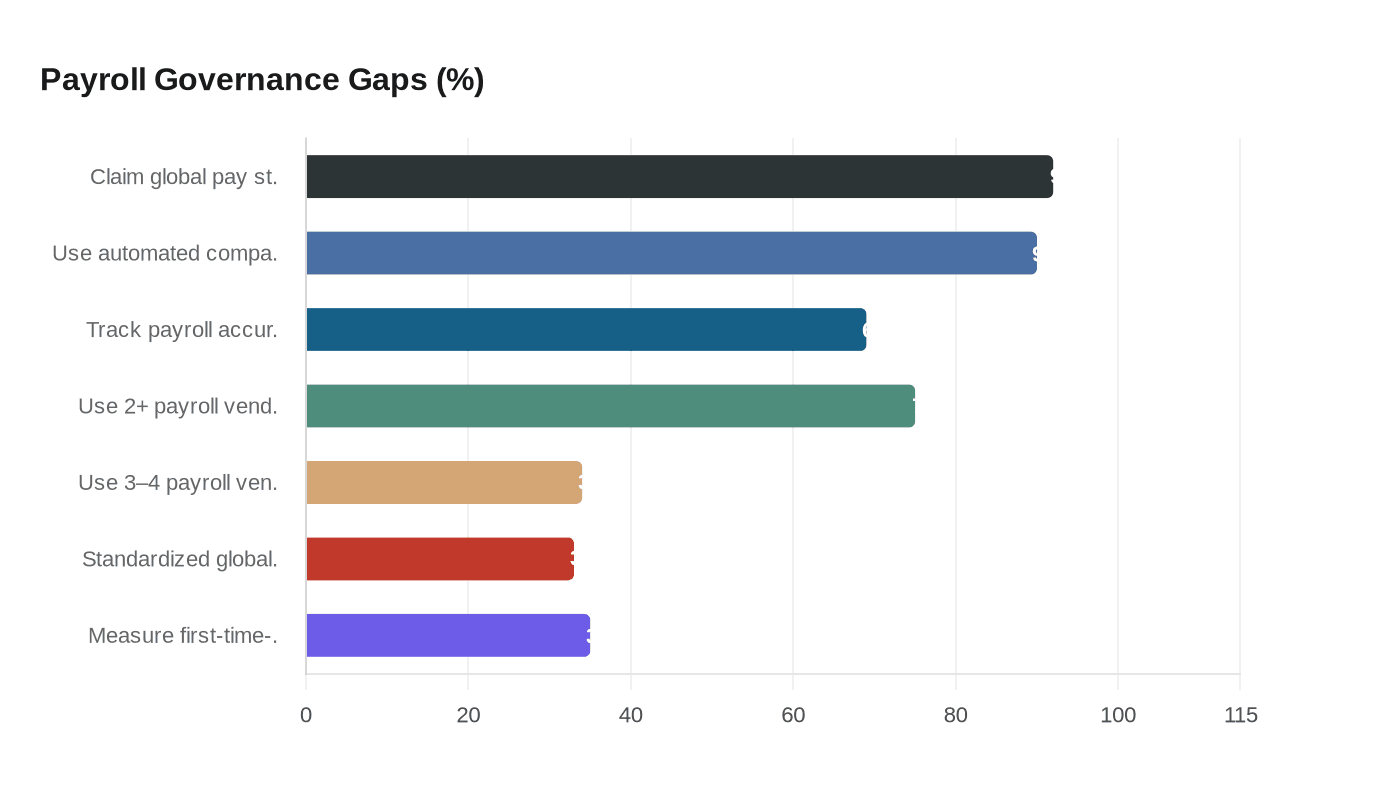
Where exactly do controls break? The data reveals a gap between the monitoring tools companies think they have and the metrics that actually predict leakage. Nine in ten respondents use automated payroll comparison tools and 69% track payroll accuracy. But only 35% measure first-time-right payroll, and fewer than half track cost per payslip, which the report identifies as the metrics most predictive of leakage. Without those specific readings, finance teams are flying partially blind through every pay cycle.
The structural problem runs deeper. While 92% of respondents say they have a global employee pay strategy, only 33% actually operate a truly standardized global model. Three-quarters run payroll through more than two vendors, and 34% rely on three or four, fracturing data visibility and multiplying compliance exposure across jurisdictions.

"The rapid evolution in how organizations manage pay presents a unique opportunity to transform complexity into clarity," said Dimitri Papageorgiou, leader of Payroll and Labor Strategy & Transformation at KPMG. "Our research indicates that when leaders elevate payroll to a strategic function, they gain enhanced visibility into workforce trends, financial performance, and operational resilience."
The governance and technology playbook the research points toward runs along three lines: consolidating fragmented vendor landscapes into fewer integrated platforms; building standardized measurement frameworks anchored to first-time-right rates and per-payslip cost rather than backward-looking accuracy checks; and deploying AI-enabled reconciliation tools capable of catching anomalies before they compound across pay cycles. KPMG frames all three as advisory engagements requiring cross-functional design, not standalone software deployments.
Richard Limpkin, General Manager of Global Payroll Solutions at UKG, framed the upside in terms of the intelligence already sitting inside payroll systems. "Payroll teams sit on a wealth of actionable insight that leaders can use to guide smarter, faster decision making," he said. "Global payroll is a rich source of workforce intelligence for organizations that make the bold decision to modernize."
For KPMG practitioners, the cross-service implications are concrete. Advisory engagements will require teams spanning GBS specialists, HR operating model consultants, data governance leads, and technology implementation resources. Audit professionals are directly in scope as well: payroll errors generate compliance exposure that surfaces in control testing and remediation assessments, pulling audit teams into redesign work beyond a traditional advisory boundary.
Papageorgiou is scheduled to moderate a follow-on webinar April 28, alongside KPMG's Matteo Busanic, Director of Human Capital Advisory, and Limpkin. For practitioners weighing where to build depth before the next performance cycle, a co-branded research launch with a major enterprise HR technology vendor typically precedes a structured go-to-market push and the client pipeline that follows.
Know something we missed? Have a correction or additional information?
Submit a Tip