KPMG Consultants Face Long Promotion Path, From Analyst to Partner
KPMG’s promotion path is longer than most new hires expect: the real jump is from billable support to client ownership, sales and leadership.
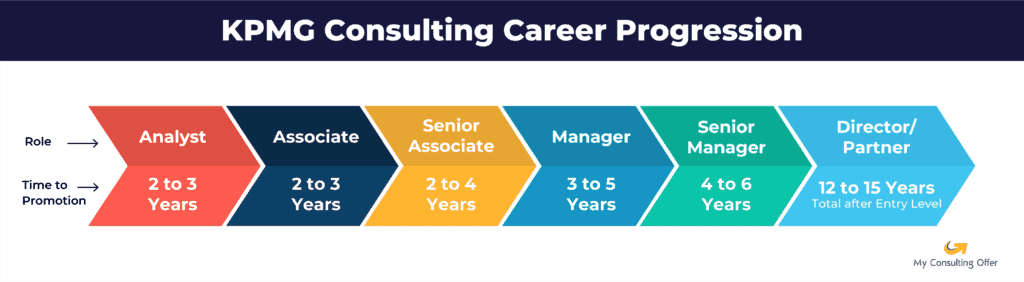
The real climb from analyst to partner
KPMG’s career ladder is not a neat series of title changes. It is a test of whether you can keep delivering more value at each rung, starting with research and project support and ending in the territory where you are expected to win work, manage clients and help shape the business itself. Consulting.us says consultants typically move through at least five to seven levels before reaching the top tier, with early roles such as Analyst, Business Analyst or Junior Consultant, then Consultant or Associate, Senior Consultant, Manager, and eventually Principal or Director, the lane that leads toward partnership.

That matters inside KPMG because the firm is built around scale and structure. KPMG U.S. says it has more than 80 offices and about 36,000 employees and partners in the United States, while KPMG International says its member firms operate in 147 countries and territories and employ more than 219,000 people globally. In a network that large, a common ladder is more than HR language: it is how the firm creates a shared definition of progress across audit, advisory and consulting teams.
What the early rungs really pay for
The first phase of the consulting career is not glamorous, but it is where the firm decides whether you can be trusted with larger problems. At the Analyst or Junior Consultant level, the work is usually research, data gathering, analysis and project support, paired with training and development programs. Consulting.us notes that junior advisors often have a declarability rate around 80% or above, which helps explain why utilization pressure is so intense so early in the job.
For KPMG professionals, that means your first promotions are less about looking senior and more about becoming faster, cleaner and more reliable. You are being measured on whether your analysis holds up in front of managers and clients, whether you can turn raw information into something useful, and whether you can stay staffed while still finding time to learn. The people who stall here are often the ones who treat billable work as the whole job; in reality, the firm is watching how quickly you build depth, judgment and independence.
When the job stops being support work
The middle of the ladder is where the promotion logic changes most sharply. Consultant, Associate, Senior Consultant and Manager are not just better-paid versions of the same role. Consulting.us describes this stage as a shift toward owning projects, managing client relationships, contributing to sales and helping shape service offerings, which is where tenure stops mattering as much as accountability.
KPMG’s own structure reinforces that point. The firm says its advisory business was organized along the same industry lines as clients, and describes KPMG LLP as the first of the Big Four to do that. That kind of setup rewards people who can speak a client’s language, understand sector pressure and connect technical work to a specific business problem. If you want to move up, it is no longer enough to do the work well; you have to show that you can frame the work in a way that clients trust and leaders can sell.
This is also where the pressure to prove value gets sharper. Efficiency expectations, tighter margins and client skepticism all make the middle ranks less forgiving than they used to be. Tasks that once bought you time, such as repetitive analysis or heavily supervised project support, are easier to standardize or automate, so the people who advance are the ones who can translate outputs into decisions, not just produce the outputs themselves.
The director step is a business test, not a title test
By the time you reach Principal or Director, the question is no longer whether you can deliver a project. It is whether you can create future work, deepen accounts and carry responsibility for the firm’s reputation in front of the client. Consulting.us describes this end of the ladder as future partner territory, and that is the right way to think about it at KPMG: the role is a proving ground for commercial judgment, leadership and business development.
KPMG’s financial scale shows why that matters. The firm reported global revenues of US$38.4 billion for FY24 and $39.8 billion for FY25, while headcount rose from 275,288 to 276,030. Those numbers show a firm that is still growing, but they also show the need for a steady pipeline of people who can step into broader responsibility. Promotion is not just a reward system; it is how KPMG replenishes the leadership bench that keeps a global professional-services business moving.
How KPMG says development is supposed to happen
KPMG’s learning and development pages show that the ladder is supported by more than performance reviews. KPMG Canada says its onboarding and leadership development programs are aimed at employees below manager level. KPMG Bermuda says employees can discuss ambitions with a performance manager and use the global performance development system to set goals. KPMG Malta says people can talk to a mentor or career coach about ambitions and then work with a performance manager on how to achieve them. KPMG India says career development is supported through client engagements, flexibility and mobility, training programs, coaching, mentoring and collaborative assignments.
Together, those programs point to a simple reality: advancement at KPMG is designed to be built through repeated exposure to real work, not abstract promises. The firm’s own culture pages say it is a people business and that it recognizes people as its most valuable asset, which is consistent with a model where learning, coaching and client responsibility are all tied together. The ladder exists, but it only works if you keep expanding what you can own.
The real lesson for KPMG consultants is that the path from analyst to partner is not about waiting your turn. It is about proving, rung by rung, that you can handle more ambiguity, more client pressure and more commercial responsibility than the title before you demanded.
This article was produced by Prism’s automated news system from verified source data, official records, and press releases, then run through automated quality and moderation checks before publishing. The system is built and supervised by the people who set the standards it runs under. Read our full AI policy.
Did this article answer your question?


.pdf%2F_jcr_content%2Frenditions%2Fcq5dam.thumbnail.319.319.png&w=1920&q=75)